Fabtech designs, supplies and qualifies pharma process equipment, and has 2000+ installations in 65+ countries.
We supply machines for oral solid dosage, which means tablets, capsules and powders. We also supply machines for sterile fill and finish, which means filling sterile liquids into vials, ampoules and syringes and then closing them.
The range starts with a single unit for lab and pilot work. It goes up to a full production line for powder processing.
On the sterile side, it covers a prefilled syringe machine and a filling and capping line for vials and ampoules.
However complex your process requirements, our solutions can be customised for your needs. The machines below are our standard range.
If your process has no standard machine, read the section on custom and special-purpose machines.
On this page
Key fact Detail
Fabtech installations
2000+
Countries
65+
Fill and finish lines we supply
Vial, ampoule and PFS lines
Capsule filling machines we supply
25,000 to 150,000 capsules an hour
OSD range
Lab and pilot units to complete production lines
Inspections the equipment is designed for
USFDA, MHRA and TGA
The pharmaceutical process equipment we supply
Fabtech supplies pharmaceutical processing equipment for oral solid dosage and sterile fill and finish, from a single lab unit to a full production line.
Pharmaceutical processing equipment is the machinery that turns a formula into a finished product in the right dose. The term "pharmaceutical machinery" is wider.
It also includes packaging, utilities and lab instruments. Process equipment is the part that touches the product while the product is being made.
Fabtech is an engineering company and also your equipment supplier.This is the difference that matters when you compare suppliers.
Buyers who search for a process equipment manufacturer are looking for one company that takes responsibility for the machine. Fabtech specifies and designs the line, supplies our pharma process equipments and qualifies them, and stays responsible for them.
The same machines are used for medicine manufacturing across the wider life sciences. This includes small-molecule pharmacy products, biopharma and biopharmaceutical work, and bulk process technology.
The machine itself stays the same. What changes is the materials, the containment and the cleaning.
Containment means keeping the product and the operator safe from each other.
On an oral solid dosage line, process equipment means the machines that mix, granulate, dry, blend, compress and coat. On a sterile line, it means the machines that fill, stopper and cap.
The water, the air, the rooms and the packaging are a different scope. A turnkey project is one where a single company delivers the whole plant.
On a turnkey project, all of these are engineered together with the machines.
Our OSD and fill-finish solutions are versatile, adaptable and scalable. When a process is proved at pilot scale, it can be built again at full scale without a new design.
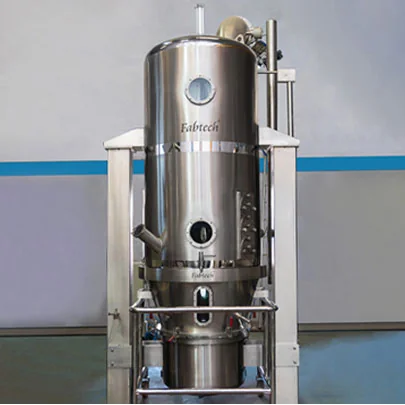
The fluid bed suite does granulation, drying and coating. Air blows up through the particles and holds them up in a suspended bed while they are processed.
The same machine granulates and then dries, with no transfer between machines. This removes one handling step, and the contamination risk that comes with it.
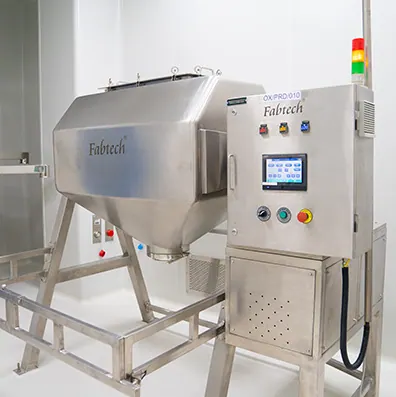
Bin, octagonal, V-type and double cone blenders mix the active ingredient and the excipients evenly before compression. Excipients are the inactive ingredients in a tablet.
Compression is the step where the tablet press makes the powder into tablets.
Blend uniformity means the blend is even. Content uniformity means every tablet has the same amount of active ingredient.
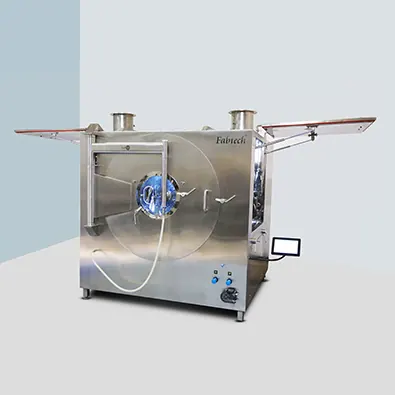
The range has perforated-pan auto coaters for tablets, and fluid bed coaters for granules and pellets. A perforated pan is a turning drum with holes that let air through.
Our pharmaceutical coating page explains which coating each machine applies, and the parameters that control it.
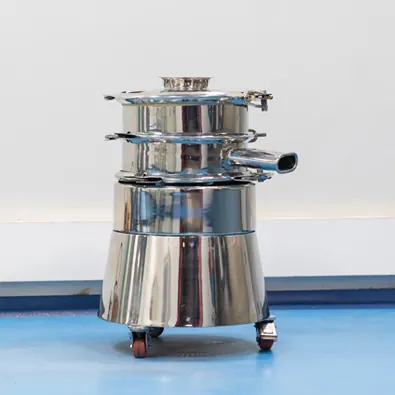
Particle sizers mill (grind) and sieve material to a set particle size. Particle size decides how fast a tablet dissolves and how well the blend flows.
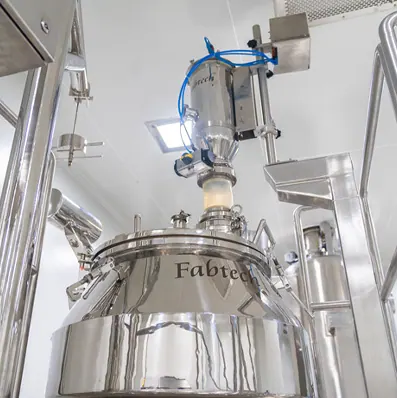
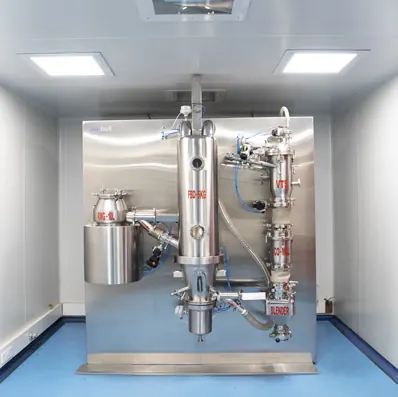
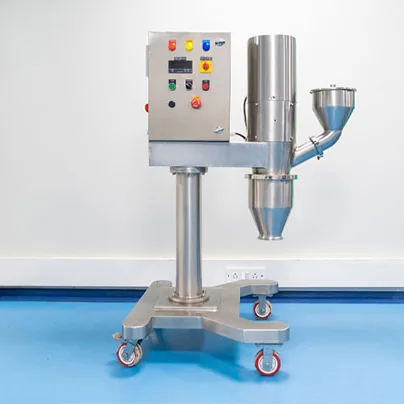
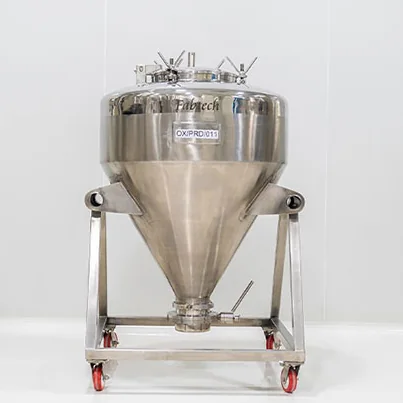
Ancillaries are the powder handling equipment for OSD manufacturing. They cover charging (loading material into a machine), transfer, containment, and the links between the machines above.
Fill and finish equipment
The fill and finish range covers production and packaging lines for parenteral and sterile liquids in vials, ampoules and prefilled syringes.
Parenteral medicines are given by injection. We supply vial and ampoule filling lines and PFS lines.
This machine fills, stoppers and caps vials and ampoules. It is designed for the aseptic room it runs in.
Aseptic means free of germs.
Stock machine
Existing beam
Floor area
User requirement specification
New design
Feed hopper
Process chamber
Discharge
Control panel
Product-contact surfaces
Documents
Custom and special-purpose machines
Some processes have no standard machine.
Custom machinery for pharma is for the process that no machine in our catalogue fits. The reason may be a dosage form that nobody makes at scale.
It may be a containment level that no standard enclosure reaches. It may be a footprint (floor area) that has to fit a building you already have.
Or it may be a line speed that no stock unit is built for.
A special purpose machine is designed to a User Requirement Specification (URS). It does not come from a standard range.
The URS is a document in which the plant writes what the machine must do. So pharmaceutical special purpose machines start as a written brief.
They go through the same stages as every other machine. The difference is that the design qualification checks a design that did not exist before.
The URS also carries more weight. The factory acceptance test is the first time anyone sees the machine run.
Design, project management and supply are the responsibility of one company. The page on Fabtech's manufacturing capability explains how we handle material logistics, spares, change parts and service.
This counts for more on a one-off machine than on a stock machine. You deal with one company for the design, the supply and the proof.
You do not have three suppliers who blame each other.
Pharmaceutical machinery fabrication for these machines uses the same materials, finishes and documents as the standard range. Surfaces that touch the product are in the specified grade of stainless steel.
Surface finishes are defined. The documents can withstand an inspection.
How a machine is specified, built and qualified
Every machine, standard or custom, goes through the same seven stages. The spec is written before anything is ordered.
Design qualification (DQ) confirms the design. The machine is then built to that design.
The factory acceptance test (FAT) is the first time anyone sees it run.
Stage
What happens
URS (user requirement specification)
The plant writes what the machine has to do
DQ (design qualification)
The proposed design is checked against the URS
FAT (factory acceptance test)
It is tested at the factory before it ships
SAT (site acceptance test)
It is tested again at your plant, after delivery
IQ (installation qualification)
It is installed and set up as designed
OQ (operational qualification)
It is proved across its specified operating range
PQ (performance qualification)
It is proved with real product, in the real process
Our equipment qualification page sets out this sequence in full. It explains what each stage proves and what makes a requalification necessary.
Control systems are built to 21 CFR Part 11 for the records they create. This is the US rule for electronic records and signatures.
Equipment is designed to withstand inspection under USFDA (United States), MHRA (United Kingdom) and TGA (Australia) standards.
Where these machines are running
Fabtech works on turnkey projects, so we describe each project by its whole scope.
We do not name a client beside a single machine. Here are three projects, each with the scope of Fabtech's work.
Fidson Healthcare in Nigeria planned six dosage lines in one plant. Fabtech's contract covered the cleanrooms, HVAC, utilities, high purity water and laboratory.
For Lab & Allied in Kenya, Fabtech delivered a turnkey project in oral solid dosage, laboratory and sterile areas.
For CPCM in Algeria, Fabtech's work was consultancy for the tablet and capsule section, and a turnkey project for cleanroom equipment.
We offer complete solutions for OSD, powder processing and fill and finish. We also cover water and air applications.
Dependable.
Design, project management and equipment supply are the responsibility of one company. This gives better quality, and you have no coordination between suppliers to manage.
Ingenious.
Our designers and engineers work to understand your challenges and offer the most suitable solution.
Compliant.
The equipment we supply is designed to cGMP (current Good Manufacturing Practice). We meet the strict approval standards of global regulatory authorities, including USFDA, MHRA and TGA.
A record you can check.
Fabtech has 2000+ installations in 65+ countries.
End to end.
From start to finish and every step in between, you can rely on us to get your project running in the shortest lead time possible.
If you need a whole plant and not only the machines, see pharmaceutical turnkey projects. It covers everything from design to handover.
FAQ
What is OSD processing in pharmaceutical manufacturing?
OSD (Oral Solid Dosage) processing covers the manufacturing processes that make solid medicines taken by mouth, such as tablets, capsules and powders. The process makes sure the drug is safe and effective. It also makes sure the patient gets the right dose, with the right release profile. Release profile means how fast the drug is released in the body.
What is pharma process equipment?
Pharma process equipment is the machinery that turns an approved formulation into a dosed, finished product. On an oral solid dosage line, it mixes, granulates, dries, blends, compresses and coats. On a sterile line, it fills, stoppers and caps. The term "pharmaceutical machinery" is wider. It also covers packaging, utilities and lab instruments.
Where does Fabtech supply its process equipment?
Fabtech supplies its machines to international buyers. Fabtech has 2000+ installations in 65+ countries. Our focus is on turnkey projects, where the machines are engineered together with the rooms, the air and the water.
Do you supply custom or special-purpose pharmaceutical machines?
In most cases, yes. We typically engineer custom machinery to a User Requirement Specification. We do not pick it from a standard range. It is for a dosage form, containment level, footprint or line speed that no standard unit covers. One company is responsible for the design, the project management and the supply.
What is a prefilled syringe machine, and its importance in pharmaceuticals?
A prefilled syringe machine is a special machine used in pharmaceutical manufacturing. It fills pre-sterilised syringes with a specific dose of medication. The machine gives a precise dose, prevents contamination, speeds up production and keeps every syringe the same. Prefilled syringes are also convenient for patients, especially those who need regular injections.
How do you maintain and clean a prefilled syringe machine?
Clean and maintain a prefilled syringe machine regularly. Every day, turn off the machine. Then carefully take apart the parts that touch the product, such as syringe holders, filling needles and dosing components. Every week, calibrate, inspect and lubricate the machine. Every month, replace worn-out parts. This routine is essential to maintain the machine.
How do blenders improve product quality?
Blenders mix the active ingredients, excipients and other components evenly. This spreads the ingredients evenly through the product and makes the product more uniform. It also keeps the dose consistent and improves bioavailability. Bioavailability is how much of the drug the body can absorb and use.
How does a closed-loop granulator improve product quality?
A closed-loop granulator improves product quality because it controls the granulation process. It keeps the particle size consistent and the formulation at its best. It also keeps human handling to a minimum, so it reduces the risk of contamination.
What are the benefits of Fabtech's fluid bed suites?
Fabtech's fluid bed suites spread heat evenly. This stops heat from damaging sensitive active ingredients (thermal degradation), and it improves bioavailability. It also gives better control over particle size, moisture and ingredient distribution. Fabtech supplies fluid bed systems that are a valuable asset to pharmaceutical companies. They scale up and adapt exceptionally well.
What is a high-shear mixer and its role in pharmaceutical manufacturing?
A high-shear mixer is an advanced mixing device used in pharmaceutical manufacturing. It blends powders and granulates materials efficiently. It also spreads the active ingredients evenly. These devices are essential for pharmaceutical formulations. They ensure efficiency, product quality and patient safety, and they optimise production processes.
What types of products can be processed with a high-shear mixer?
High-shear mixers are widely used in the pharmaceutical, food and chemical industries. They process many products, including excipients for tablets and capsules, powders, creams, ointments, gels, suspensions, syrup, nutraceuticals and food products.
What safety features are included in high-shear mixers?
Fabtech Technologies supplies high-shear mixers with advanced safety mechanisms. These include enclosed systems, automated process controls, interlocking safety mechanisms, CIP (Clean-in-Place) and SIP (Sterilize-in-Place) systems, overload protection and emergency shut-off.