Prefilled syringe machine

Fabtech supplies prefilled syringe filling machines with time pressure filling and up to five pumps. A prefilled syringe filling machine fills sterile, nested syringes with a measured dose and closes each one with a plunger stopper.

Fabtech also supplies vial and ampoule filling lines and prefilled syringe (PFS) lines.

The machine takes the syringes out of their tub and returns them packed and ready. Fabtech's prefilled syringe machine has been designed and built to conform to GMP standards (Good Manufacturing Practice, the quality rules for making medicines). It meets the strictest quality requirements of the pharmaceutical industry in a wide range of formats. It will meet the varied needs of every customer.

We reply within 24 hours.

Key fact Detail

Filling lines Fabtech supplies
Vial, ampoule and prefilled syringe (PFS) lines
Enclosure
oRABS, cRABS or an isolator
Filling system
Time pressure filling with peristaltic pumps
Pumps
Five maximum, modular design
Infeed
Manual, semi-automatic or fully automatic

The prefilled syringe filling machine we supply

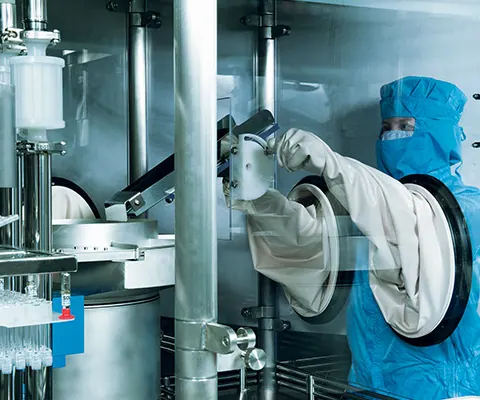
Fabtech's machine opens, fills and closes syringes in their nested tub, inside an oRABS, a cRABS or an isolator.

A prefilled syringe, PFS for short, arrives at the plant already made. It is sterile and siliconised (coated inside with silicone).

It comes packed in a nested tub: the syringes sit in a tray called a nest, inside a tub sealed with a Tyvek lid.

So the filling equipment has a different job. It does not form the container.

It opens the sealed tub without contaminating the syringes inside. It fills syringes that are held in a nest, not standing on a conveyor.

It puts in the plunger without trapping air behind it.

This is why a syringe filling machine is a different class of equipment from a vial line. Both do aseptic filling, which means filling a sterile product in sterile conditions.

But the syringe arrives sterile, so the machine's job is to keep it sterile.

The market uses several names for the same equipment: syringe filling device, syringe filler, automated syringe filling systems, or simply syringe filling equipment. They all mean this machine.

The difference is how much of the line is included. The three stations below show each part.

The three stations

A complete syringe filling system is three machines that work together as one line.

Tub opening

A Robotic Tyvek Removal System that automatically opens tub barrels and peels them off, a de-lidding and de-lining machine to open sterile tubes, a waste receptacle and a lid removal station. The system moves the pen tub gently to the filling machine.

It can be enclosed in oRABS, cRABS or an isolator per product requirement.

The sterile barrier opens when the machine peels off the Tyvek lid. So this station is where you choose the containment (the type of enclosure around the machine).

You do not choose it at the filling head.
Filling and closing

A Syringe Filling and Closing Machine to process disposable, nested syringes. It is a time pressure filling system: the dose is set by pressure and by how long the valve stays open.

It uses peristaltic pumps, which push the liquid by squeezing a flexible tube. The design is modular, with a 5 pumps output max.

Output runs from 6,000/hr with two lanes up to 8,500/hr with five.

More detail

The machine has a compact, superior construction and the highest dosing accuracy. It also assures sterility throughout the entire process.

Size changeovers (moving to a different syringe size) are easy to execute. The settings for dosing volume, filling needle movement and stopper position are easily reproducible.

Available with manual, semi-automatic and fully automatic infeed (the way syringes are fed into the machine).

Filling and stoppering happen in the same pass. Stoppering means closing the syringe with its stopper.

The needle goes down into the barrel and fills as it comes back up, so the liquid does not foam. The plunger rod or stopper goes in right after, by vacuum or by vent tube, depending on the product.

Packaging

A Syringe Packaging System with an automatic syringe de-nester for removing syringes from the nest, and a fully automatic rotary plunger rod inserting machine.

Output and configuration

The number of filling lanes sets the output. The machine takes up to five lanes.

LanesOutput
2 lanes6,000 syringes an hour
5 lanesup to 8,500 an hour

Infeed is manual, semi-automatic or fully automatic. The design is modular.

So the three stations can be supplied as complete automated syringe filling systems, or matched to equipment already on your plant floor.

Five lanes give about 40% more output than two lanes, not 150% more. One possible reason is that on a nested-tub line, tub handling can set the speed instead of the filling heads.

In that case, extra lanes past that point add little output.

Specifications

  • Robotic Tyvek removal, de-lidding and de-lining, waste receptacle and lid removal station.
  • Time pressure filling with peristaltic pumps, five pumps maximum.
  • Automatic syringe de-nester and fully automatic rotary plunger rod inserting machine.
  • Finished in stainless steel.
  • All safety interlocking and sensors as per GMP and FDA requirement.
  • CE compliant.
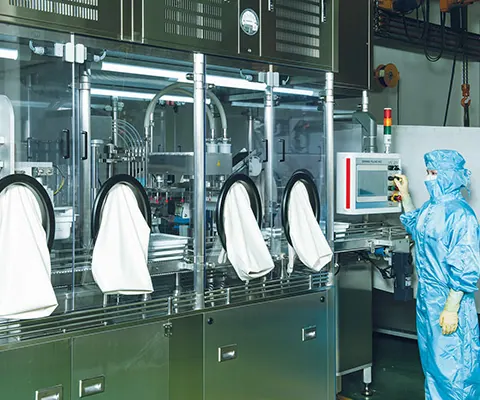
A syringe filling line inside its glove-port enclosure, an operator in a gown at the control screen

Containment: RABS and isolators

The tub station can be enclosed in oRABS, cRABS or an isolator, per product requirement.

These are three different enclosures. You choose one based on the product.

oRABS means open restricted access barrier system. A physical barrier and airflow keep the operator away from the product.

But it is open to the room around it. So the room itself has to be classified to the higher cleanliness standard.

cRABS closes that barrier. The enclosure then keeps its own controlled environment during a production run.

An isolator is sealed completely, and it is decontaminated as one unit. Under EU-GMP Annex 1, that typically allows a lower classification for the room outside.

It is the usual route for a potent or highly sensitive product.

The version of this equipment built to run inside a sealed enclosure is the filling isolator line for vials, prefilled syringes and cartridges. If the container is a vial rather than a syringe, the matching unit is the vial filling and capping machine.

The filling method the whole line is designed around is in our guide to aseptic filling.

An operator's arm in a glove port, working at the filling station inside the enclosure, containers in their nest at the lower left

How it is specified, built and qualified

We supply the line to a User Requirement Specification and hand it over against a qualification file.

The work starts with the URS (your written list of what the machine must do) and the design qualification. Next comes a factory acceptance test before the line is shipped.

Then, at your plant, come site acceptance and the installation, operation and performance qualification. You can read the full sequence on the qualification page.

It also explains what triggers a requalification later.

Buyers who search for prefilled syringe filling machine manufacturers are looking for one company that takes responsibility for the line. Fabtech supplies the syringe line and stays responsible for it.

The rest of the range is in the process equipment catalogue. Sometimes the syringe line is one part of a facility rather than a purchase on its own.

Then a turnkey pharmaceutical project covers the process, the water, the air and the rooms together.

FAQ

What is a prefilled syringe filling machine?

It is equipment that opens a sealed tub of sterile nested syringes. It fills each syringe with a measured dose and seats the plunger. Then it de-nests the syringes and packs them. The syringe arrives sterile, so the machine does not form the container. Its job is to keep the syringe sterile.

Does Fabtech supply prefilled syringe filling machines?

Yes. Fabtech supplies vial and ampoule filling lines and prefilled syringe (PFS) lines. Send us your syringe format, fill volume and target output, and we will specify the line.

What output can a syringe filling machine reach?

The number of filling lanes sets the output, up to five lanes. Fabtech's current datasheet gives 6,000 syringes an hour with two lanes and up to 8,500 with five.

What is the difference between a syringe filling machine and a vial line?

The container. A syringe arrives already made and sterile, held in a nest under a Tyvek lid. So the equipment opens a sterile barrier and works with the nest. A vial line fills, stoppers and crimps loose containers that move on a conveyor.

What does PFS stand for?

Prefilled syringe. The abbreviation is used for the syringe format, for the filling equipment, and for the whole line.

Can the machine be enclosed in RABS or an isolator?

Yes. The tub station can be supplied in oRABS, cRABS or an isolator per product requirement. oRABS is open to the room, so the room carries the classification. cRABS closes the barrier. An isolator is sealed and is decontaminated as one unit. It is the route for potent or highly sensitive products.

Does the machine stopper the syringes as well as filling them?

Yes. The filling and closing machine fills and closes each syringe in the same pass. Plunger rod insertion is a separate automatic station, after de-nesting.

Is a "syringe filling device" the same as a prefilled syringe machine?

Yes. Syringe filling device, syringe filler, automated syringe filling system and syringe filling equipment all describe this machine. The name changes by vendor and by how much of the line is included.

What infeed options are available?

Manual, semi-automatic and fully automatic. The three stations are modular. They can be supplied as a complete line or matched to equipment already installed.

Send us your syringe format, fill volume and target output, and we will specify the line