QC / IPQA Isolator
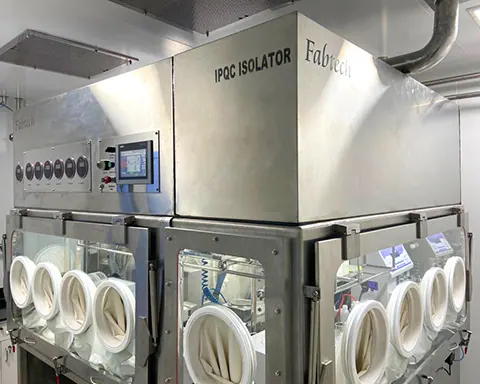
Fabtech supplies QC isolators in SS 316L stainless steel, with four glove ports on the main chamber. Quality control (QC) means opening the container and testing a sample.
We reply within 24 hours.
The rest of the plant works hard to keep the product closed. Each in-process check and each sample taken from the line opens it.
A potent compound is a drug that is strong even in very small amounts. With a potent compound, this is when the operator can be exposed.
In-process quality control is called IPQC or IPQA, depending on the company's SOPs (standard operating procedures). It is the checking done while the batch is still running, not after it ends.
These checks need precision equipment. The equipment must give a reliable analysis of whether the product is fit to use.
Potent products make this harder, because the check itself can expose the operator and the environment.
A QC/IPQA isolator is a sealed chamber. The team runs these checks inside it, so the compound stays contained.
On this page
Key fact Detail
- Chamber material
- SS 316L stainless steel
- Glove ports in the standard configuration
- 4 on the main chamber, 2 on the pass box
- Inlet air
- H14 HEPA filtration
- Exhaust air
- Double HEPA filtration
- Supplied in the standard configuration
- Glove integrity tester
Designed around your test instruments
Fabtech designs its QC isolators around the instruments you already run, which are usually made by other companies.
So the design starts with your instrument list.
The chamber can take balances, hardness and friability testers, disintegration apparatus, moisture analysers and sampling equipment. Each instrument has its own size, services and heat output.
Each one also reacts in its own way to vibration.
A balance is the hardest one to place. It does not work well in the airflow that keeps the chamber contained.
So the layout must shield the balance without creating a dead spot, a place where the air does not move.
Send the instrument list with the enquiry.
The instruments set the size of the chamber more than anything else. They also set the service penetrations (holes in the wall for services) and where the glove ports go.
How the containment works
The chamber runs at negative pressure.
Air flows into the chamber, not out of it, so anything released inside stays inside. Inlet air passes through an H14 HEPA filter.
This is a very fine filter that stops small particles. Exhaust air goes through double filtration.
Where the compound needs it, an inline scrubber also cleans the exhaust air.
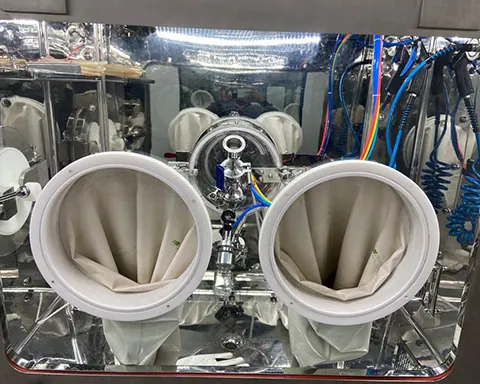
Operators work through glove ports. These are gloves fixed into the chamber wall.
Samples pass in and out through a pass box or antechamber. This is a small box at the side of the chamber.
In-situ washing and drying is built in. This means the chamber is washed and dried where it stands.
A drain collection cachepot collects the wash liquid. The liquid is then handled as contaminated waste.
It does not go to the drain.
Specifications
- Robustly constructed in SS 316L, with H14 HEPA filtration on inlet air and double HEPA filtration on exhaust
- Optional room air intake and dedicated air handling unit for temperature and humidity management
- Safe changing of HEPA filters
- Inline exhaust scrubber for exhaust air treatment
- Customisable ergonomics
- Standard configuration: one pass box with 2 glove ports, main chamber with 4 glove ports, and a glove integrity tester
- Multiple chamber configuration options available
- In-situ chamber washing and drying, with drain collection cachepot for safe handling
- Password protection for different authorisation levels
- Optional IPC SCADA 21 CFR Part 11 for high-grade integration and compliance
QC, IPQA and sterility testing are three different units
These isolators have similar names, but the equipment is not the same.
The table shows what each one is for.
| Unit | What it is for | Pressure |
|---|---|---|
| QC / IPQA isolator (this page) | In-process checks and quality control on potent compounds | Negative, to protect the operator |
| Sterility testing isolator | Pharmacopoeial sterility testing and microbiology | Positive, to protect the sample |
| Sampling and dispensing isolator | Raw material sampling and day-quantity dispensing | Negative, to protect the operator |
Positive pressure keeps the sample clean. If keeping the sample clean matters most, choose the sterility testing unit.
Negative pressure keeps the compound away from the analyst. If keeping the analyst safe matters most, choose this one.
For in-process checks on a running tablet press, also look at the tablet compression isolator. If the laboratory work uses live pathogens (germs that cause disease) instead of potent chemistry, the scope changes again.
You then need a BSL-3 laboratory.
FAQ
Why is a QC and IPQA isolator important in quality control?
It keeps powder and liquid inside. It prevents leaks and removes particles from the air. It guards against accidental operation. It also keeps the analyst from touching the compound.
What is the standard configuration of a QC and IPQA isolator?
Fabtech supplies the isolator in SS 316L stainless steel, with four glove ports on the main chamber and two on the pass box. The inlet air has H14 HEPA filtration, and the exhaust has double HEPA filtration. A glove integrity tester is part of the standard configuration.
Can a QC isolator be integrated with other pharmaceutical processing equipment?
Yes. Fabtech designs its QC isolators around the instruments and equipment you already run. This is why we ask for the instrument list with the enquiry.
What safety features are included for handling potent products?
The features are contained material transfer systems, containment hoppers, HEPA filtration, glove port isolation, explosive-risk mitigation and particle monitoring.
What industries can benefit from an IPQA isolator?
These industries can use it: pharmaceuticals, biotech, contract laboratories, hospitals, agrochemicals, speciality chemicals, nutraceuticals and chemicals.
What is the difference between a QC isolator and a sterility testing isolator?
The difference is the pressure, and so the purpose. A QC/IPQA isolator runs at negative pressure to protect the analyst from a potent compound. A sterility testing isolator runs at positive pressure to protect the sample from the analyst.
Does it run at positive or negative pressure?
It runs at negative pressure, because the hazard it manages is exposure. Some checks on a potent product must also be aseptic, which means free of germs. For these, the answer is a pressure cascade across chambers, with a different pressure in each chamber. It is not a choice between the two.
Tell us which checks you run and on what compounds, and we will set up the isolator for them
We reply within 24 hours.