Sampling and Dispensing Isolator
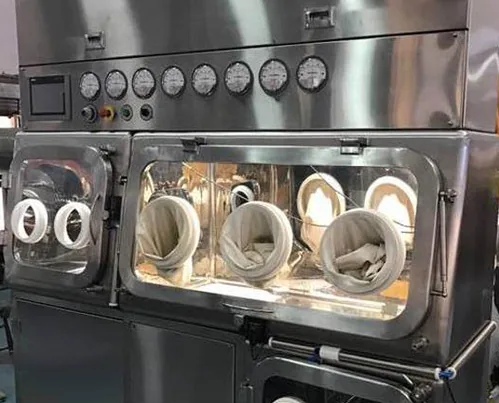
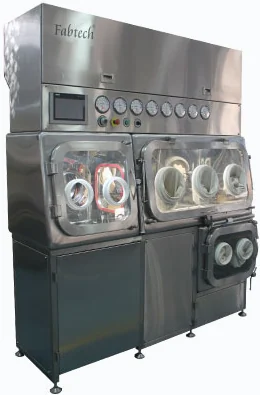
Most operator exposure in a plant happens before manufacturing starts. Fabtech supplies the sampling and dispensing isolator in SS 316L stainless steel, with four glove ports on the main chamber and two on the pass box.
We reply within 24 hours.
Raw material arrives in drums. An operator opens a drum, takes a sample for QC (quality control), and later weighs out the amount needed for the day.
At each step, a person works next to an open drum of pure, undiluted active ingredient. This is when the active ingredient is at its strongest in the whole process.
Fabtech offers containment for both steps: collecting raw material samples for QC, and dispensing qualified material to day-quantity calculations. Dispensing means weighing out approved material for the day.
Depending on the process and your cleaning SOPs (written cleaning steps), this can be two separate isolators or one combined unit.
On this page
Key fact Detail
- Chamber material
- SS 316L stainless steel
- Air filtration
- H14 HEPA on inlet air, double HEPA on exhaust
- Glove ports in the standard configuration
- 4 on the main chamber, 2 on the pass box
- Supplied in the standard configuration
- Glove integrity tester
- Supplied as
- Two separate isolators or one combined unit
One isolator or two
Cost does not decide how many units you need.
Two units suit a plant where sampling happens at goods-in, where raw material is received, and dispensing happens near production. Two units also suit a plant where cleaning between materials would slow down a shared unit too much.
One combined unit suits a smaller plant. It also suits a plant where both jobs happen in the same room and the list of materials is short.
There, cleaning between materials does not hold up the work.
The choice depends on your cleaning SOPs and on how many different materials pass through the unit in one shift. Work this out before you size any unit.
Dispensing is also the first step in a chain. After it is weighed, the powder may be granulated, compressed in a tablet compression isolator, or made into a liquid for a filling line.
If the compound is potent enough to need containment at dispensing, each of those later steps needs containment too. It costs less to plan them all at once than one at a time.
A sterile liquid is measured out in a different unit, the liquid dispensing isolator.
How the containment works
The chamber runs at negative pressure.
This means the air pressure inside is lower than in the room, so air flows in, not out. The powder stays inside the chamber, and the operator works from outside it.
Glove ports are sealed gloves fixed in the chamber wall. The operator uses them to weigh, scoop and take samples.
Material goes in and out through a pass box or antechamber. This is a small sealed chamber next to the main one.
An optional drum or container loading arrangement is available. Where drums are heavy or frequent, a PLC-operated drum loader is used.
A PLC is an industrial controller.
Air coming into the chamber is filtered through H14 HEPA. HEPA filters trap very fine particles.
Exhaust air passes through double HEPA filtration, which means two stages of HEPA filters. Where the compound requires it, an inline scrubber also cleans the exhaust.
Dispensing into blender bins or product containers is enclosed. A Split Butterfly Valve is a valve made in two halves.
It keeps the transfer closed on both sides.
Specifications
Robustly constructed in SS 316L, with H14 HEPA filtration on inlet air and double HEPA filtration on exhaust
Optional room air intake and dedicated air handling unit for temperature and humidity management
Safe changing of HEPA filters
Inline exhaust scrubber for exhaust air treatment
Customisable ergonomics
Standard configuration: one pass box with 2 glove ports, main chamber with 4 glove ports, and a glove integrity tester
Multiple chamber configuration options available
Enclosed dispensing into blender bins or product containers
Transfer routes through RTP
In-situ chamber washing and drying, with drain collection cachepot for safe handling
Waste liner port for waste bag discharge
Optional drum or container loading arrangement
PLC-operated drum loader
Password protection for different authorisation levels
Optional IPC SCADA 21 CFR Part 11 for high-grade integration and compliance
Why ergonomics matter most in dispensing
Ergonomics means making the unit fit the person who uses it.
Weighing is skilled manual work done for hours at a time. An analyst can accept an awkward reach during a ten-minute sterility test.
A dispensing operator cannot accept it for a full shift.
These details matter. The first is the height and spacing of the glove ports.
Then the working height of the balance, a clear view of the scale display, and how far a drum has to be lifted. Each one decides if operators use the unit as designed or find a way around it.
This is why we run a mock-up trial before any unit is built where the ergonomics are not obvious. A mock-up is a test model of the unit, made before the real one.
Finding a problem now costs far less than finding it at qualification, the formal testing after the unit is built.
FAQ
What is the function of negative pressure in a dispensing isolator?
It keeps the isolator at a lower pressure than the room, so any leak pulls air inward. This stops hazardous material from reaching the operator and the room. It also stops dust from escaping.
Can a dispensing isolator be integrated with existing processing equipment?
Yes. We design the unit around the equipment and the containers you already use.
What safety features are available for handling potent or hazardous powders?
The available features are bag-in bag-out systems, hoppers, dust suppression, HEPA filtration, glove port isolation, interlocks, particle monitoring, alarmed setpoints and explosive-risk mitigation.
What temperature and humidity control options are there?
Options range from basic temperature and humidity control inside the unit to full conditioning through a dedicated air handling unit. The right one depends on how sensitive the material is.
What materials can be processed in a sampling and dispensing isolator?
Powders, granules, sterile liquids and highly active APIs.
Can one isolator be used for both sampling and dispensing?
Yes, and this is common. Whether you should use one unit depends on your cleaning SOPs and how many materials pass through it. The section "One isolator or two" above explains this.
What industries use isolators apart from pharmaceuticals?
Isolator technology is used in biotechnology manufacturing, chemicals, research laboratories, aerospace and food production. Fabtech's own work is in pharmaceuticals, biopharma and healthcare only.
How is the operator protected while loading a drum?
Through the drum or container loading arrangement. Where drums are heavy or handled often, a PLC-operated drum loader is used. The container is docked to the isolator, so it is not opened in the room.
What does the standard configuration include?
Fabtech supplies this isolator in SS 316L stainless steel, with four glove ports on the main chamber and two on the pass box. The standard configuration also includes a glove integrity tester. Inlet air passes through H14 HEPA filtration, and exhaust air through double HEPA filtration.
Tell us your materials, your batch sizes and your cleaning SOPs, and we will scope the isolator
We reply within 24 hours.