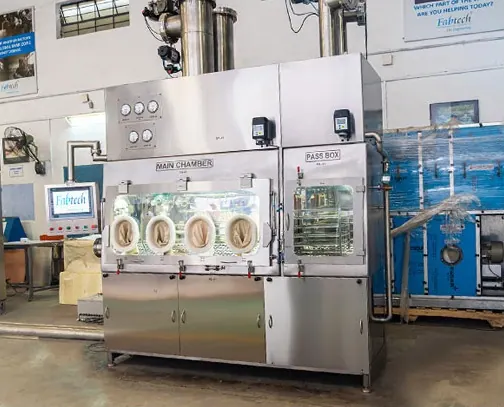
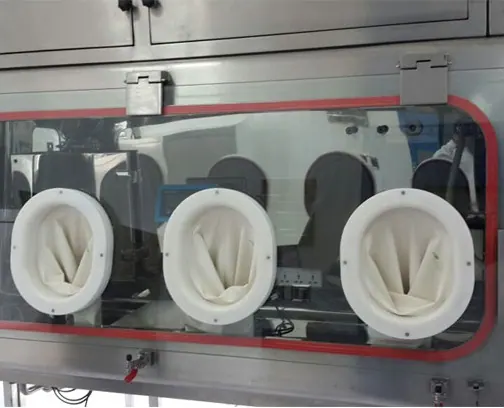
Fabtech supplies the sterility test isolator in SS 316L stainless steel, with four glove ports on the main chamber and two on the pass box. A sterility testing isolator is a sealed cabinet with clean Grade A air inside.
An analyst uses it to run a sterility test on a sample. If microbes grow in the test, the result can be attributed to the sample and not to the room.
The operator works through glove ports. Samples and media enter through a transfer chamber.
Nothing goes in or out through an open door.
Inside, laminar airflow (air that moves in one direction) keeps the air at ISO Class 5. The isolator is compatible with VHP decontamination.
We qualify each unit in the laboratory where it will stand.
We also build the room around the isolator. This matters in a QC (quality control) laboratory.
The isolator, its services and its qualification documents arrive as one scope. We work this way because we build whole facilities.
We do not only ship machines into them.
Our main work is turnkey pharmaceutical projects. In a turnkey project, the QC laboratory is designed and qualified together with the plant.
It is not fitted into the plant afterwards.
On this page
Key fact Detail
Air in the work zone
ISO 5 Grade A, laminar airflow
Chamber material
SS 316L stainless steel
Glove ports in the standard configuration
4 on the main chamber, 2 on the pass box
Supplied in the standard configuration
Glove integrity tester
Decontamination
Compatible with VHP
What we supply for the last check before release
Fabtech supplies this isolator for the sterility test, the last check before a batch is released.
A false positive is a result that shows growth when the product is in fact sterile. A false positive costs almost as much as a true one, because an investigation stops the batch in both cases.
On an open bench
Inside the isolator
The isolator removes the environment around the test as a possible cause.So when growth appears, the analyst can say it came from the product.
For this reason, the isolator keeps the work zone at ISO Class 5 / Grade A, even when the room outside is a lower grade. Grade A is the highest air grade in EU GMP.
Between sessions, the chamber is bio-decontaminated. Cleaning alone is not enough.
Bio-decontamination kills microbes on the inside surfaces.
Sample
Pump
Waste route
Canister manifold
Membrane
Growth media
What sterility testing needs from the isolator
Two features of the test decide most of the isolator specification.
The test runs for 14 days. The samples are incubated (held at a set temperature so that microbes can grow) for 14 days.
Slow-growing and stressed organisms may not show in less time. The isolator is not in use for those 14 days.
But the handling at the start of the test must be clean enough that nobody has reason to doubt the room for the next two weeks.
There are two test methods, and each needs different handling.
Membrane filtration
Membrane filtration is the default method when the product can be filtered. The sample passes through a membrane inside the isolator. The membrane is rinsed and then moved into growth media.
Filtration needs a pump, a canister manifold and a waste route inside the chamber.
Direct inoculation
Direct inoculation is used when the product cannot be filtered.
Direct inoculation needs less hardware but more open handling.
Tell us which method you run before the chamber is configured. The method changes the internal layout, the number of glove ports and the size of the transfer chamber.
In the QC microbiology laboratory
A microbiology laboratory does several jobs, and sterility testing is only one of them.
The same isolator is often used for more than one job. Environmental monitoring plates, media fill reading, bioburden work and growth promotion testing all need the same sealed Grade A zone.
On an open bench, all of them have the same false-positive problem.
When a QA microbiology isolator must cover several of these jobs, three questions decide the design:
How much material must enter during a session.
Whether incubation happens inside the unit or outside it.
Whether one chamber or a split configuration suits the workflow.
If a microbiological isolator is sized only for the sterility test, it will slow down every other job the lab does in it.
Specifications
A buyer will compare four figures against Getinge, Tema Sinergie and Labconco.
We cannot publish these four figures yet. They are tests per shift, VHP cycle and aeration time, filter class, and the log reduction the cycle is validated to Log reduction measures how many microbes the cycle kills.
Robustly constructed in SS 316L with laminar airflow, ISO 5 Grade A classification
Customisable ergonomics
Standard configuration: one pass box with 2 glove ports, main chamber with 4 glove ports, and a glove integrity tester
Multiple chamber configuration options available
On-demand process equipment and online particle counter integration
H2O2 decontamination optional
Password protection for different authorisation levels
Chamber and transfer configuration
The transfer chamber decides whether most sterility testing isolators work well, because it is the only route in and out.
It has its own seals and its own decontamination. So material can enter without breaking the clean condition of the main chamber.
When material has to come from another aseptic isolator in a different room, a mobile isolator carries it across in a closed chamber.
Make these configuration decisions early:
Decision
What drives it
Number of chambers
How often material must enter during a session
Transfer chamber size
The largest item you will pass in, not the average item
Glove port count and position
The test method, how far the analyst can reach, and whether two people work at once
Rapid transfer ports
Whether you use pre-sterilised canisters or beta bags
Particle counter integration
Whether monitoring runs all the time or once per session
VHP generator
Vapour in
Vapour in
Cycle record
Biological indicator
Biological indicator
Glove ports
Glove ports
HEPA filter
HEPA filter
Return
Air out
Growth media
Membrane canisters
VHP decontamination
An automated cycle bio-decontaminates the chamber with vapourised hydrogen peroxide (VHP), and the cycle parameters are logged.
The cycle is developed by testing it against biological indicators. It is not assumed to work.
After decontamination comes the aeration phase. Aeration removes the peroxide.
Aeration matters more on this isolator than on any other isolator. It must bring residual peroxide down to a level that will not affect the growth media.
Peroxide residue slows or stops the growth that the test is looking for. So a careless decontamination step becomes a false negative on a batch you were about to release.
A false negative is a result that shows no growth when the product is contaminated.
Glove ports and integrity testing
Glove ports are positioned ergonomically for the method being run, so the analyst can reach the work easily.
Every unit ships with a glove integrity tester. Gloves are one of the most common failure points on any isolator.
These isolators are designed to comply with EU GMP Annex 1 and FDA guidance. Air classification follows ISO 14644. The work zone is ISO Class 5 / Grade A. Each market also has local regulatory requirements, and these apply on top. They differ from market to market.
Qualification follows the normal DQ/IQ/OQ/PQ route, which covers design, installation, operation and performance. It is written against a specification you approve first. The unit is tested at the factory before despatch, and again on site after installation. Control systems that hold electronic records are built to 21 CFR Part 11. The equipment qualification page sets out the full protocol set.
Installation, commissioning and maintenance
Lead time and commissioning duration depend on the configuration. We do not publish a single figure, because one standard figure would be wrong for most projects. These things change it: chamber count, transfer arrangement, whether a VHP generator is integrated or external, particle counter integration, and the state of the room the isolator goes into. We quote both against a filled specification.
Routine maintenance:
Daily or per use:visual checks of gloves, seals and pressure readings
Weekly:surface swabs, transfer port checks, VHP generator inspection
Quarterly or annually, depending on use:particle counts, glove replacement, calibration, verification, preventive maintenance
Build the maintenance plan around how often you run sessions, not around a general calendar.
FAQ
How does a sterility testing isolator work?
It keeps the samples and the operator apart. The operator works on the sample through glove ports. The inside is a highly controlled environment, designed to eliminate contamination from people and from the surroundings.
What are the types of sterility testing isolators?
Closed isolators have no direct connection to the room. Material passes in and out only through sealed ports. Open isolators have a controlled opening, kept clean by air flowing outward. Positive pressure prevents contamination getting in. Negative pressure suits tests on dangerous compounds. RABS are often listed with these, but a restricted access barrier system is not an isolator.
What is the standard configuration of a sterility testing isolator?
Fabtech supplies the isolator in SS 316L stainless steel, with four glove ports on the main chamber and two on the pass box. A glove integrity tester is part of the standard configuration. Other chamber configurations are available.
Which test is used for sterility testing?
Membrane filtration when the product can be filtered, and direct inoculation when it cannot. Membrane filtration is the default method in the pharmacopoeia, because it separates the organisms from any antimicrobial properties of the product itself.
Why is the sterility test incubated for 14 days?
Fourteen days gives slow-growing and stressed organisms time to appear. With a shorter incubation, a batch could be released on a result that had not finished developing.
What design features differentiate an isolator for sterility testing from standard cleanroom systems?
A cleanroom is a fully controlled room. It is engineered with pressure cascades (rooms held at different air pressures), and operators have open access. An isolator is a sealed unit. It has rigid barriers, glove ports, and built-in filtration and decontamination systems.
How do sterility testing isolator manufacturers integrate glove ports, transfer chambers and VHP decontamination effectively?
Transfer chambers have separate seals. Glove ports are positioned ergonomically and validated with leak and penetration tests. VHP systems are integrated, the cycle parameters are logged, and the cycle is tested with biological indicators. All interfaces are tested before use.
How long does it take to install and commission a sterility testing isolator in a pharmaceutical lab?
It depends on the configuration and on how ready the room is. So we quote it per project and do not publish one figure. The biggest variables are chamber count, transfer arrangement, whether the VHP generator is integrated, and whether the lab is ready to receive the unit.
What maintenance and calibration routines keep sterility testing isolators compliant?
Do visual checks daily or at each use. Do surface swabs, transfer port checks and a VHP generator inspection every week. Do particle counts, glove replacement, calibration, verification and preventive maintenance every quarter or every year, depending on how much the unit is used.
How does HEPA filtration maintain ISO Class 5 inside the isolator?
Filters, laminar airflow and a sealed chamber keep the air inside at ISO 5, whatever the grade of the room outside. HEPA filters stop particles. They do not stop gases or vapours.
What does a sterility testing isolator cost?
We do not publish a price. Chamber count, transfer arrangement, VHP integration and particle counter integration change the price too much for one figure to be useful. We quote against a filled specification.
Is this the same as a vial filling machine isolator?
No. This isolator is for testing a sample after the batch is made. Aseptic filling of vials, syringes and cartridges is done on a filling isolator line. That is a production machine, with a different scale and a different qualification set.
What regulatory guidelines apply to sterility testing isolator design?
EU GMP Annex 1 and FDA guidance are the main references. Air classification follows ISO 14644. Local authorities add their own requirements in the market where the lab operates.