Pharmaceutical blenders
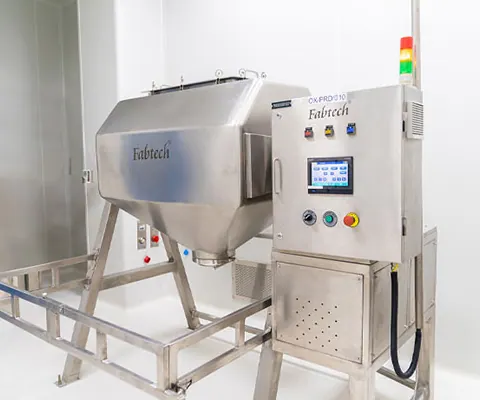
Fabtech's Blenders are used to mix powders or work granules with tumbling. Fabtech supplies four types: bin, octagonal, V-type and double cone. They gently mix powder ingredients and formed granules.
A blender in the pharmaceutical industry has one job: to mix the batch evenly. Every tablet in a batch must carry the same dose, and the blending step decides this.
We reply within 24 hours.
People often ask for pharmaceutical mixers and blenders together, but they are different machines. Every blender on this page mixes by tumbling: the container turns and the powder falls over itself inside it.
None of them has an impeller (a turning blade that pushes the powder).
On this page
Key fact Detail
- Types
- Bin, octagonal, V-type and double cone
- Compliance
- cGMP and 21 CFR Part 11
- Models
- Lab, pilot and commercial production
- Construction
- SS 316 or SS 316L
- Controls
- PLC with user-set recipes
The blenders we supply, and the working principle behind them
Fabtech supplies bin, octagonal, V-type and double cone blenders in lab, pilot and commercial production models.
Blending is the step that spreads the active ingredient evenly through the batch. The active ingredient is the part of the medicine that treats the patient.
Spreading it evenly is the purpose of a blender in pharmaceutical manufacturing. Every other part of the machine is there to do this well.
The working principle of a blender in pharma is diffusion by tumbling. Diffusion here means the particles spread out at random, a small step at a time.
The shell (the container that holds the powder) turns and carries the powder up its wall. When gravity becomes stronger than friction, the powder falls back down through itself.
Each fall moves particles a small, random distance from the particles next to it. After a few hundred turns, the mixture is close to uniform, which means it is the same in every part.
The basic mixing action has no impeller and no forced shear. The energy for mixing comes from the fall.
An intensifier bar is an optional part that breaks up lumps (agglomerates). It is a separate question, and it is still open.
This working principle gives three rules for how a blender is specified:
Fill level matters more than speed. If the shell is too full, the powder has no room to fall through itself.
It slides as one mass instead of falling through itself. The usual practice is to fill the shell well below its full geometric volume.
Rotation speed has an upper limit. If the shell turns too fast, centrifugal force holds the powder against the wall.
The powder does not fall, so mixing stops. The useful speed is well below that point.
Similar particles blend more evenly, and stay mixed. When particles differ a lot in size or density, the fines (the smallest particles) move down between falls.
This separation is called segregation, and blending exists to prevent it. So the properties of the granules that go into the blender decide how good the blend will be.
The working principle of an octagonal blender is the same diffusion by tumbling, inside a shell with flat sides. What the flat sides change is explained under the four types below.
It is still an open question.
The importance of a blender in the pharmaceutical industry is clearest when blending fails. An uneven blend cannot be corrected at the tablet press.
The problem appears in the content uniformity test at batch release, after the batch is already made. This test checks that each tablet holds the right amount of the active ingredient.
Types of blenders in the pharmaceutical industry
Fabtech offers Bin, Octagonal, V-type and Double Cone Blenders.
All four are tumbling blenders. The shell turns and the powder falls through itself.
The four types differ in the shape of the shell, and the shape decides how the powder folds over as it mixes.
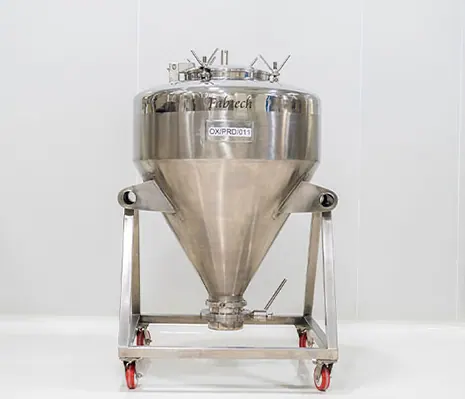
Bin blenders are widely used due to their flexibility with different capacities, closed-loop material transfer and better mixing efficiency. Bin blenders also allow for improved material handling both upstream and downstream.
This operator-friendly system is easy to install, dismantle and clean and can be seamlessly scaled up from laboratory to production scale.
The bin is the same container that brings the material in and takes it out. So the powder is never decanted (poured) into a separate blender.
This is why a bin blender suits a contained line, where the powder stays closed in.
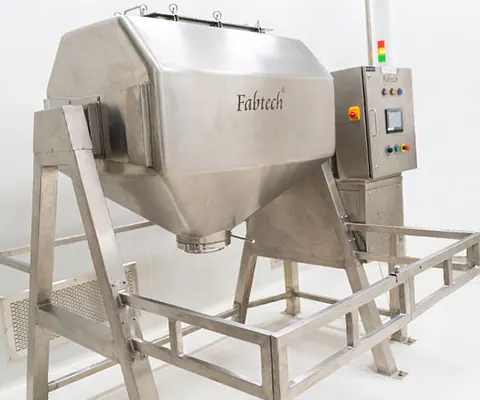
Octagonal blenders use a drum with flat sides. They are generally used for large volumes of granules that need gentle handling.
The usual explanation is that the flat sides drop the material a shorter distance on each turn than a round shell does.
V-type blenders have two arms in the shape of a V. On every turn, the batch splits into the two arms and then comes back together.
This splitting and joining folds the powder more actively than a plain tumble. The V-type is the usual choice for a small batch that must be proved uniform.
Double cone blenders are narrow at both ends. On each turn, the material comes together at one end and then spreads out again.
They empty cleanly. This matters when the product is expensive, or when the machine changes from one product to another often (frequent changeover).
A fifth type, the conta blender, appears on the OSD manufacturing guide in a list of equipment used in the industry. It is not one of the four types this page offers.
Which blender for which job
The choice usually depends on three things.
Does the material arrive in a bin? How gentle must the mixing be?
How will the machine be cleaned?
| If | The usual answer | Why |
|---|---|---|
| Material moves in bins along a contained line | Bin blender | The bin is the blender, so there is no decanting and no transfer step |
| Large granule volumes, gentle action | Octagonal | Large surface area for each unit of batch volume |
| Small batch, uniformity has to be proved | V-type | Splits the batch and joins it again on each turn |
| Expensive product or frequent changeover | Double cone | The cone narrows to the outlet, so less residue is left to clean |
Blending machine selection in the pharmaceutical industry is also a cleaning decision. Blenders are cleaned between products, and the plant must be able to prove each clean.
A shell shape that mixes well is often hard to reach inside for cleaning. So for the blenders on this page, the cleaning method is agreed before the shell is chosen.
In some plants the blender is part of a fully contained line instead of a stand-alone machine. There, it is part of the closed loop granulator line.
That line connects to the blender bin through a split butterfly valve, a closed valve for moving powder from one container to another. So the powder is never exposed.
If the step before blending is wet granulation (making granules with a liquid binder), the machine for that step is the high shear mixer granulator. It is a different type of machine.
It mixes, masses and granulates. A blender only mixes.
Why blend uniformity decides content uniformity
Blend uniformity means the active ingredient is spread evenly through the whole blend. Content uniformity means each tablet carries the same amount of it.
Blending is the last step where the active ingredient can be spread evenly. After blending, the mix goes to the tablet press.
If the active ingredient is not spread evenly, no press setting can correct it. The failure shows up in the content uniformity test at release.
It is not visible on the production line.
Blending too little and blending too much both cause problems. A lubricated mix is a mix that already contains the lubricant.
Over-blending a lubricated mix coats the granule surfaces and weakens the tablet. So blend time is a validated parameter: it is fixed by trial and then kept the same.
The five properties a granule must have before it reaches the blender are on properties of good tablet granulation. The place of blending in the whole OSD (tablet and capsule) sequence is on the OSD manufacturing process.
Blender specifications
- All contact parts manufactured in SS 316L
- PLC operations through user-set recipes
- 360-degree rotation in a diagonally eccentric plane
- Changeable number of blades to suit the process and material
The last specification mentions blades. More often, a tumbling blender has no blades at all, and an intensifier bar is an option rather than the standard.
The third specification is the diagonally eccentric rotation. The general explanation is that this rotation changes the direction of the fall on every turn.
So the powder does not settle into one repeating path and simply turn with the shell.
Scale, materials and compliance
Our Blenders are cGMP and 21 CFR Part 11 compliant and available in lab, pilot and commercial production models constructed with SS 316/SS316L. Product contact parts are mirror-finished and non-contact parts are matt-finished.
cGMP means current Good Manufacturing Practice, the quality rules for making medicines. 21 CFR Part 11 is the US FDA rule for electronic records, such as the records the PLC (the machine's control system) creates.
SS 316 and SS 316L are grades of stainless steel.
Lab, pilot and production models in one range make a blend time transferable from one scale to the next. A blend proved on a laboratory shell is checked again at production scale.
It does not have to be developed again from the start, because the shell shape is the same and only the fill volume changes.
Each machine is supplied to a User Requirement Specification (URS). This is the document where the buyer lists what the machine must do.
The machine is handed over with a qualification file, which records the tests that prove it meets the specification. The qualification steps are on equipment qualification.
The rest of the range is in the process equipment catalogue.
We reply within 24 hours.
FAQ
What is a blender in the pharmaceutical industry?
It is a machine that mixes powders and granules by tumbling them. It spreads the active ingredient evenly through the batch before compression or filling. This step decides whether every tablet in a batch carries the same dose.
What types of blenders are used in pharmaceuticals?
Fabtech offers four: bin, octagonal, V-type and double cone. All four are tumbling blenders, and the shape of the shell decides how the powder folds. Bin blenders suit contained lines. Octagonal blenders suit large volumes of granules. V-type blenders split and rejoin the batch, for small batches that must be proved uniform. Double cone blenders empty cleanly.
What is the purpose of a blender?
Its purpose is to spread the active ingredient evenly through the batch before compression or filling. Then every tablet carries the same dose. An uneven blend cannot be corrected later at the tablet press.
What is the principle of a blender?
The principle is diffusion by tumbling. The shell turns and carries the powder up its wall. When gravity becomes stronger than friction, the powder falls back down through itself. Each fall moves the particles a small, random distance from their neighbours. There is no impeller. The energy for mixing comes from the fall.
What is the difference between a blender and a mixer granulator?
A blender only mixes. A high shear mixer granulator mixes, masses and granulates in one bowl. It adds a binder to grow granules. They are different stages: granulation comes first, and blending comes after drying.
What batch sizes are available?
There are lab, pilot and commercial production models, and the shell is sized to the batch. We would confirm the working volume of each model before quoting.
Are the blenders cGMP and 21 CFR Part 11 compliant?
Yes. They are built to cGMP, and to 21 CFR Part 11 for the records the PLC creates. They are made in SS 316 or SS 316L. Product contact parts are mirror-finished, and non-contact parts are matt-finished.
How is blend time decided?
It is decided by trial, and then held as a validated parameter. Blending too little and blending too much both cause problems. Over-blending a lubricated mix coats the granule surfaces and weakens the tablet. So a longer blend time is not safer.
Send us your batch size, bulk density and blend time, and we will specify the machine