High Shear Mixer Granulator
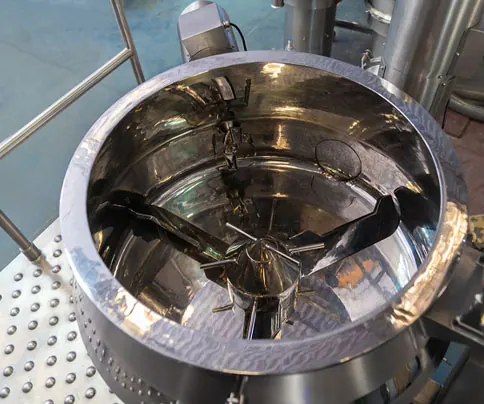
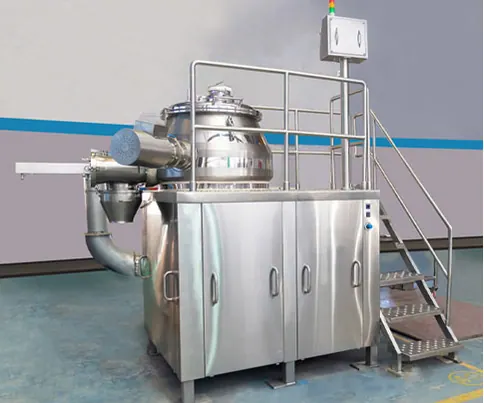
Fabtech supplies the high shear mixer granulator in lab, pilot and commercial models, with a four-blade impeller and a chopper. It mixes dry powders and turns them into granules in one bowl.
The machine is also called a rapid mixer granulator (RMG). Granules (small, dense grains made from fine powder) flow better than powder, and they press into tablets more evenly.
We reply within 24 hours.
Fabtech's High Shear Mixer Granulator (also known as Rapid Mixer Granulator) has an ergonomic, compact design that allows for efficient performance of dry mixing and wet granulation processes. It delivers homogeneous mixing, even binder distribution, wetting and granule size growth through a controlled process.
The result is a homogeneous product, stabilised by lower heat transfer with excellent colour distribution and rapid drying. The granules are dried in the dryer that follows.
This machine does not dry.
Wet granulation means making granules with a liquid binder. The aim is a homogeneous product (the same in every part).
On this page
Key fact Detail
- Models
- Lab, pilot and commercial
- Mixing tools
- Four-blade impeller and chopper
- Construction
- Bowl, cover, impeller, granulator and discharge chute in SS 316
- At discharge
- Wet co-mill on pilot and production models
- Controls and compliance
- PLC and touchscreen recipes; GMP and 21 CFR Part 11 compliant
The high shear mixer granulator we supply, step by step
Fabtech's high shear mixer granulator makes the whole batch in one closed bowl.
Mixing, massing and granulation are all performed in minutes.
Dry mixing comes first. The powders are loaded into the mixing bowl and the top lid closes.
The impeller is the large blade that turns in the bowl. The four-blade impeller design makes for better dry mixing of powder and faster processing.
The binder goes in next. A binder is a liquid that makes the particles stick together.
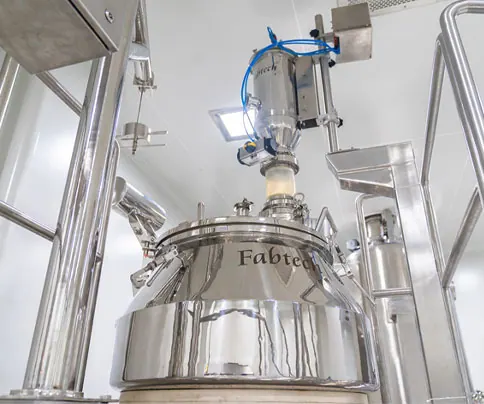
It enters through the binder addition port, and the binder sprinkle nozzle spreads it over the moving powder. The powder becomes wet evenly, and the particles begin to join.
Wet massing is the step where the granules form. The impeller keeps working the wet powder and presses the particles together.
The unique impeller design produces high-density granules.
The chopper works at the same time as the impeller. It is a smaller blade that turns fast.
It cuts the agglomerates (lumps) that form in the wet powder. Rapidly moving chopper blades effectively break down oversized agglomerates and distribute binder uniformly.
The operator can watch the batch through the view glass with light.
Discharge is the last step. The discharge port opens by compressed air, and the wet granules leave through the discharge chute.
Pilot and production models include a wet co-mill at discharge to ensure uniform, speedy drying. A co-mill is a conical mill.
It breaks wet lumps to an even size. The granules then go to a dryer, usually a fluid bed dryer.
RMG and high speed mixer: other names for one machine
Buyers use several names for this machine.
RMG, rapid mixer and high speed mixer granulator all mean the same equipment, which is also called a high shear granulator. You may also see it called a granulator mixer, a mixing granulator or a granule mixer machine.
High speed granulators are also called high shear, because shear is the force that the blades put on the powder. This type is a common granulator machine for pharmaceuticals made as tablets or capsules.
Our granulation techniques guide explains low, medium and high shear. It also compares wet granulation with dry granulation.
This machine is different from a blender. Pharmaceutical mixers such as tumbling blenders only mix dry powder.
The granulator mixes the powder, wets it and forms granules.
Specifications
Our High Shear Mixer is GMP and 21 CFR Part 11 compliant.
It is available in lab, pilot and commercial models.
GMP means Good Manufacturing Practice. 21 CFR Part 11 is the US FDA rule for electronic records and signatures.
- Mixing bowl, cover, impeller, granulator and discharge chute constructed in SS 316
- Four-blade impeller design and chopper
- Pilot and production models include a wet co-mill at discharge to ensure uniform, speedy drying.
- Binder addition port with binder sprinkle nozzle, vent filter, view glass with light
- Customized recipe operation driven through PLC and touchscreen controls
- Pneumatically operated top lid and discharge port
- Heavy-duty square tube main structure without platform and staircase
- Anti-vibration pad
SS 316 is a grade of stainless steel. The vent filter lets air out of the bowl and keeps the powder in.
The lid and the discharge port are pneumatic, so the machine needs a compressed air supply.
High shear or fluid bed granulation
Two machines are commonly used for wet granulation.
A high shear machine presses the wet powder into a mass with its blades, so the granule tends to be denser.
A fluid bed granulator sprays the binder onto powder that floats in air, so the granule tends to be lighter and more porous.
The high shear machine does not dry the granules, so a dryer follows it.
Our high shear versus fluid bed granulation guide compares the two routes.
A granule must meet five properties before it reaches the tablet press.
The guide to the properties of a good tablet granulation explains them.
Where it sits in the granulation line
The granulator is one step in a line.
- Sifted
- Granulated
- Wet milled
- Dried
- Sized
- Blended
- Pressed into tablets
Before it, the powders are sifted. After it, the granules are wet milled, dried, sized, blended and pressed into tablets.
Fabtech supplies the machine on its own, or as part of a closed loop granulation line. In that line, the granulator, the fluid bed equipment, the mill and the blender are piped together.
The product moves between the machines without being exposed to the room.
Fabtech also supplies the equipment around the granulator. Particle sizers include the sifter, the multi mill and the dry co-mill.
Ancillaries include IPC bins (containers that carry the product between machines), lifting and tilting devices and vacuum transfer. The rest is in the process equipment range.
How a machine is tested and handed over is explained on equipment qualification.
To get a quote, send us your product, your batch size, the binder you use and the model you need (lab, pilot or commercial). It also helps to know the bulk density of your blend and how you will load the bowl.
Tell us which dryer the granules go to, and how you decide the end point today (time or impeller load).
FAQ
What is the difference between a rapid mixer granulator and a high shear mixer granulator?
There is no difference. RMG, rapid mixer and high speed mixer are other names for the same machine. High shear describes the force of the blades. Rapid describes the short cycle.
What is the working principle of a high shear mixer granulator?
The impeller mixes the dry powders in the bowl. A binder is sprinkled in through a nozzle. The impeller then presses the wet powder into dense granules, and the chopper breaks oversized lumps. The wet granules leave through the discharge port and go to a dryer. Our granulation techniques guide explains the wet route.
What do the impeller and the chopper do?
The four-blade impeller mixes the dry powder and then builds high-density granules from the wet mass. The chopper blades move rapidly. They break down oversized lumps and distribute the binder uniformly.
Is there a lab granulator model?
Yes. Fabtech supplies the machine in lab, pilot and commercial models, with a four-blade impeller and a chopper. Pilot and production models include a wet co-mill at discharge.
How is the machine cleaned?
The parts that touch the product (the bowl, cover, impeller, granulator and discharge chute) are made in SS 316, and the top lid is pneumatically operated. The cleaning method depends on your product and your model. Ask us about the cleaning method for your model.
What comes after the granulator?
Drying comes next. The wet granules are milled to an even size and dried, usually in a fluid bed dryer. The dry granules are then sized, blended and pressed into tablets or filled into capsules.
Send us your product, your batch size, your binder and the model you need. We will size the machine
We reply within 24 hours.