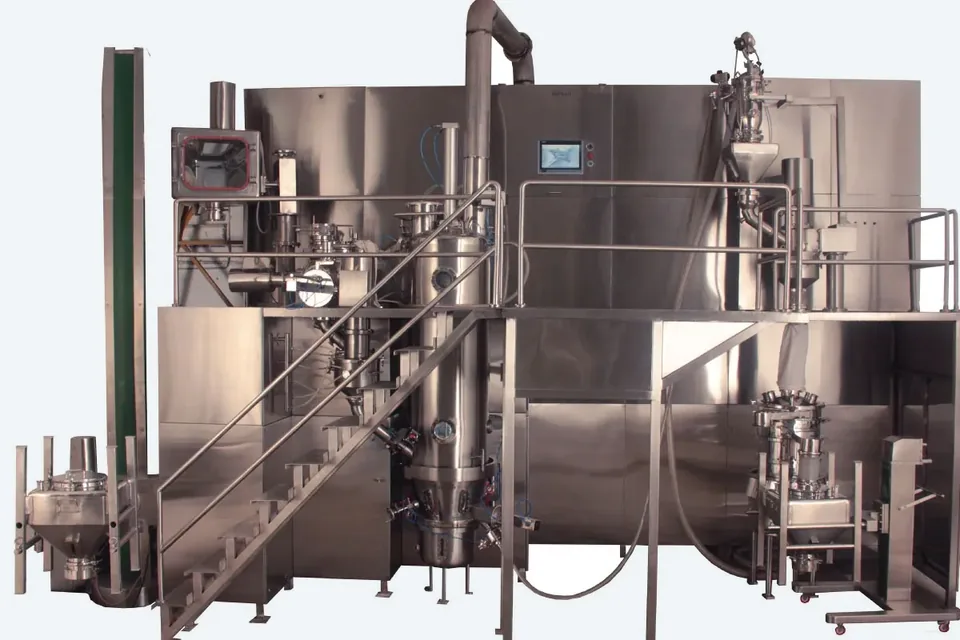
Closed Loop Granulator

Fabtech supplies closed granulation lines for batches up to 300 kg, with five units piped together in SS 316L. The line is for companies that want more automation and a healthier work environment for their teams.

A closed loop granulation line works as one machine. The product stays inside the line from start to finish. It moves between the units through pipes. So the operator is not exposed to the product, and the product is not exposed either.

We reply within 24 hours.

Key fact Detail

Batch size
Up to 300 kg
Units in the line
Five, piped together
Compliance
cGMP and 21 CFR Part 11
Models
Lab, pilot and commercial production
Construction
SS 316 or SS 316L

What our closed granulation line includes

Fabtech's line is an efficient closed-loop granulation system. In line with the granulation process sequence, it consists of a Rapid Mixer Granulator, Fluid Bed Equipment, Vacuum Transfer System, Dry Co mill and Blender. These are directly connected to each other through SS 316 L breaded flexible pipelines. Because they are adapted to each other, they provide the best production results.

Together, these five units are called a granulation train. In a normal granulation suite, the same five stages are separate machines.

Operators move the product between rooms in bins. In this line, the machines are integrated into one line and piped together.

You buy this granulation line machinery as one system, on one specification. It is qualified (tested and documented as fit for use) once, as one line.

The line offers advantages like low space occupation, increased productivity due to fast product transfer, less human intervention and a high yield rate.

The plant elements can be combined in different ways. This allows completely closed and contained product transfer, based on the hazardous nature of the product. It also gives the highest assurance of cleaning.

Each stage also exists as a standalone machine. The right choice depends on how potent the product is and how much floor space you have.

The individual units are the high shear mixer granulator, the fluid bed suite and the blenders. The process itself is explained on granulation techniques.

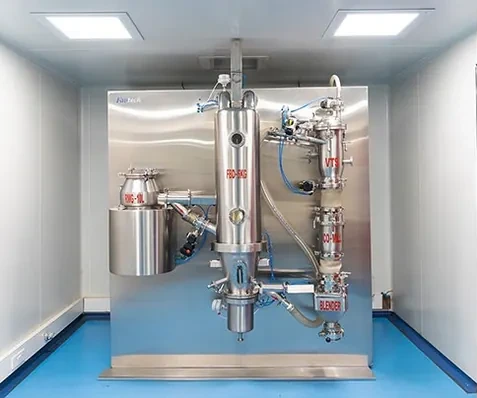
A Fabtech closed loop granulation unit set flush into a cleanroom wall: the RMG bowl at the left, the fluid bed column in the centre, the vacuum transfer, co-mill and blender bin stacked at the right

The closed loop contained granulation line Fabtech commissioned

The Granulation system is a complete wall flush unit with a common SCADA operation system and single screen operation.

Wall flush means the unit is set into the wall, level with it. SCADA is the computer system that controls the line, and the operator runs it all from one screen.

It comprises a High Shear Mixer with a charging and sampling Isolator. It also has a positioning system with Alpha Beta Split butterfly valves. An isolator is a sealed box.

The operator works inside it through gloves.

A Wet Milling Comill leads granules to the Fluid Bed Dryer with a tangential flow sieve. This gives a spiral motion of fluidisation and ensures uniform drying.

Dried products are discharged into a Vacuum transfer device. The product is then milled and sieved within the Isolator and fed to the Blender Bin with passive Split Butterfly Valves.

The Blender Bin comes with a manual lifting trolley (worm wheel type) that makes docking in the Blender easy.

The complete system is flame-proof. The entire system adheres to 21 CFR part 11 as well as cGMP guidelines. Sensors measure process endpoints and also endpoints for cleaning and validation. 21 CFR Part 11 is the US FDA rule for electronic records and signatures.

cGMP means current Good Manufacturing Practice. An endpoint is the point where a step is complete, for example when the granules are dry enough.

System highlights

  • Spiral Tangential Flow Sieve for Fluid Bed discharge into Vacuum Transfer System.
  • Leak-proof High Shear mixer and Fluid Bed dryer to maintain the highest levels of containment.
  • Specially designed sampling valves as well as cleaning nozzles to ensure the validation of system is perfect.
  • All containment equipment filters incorporate the BIBO system for hassle-free filter changing procedures.

BIBO means bag-in bag-out. The operator changes a filter through a sealed bag, so the dust inside does not escape.

We also provided a multi-purpose washing station for bin washing bottles, blender bins and other equipment. The station is designed to incorporate manual half suit entry for flexibility of use. This also helps clean parts that are difficult from a validation point of view. A half suit is a sealed suit fixed into the station wall.

Through it, an operator can reach into the station without being exposed.

We designed the API section with reactors (with contained charging Isolator), Agitated Nutsche filter dryer, Micronizing Mill with complete containment. An IPQC Isolator with instruments like weigh balance, disintegration apparatus, oven friability tester, hardness tester and Karl Fisher apparatus (moisture analysis) completes the system.

API means active pharmaceutical ingredient, the substance in a medicine that treats the patient. IPQC means in-process quality control: tests on the product while it is being made.

Granulation terms this line is specified against

These three terms come up when you specify a granulation line.

RMG

RMG means Rapid Mixer Granulator. It is the first machine in the line.

It mixes the dry powders and adds the binder, a liquid that makes the particles stick together. Then it forms the wet mass into granules, all in one bowl.

It is the same type of machine as the high shear mixer granulator. Fabtech supplies the RMG both standalone and at the head of this line.

Wet and dry

The two types of granulation are wet and dry. Wet granulation adds a liquid binder to grow granules, and then dries them.

This line is built for wet granulation: first the RMG, then fluid bed drying. Dry granulation presses the powder together (compaction) instead of using liquid.

It is used for active ingredients that are damaged by moisture or heat. The full comparison is on granulation techniques.

CPP and CQA

CPP and CQA are used together to prove that the line makes good product.

A Critical Quality Attribute (CQA) is a property of the product that must stay inside a limit. Examples are granule size distribution, moisture and bulk density.

A Critical Process Parameter (CPP) is a machine setting that changes a CQA when the setting changes. Examples are binder addition rate, impeller speed, inlet air temperature and drying end point.

To qualify a closed line, you show which CPPs change which CQAs, and you keep those CPPs in their limits. This is one reason the endpoint sensors are more important on a contained line than on an open one.

Nobody can open a closed line and look at the product.

Containment, and why the line is closed

A granulation line is closed because of the compound it handles.

In an open suite, a potent active ingredient is contained by the room and by what the operator wears. Both are administrative controls: they depend on people following the rules.

A closed line contains the compound by engineering, with the equipment itself. This is why the containment band decides the specification first, before the batch size.

Containment happens at each transfer. At every point where powder would otherwise be poured, scooped or decanted, the line has a split butterfly valve instead.

The valve has two halves. The active half stays on the equipment and the passive half stays on the bin.

The valve opens only after the two halves are docked and sealed together. So the product is never exposed to the room.

Containment granulation and high-containment granulation are generally the same idea at different bands. The compound's occupational exposure limit sets the band.

The machine does not set it. This limit is the amount of the compound a worker can safely be exposed to.

Sometimes only one step of the train needs containment. Then the answer is a granulation isolator instead of a closed line.

This line is built for toxic material granulation. A contained granulation line in pharma must provide containment, and it must also prove it.

The sampling valves and the endpoint sensors are there for this. A containment claim must be based on a measured result.

A design intention alone is not proof.
Line specifications

  • Fully automated from Start to finish in a closed-loop sequence
  • Enhanced operator, environment and process safety
  • SS 316 L pipelines that avoid exposure of the process material from the environment in the suite
  • Dust free operation
  • Fit critical equipment with Active-Passive-Valve for contained loading and unloading
  • Available in batch sizes up to 300 kgs batch sizes
The closed loop contained granulation line Fabtech commissioned: the charging isolator and high shear mixer at the left, the fluid bed dryer and its platform in the centre, the sieve and the blender bin on its lift at the right

Three hundred kilograms is the top of the range. The integrated granulation line machine is sized down from there, not up.

The line is built around the largest batch it will ever run. This is because the pipework and the valve sizes are fixed once the line is installed.

Scale, materials and compliance

The system is cGMP and 21 CFR Part 11 compliant. It is available in lab, pilot and commercial production models constructed with SS 316/SS316L. The product contact parts are mirror-finished, and the non-contact parts are matt-finished.

A closed line is qualified as one line. The five machines are not qualified one by one.

The transfers are what must be proved. So the qualification file covers the docking, the cleaning and the containment, as well as how each unit performs.

The steps are on equipment qualification. The rest of the range is in the process equipment catalogue.

Buyers who search for closed granulation line manufacturers, suppliers or a closed granulation line factory are looking for one company that takes responsibility for the whole line. Fabtech designs and supplies the line as one system, piped together to your batch size, and stays responsible for it.

On a closed line, the transfers between the units must be proved, as well as the units. That qualification work belongs to whoever owns the interface, meaning the connection points between the units.

When you compare toxic material granulation line suppliers, ask each one who owns the interface.

The same split valve method also works for moving powder on its own, without a full granulation train. This is done in closed loop powder handling systems, which are specified from the same containment band.

FAQ

What is a closed loop granulation line?

It is a granulation train. The Rapid Mixer Granulator, fluid bed equipment, vacuum transfer, co-mill and blender are piped directly to each other in SS 316L. The product moves between the stages without being exposed to the room or the operator.

What is in the line?

It has a Rapid Mixer Granulator, fluid bed equipment, a vacuum transfer system, a dry co-mill and a blender. SS 316L flexible pipelines connect them. There is a split butterfly valve at every transfer.

How does the containment actually work?

Containment works at the transfers. Every point where powder would be poured or decanted has a split butterfly valve. The active half is on the equipment and the passive half is on the bin. The valve opens only once the halves are docked and sealed. Sampling valves and endpoint sensors prove the containment, so it is not assumed.

What batch sizes does it run?

The line is available in batch sizes up to 300 kg. It is built around the largest batch it will run. This is because the pipework and valve sizes are fixed at installation.

When is a closed line the right answer instead of separate machines?

Look at the compound's exposure band. For some bands, room controls and personal protective equipment would be doing the containment. Then a closed line is the right answer, because it contains the compound by engineering instead. If only one step needs containment, a granulation isolator is usually a better fit than a whole closed line.

Is it flame-proof?

The commissioned system described above is flame-proof throughout. We would confirm whether flame-proof construction is standard on this line or was specific to that installation.

Tell us the compound, its OEB band (how potent it is) and the batch size. We will plan the line for you