Static pass box
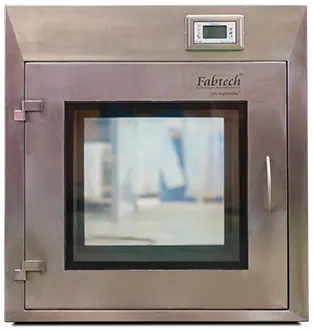
Fabtech supplies static and dynamic pass boxes for cleanrooms, in SS 304 or SS 316 stainless steel. A pass box is a small chamber built into a cleanroom wall.
Material goes in on one side and comes out on the other. Every cleanroom needs a way to move material between classified areas. Each transfer can carry dirt from the less clean room into the cleaner one. A pass box makes that transfer safe.
We reply within 24 hours.
It does this with three controls. The doors are interlocked, so both doors can never open at the same time.
The air is filtered, so the chamber cleans itself. The pressure is set so that any leak flows from the clean side toward the less clean side.
Know one limit before you specify a pass box. HEPA filtration captures particles.
It does not capture gases or vapours. Material that is wet with solvent needs a different control for this reason.
Fabtech's dynamic pass box is a GMP-compliant system for transferring materials between classified areas. It runs a recirculatory air system, so the same air moves round the chamber again and again.
A part of the air is fresh air taken in from outside. This keeps the chamber at positive pressure.
The material airlock acts as the barrier between greyroom and cleanroom.
People write it as one word or two, passbox or pass box. It is the same unit.
An active passbox is another name for the dynamic one. It is called active because it moves and filters air.
It does more than seal a hole in the wall. A cleanroom passbox on a grade boundary should always be the dynamic kind.
Key fact Detail
A static pass box only seals and interlocks. A dynamic one also filters its own air.
| Static pass box | Dynamic pass box | |
|---|---|---|
| Air handling | None. A sealed box with interlocked doors | Fan and HEPA filtration, actively purged |
| Use between | Two areas of the same cleanliness class | Areas of different classes |
| What it controls | Personnel movement and door discipline | Airborne particulate on the material itself |
| Typical position | Within a classified zone | Between greyroom and cleanroom |
The most common pass box error is also the most expensive one. It is a static box placed on a grade boundary.
It looks like a control, but it does not work as one.
Our guide to static and dynamic pass boxes explains how to choose. The VHP pass-through chamber guide explains what changes when decontamination is added.
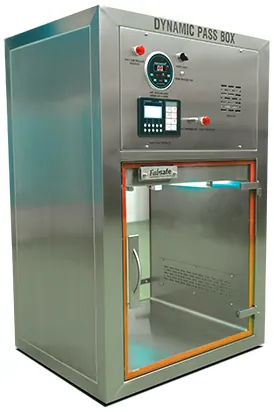
Fabtech designs and supplies static and dynamic pass boxes.
We supply them to international markets, including the GCC and Africa. We supply them as standalone units or as part of a turnkey cleanroom.
Buyers who search for a dynamic pass box manufacturer or a static pass box manufacturer want one company that takes responsibility for the unit. Buyers who compare dynamic pass box manufacturers want the same thing.
Fabtech designs and supplies the pass box and stays responsible for it. We specify each unit for the market it goes to.
We do not use one fixed specification for every market. The door swing, voltage, controller language and set of validation documents all change by market.
For a cleanroom project in India, Fabtech Technologies Cleanrooms Ltd is the company to contact. It is a separate company and is listed separately.
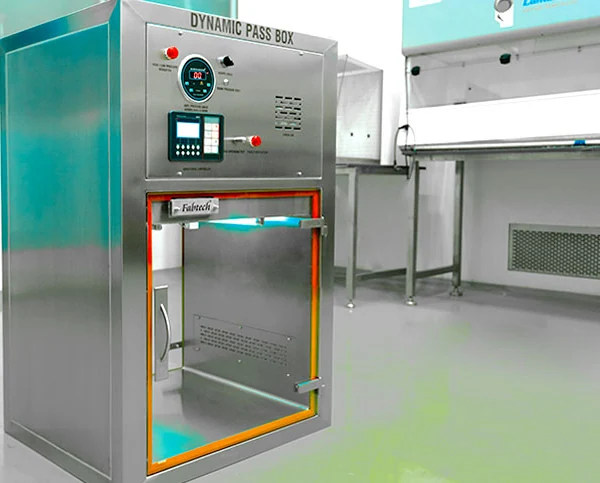
VHP means vapourised hydrogen peroxide.
Adding VHP turns a filtered airlock into a decontamination airlock. Without VHP, the box depends on the surface of the material being clean when it goes in.
With VHP, the box runs a proven cycle on whatever is inside. The door on the clean side stays locked until that cycle finishes.
VHP helps where material cannot be wiped down, and where the receiving room is Grade B or A. It suits a boundary with a low number of transfers.
On a busy boundary, the cycle time slows every transfer, and a different solution is better.
A static pass box is a passive transfer chamber with no active air handling. It is used between areas of the same cleanliness class. A dynamic pass box adds HEPA or ULPA filtration and a fan to control airflow and pressure. So it can move material safely between different cleanliness grades.
It is a barrier for material transfer. It reduces how often people move between zones, which is where most cross-contamination starts. It also keeps handling GMP-compliant between controlled areas.
A blower feeds filtered air into the chamber at a set rate. This keeps the pressure slightly higher than in the rooms on either side. Constant airflow, door interlocks and a sealed build then keep dirt out while material passes.
Filtration, controlled airflow, dual-door interlocks, smooth internal finishes and stainless steel. Units meet ISO 14644 and GMP criteria for particle counts, airflow and pressure.
Stainless steel is standard. Fabtech supplies pass boxes in SS 304 or SS 316 stainless steel, because it resists corrosion and is easy to sanitise. Powder-coated panels or toughened glass windows suit non-critical or inspection areas.
It runs the door interlocks and purge cycles. It checks filter and pressure status, logs events and raises an alarm on a fault. This leaves less room for human error and gives a clearer record.
It supports DQ/IQ/OQ/PQ. It also follows ISO 14644, and EU GMP Annex 1 where that applies. Validation usually covers airflow mapping, particle counts, filter integrity testing and pressure differential checks.
Yes. UV, shelving, and stronger interlock and monitoring packages are also available where the sterility need is stricter. VHP lets the box decontaminate its contents in place. Gasket doors seal the box more tightly.
Pharma and biotech, hospitals and clinical labs, food processing, cosmetics and research. Pass boxes are used anywhere material has to cross a clean boundary. Fabtech supplies them for pharma, biopharma and healthcare projects.
Fabtech supplies pass boxes to international projects, including across the GCC and Africa. We specify each unit to the requirements of the market it goes to.
Tell us the two room grades and what has to cross between them, and we will specify the pass box
We reply within 24 hours.