Vertical Laminar Airflow (LAF) Unit
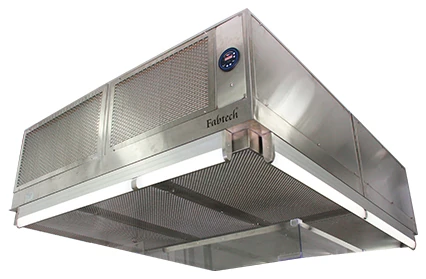
Fabtech supplies vertical LAF units that keep an ISO Class 5 zone at the point of work. A vertical LAF unit blows clean, filtered air down over a work area. The air moves in one direction.
This keeps the product you handle away from the mixed, turbulent air of the room. A vertical LAF unit protects the product. It does not protect the operator.
Our GMP and FDA-compliant systems give product protection in work areas of different sizes. They are used for sampling, general process technology and sterile product filling.
We reply within 24 hours.
Work zone
The protection comes from the direction of the airflow. Clean, low-turbulence air flows down onto the work area.
It then leaves the unit at table height and goes back into the room.
Motor blower
The motor blower is statically and dynamically balanced. So it keeps the capacity and static pressure the unit needs for the whole life of the filter.
HEPA filter
The unit collects airborne particles and removes them in a controlled way. Every filtered unit has one limit.
HEPA (high-efficiency particulate air) filters capture particles. They do not capture gases or vapours.
On this page
Key fact Detail
- Construction
- Powder-coated SS 304 or SS 316
- Air cleanliness
- ISO Class 5
- Air velocity
- 0.45 ± 0.05 m/s, vertical airflow
- Filter
- H14 or H13 HEPA
- Noise
- Below 67 dB on Scale A
Product protection, not operator protection
A vertical LAF unit protects the product.
It does not protect the person who works at it. Many people get this point wrong.
Check this point first, because it decides if this is the right machine for your work.
The unit pushes filtered air down over the work zone. The air then flows out toward the operator.
Some materials are potent, cytotoxic (toxic to living cells) or biologically hazardous. For these materials, a LAF unit is the wrong equipment.
You need a containment isolator at negative pressure, or a biological safety cabinet. Negative pressure means that air flows into the isolator, not out of it.
Use a LAF unit when the risk is contaminating the product. Use containment when the risk is exposing the person to the material.
Specifications
- Material of construction: powder-coated SS 304 or SS 316
- HEPA filtration to H14 or H13
- LED lighting, digital gauges, automatic fan control for constant LAF speed
- Perforated plate or membrane distributor air outlet surface
- Air cleanliness ISO Class 5. Air velocity 0.45 ± 0.05 m/s, vertical airflow
- Minimum vibration
- Noise below 67 dB on Scale A, measured with ambient at 55 dB on Scale A
- Options:
- integrated cooling system
- flameproof ATEX model
- legs with or without rollers
- Flow restriction by PVC curtain, blades or closed wall elements
- Tubular frame construction with electrically monitored safety glass doors and glove ports
Sizing and where units go
We size a LAF unit by the work area it must cover.
The size of the room it stands in does not decide the size of the unit. We need to know four things:
the floor area of the work
the height you work at
if anything tall sits under the unit and disturbs the airflow
if the work runs all the time or only some of the time
The last point is important. A unit that runs all the time in a warm room usually needs the cooling option.
Half a metre per second of air over a bench for eight hours affects the operator's comfort as well as the air quality.
LAF units are common in sampling and dispensing areas and in general process technology. They are also used in sterile product filling.
There, the unit gives the Grade A zone over an open container. Grade A is the cleanest air zone, used where a sterile product is open to the air.
Material usually reaches these areas through a pass box, a small chamber in the wall with a door on each side. The room around them is built from cleanroom systems.
Supply and support
Fabtech is an export house.
We design and supply LAF units for international pharma, biopharma and healthcare projects. Named projects on this site show our delivered work across the Gulf and Africa.
We specify each unit to the electrical and documentation requirements of the country where it will be used. We do not supply every unit to one single specification.
Buyers who search for LAF manufacturers or for a LAF supplier are looking for one company that takes responsibility for the unit. Fabtech designs and supplies the LAF unit and stays responsible for it.
If your project is in India, send India cleanroom enquiries to Fabtech Technologies Cleanrooms Ltd. It is a separate and separately listed group company.
FAQ
What is a vertical LAF unit?
It is a unit that blows filtered air down over a work area in one direction. It keeps an ISO Class 5 zone at the point of work, whatever the grade of the room around it. Fabtech supplies the unit in powder-coated SS 304 or SS 316 stainless steel.
What is the standard air velocity?
0.45 metres per second, plus or minus 0.05. This figure is the industry convention for unidirectional (one-direction) flow. The unit is validated against it.
Does a LAF unit protect the operator?
No. A LAF unit protects the product. Air moves from the filter, across the work, and toward the operator. To protect the operator, you need containment at negative pressure or a biological safety cabinet.
What is the difference between a LAF unit and a LAF workbench?
The difference is size and use. A LAF workbench is a bench-size station for laboratory work. A vertical LAF unit covers larger process areas, up to and including a filling line.
What is the difference between vertical and horizontal laminar flow?
The difference is the direction of the air. Vertical flow moves down onto the work and leaves at table height. Horizontal flow moves from the back toward the operator. Vertical flow suits work where something tall sits on the bench, because the tall object would block horizontal flow.
Can it be used in a flameproof area?
Yes. There is a flameproof ATEX model. Solvent handling normally requires this model.
How is a LAF unit validated?
It goes through the standard qualification sequence. The tests map the airflow velocity. They count particles to ISO 14644. They also test the filter by DOP or PAO.
How often should the HEPA filter be changed?
Change the filter when its condition shows that it needs changing. A fixed calendar date is the wrong guide. The automatic fan control keeps the air velocity constant as the filter fills with particles. So the pressure reading tells you when the filter is used up.
Which markets do you supply LAF units to?
Fabtech is an export house. We supply LAF units to international projects. Tell us your country, and we will specify the unit to its electrical and documentation requirements.
Send us your work area, your process and your market, and we will size the LAF unit
We reply within 24 hours.