Contents
Fabtech Technologies designs, manufactures and qualifies both kinds. Aseptic isolators protect sterile products. They hold a positive-pressure, HEPA-filtered ISO Class 5 zone. Containment isolators hold negative pressure, so potent compounds stay inside.
We also build the room the isolator stands in. The isolator, the room, the air system that feeds it and the qualification documents that release it become one scope. You do not have to manage four suppliers who blame each other.
What a pharmaceutical isolator is
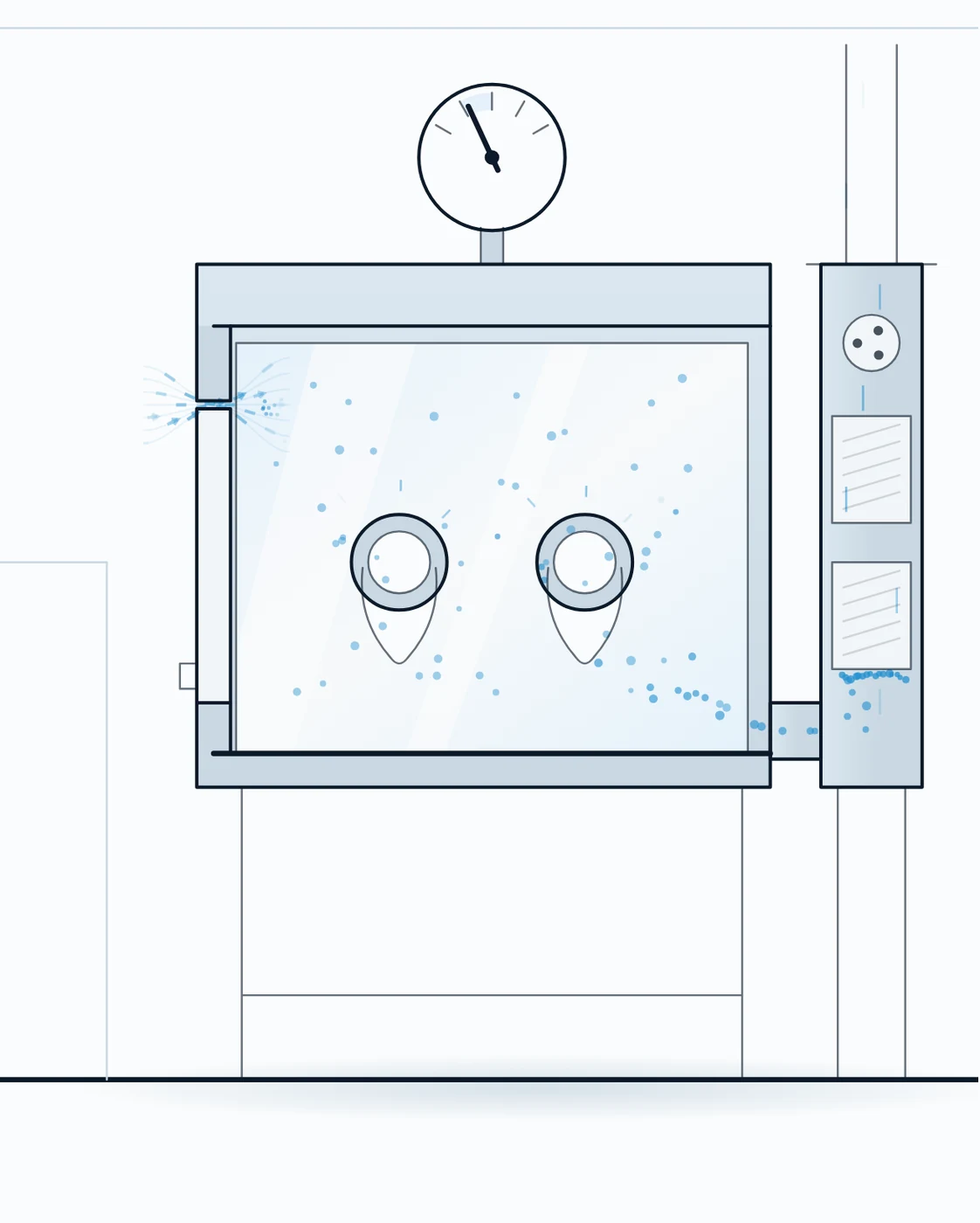
An isolator is a rigid, closed box with its own air inside. That air is kept apart from the room around it. Air comes in through HEPA filters, which are fine filters that stop particles. It crosses the work zone in a set pattern and leaves through filters on the way out. Operators reach in through glove ports or half-suits. Materials go in and out through transfer hatches, rapid transfer ports or a decontamination airlock. They never pass through an open door.
Isolation in pharma is the wider idea behind the box. A physical barrier keeps the process apart from the room around it. The process does not rely only on procedure, gowning and room grade. An isolator is the strictest form of isolation. RABS and containment booths are less strict forms of the same principle.
HEPA filters stop particles. They do not stop gases or vapours. Solvent vapour and volatile compounds need a different control. This is usually carbon filtration or a separate exhaust route. An isolator specified only on HEPA performance will not handle a solvent-wet process.
Isolators spread through the pharma industry for one reason: cost. A cleanroom on its own cannot separate an operator from the product. An operator in a gown still sheds particles the whole time they work.
Put a barrier between the two. Then a Grade A zone can sit inside a Grade C or D room instead of a Grade B room. Grade A is the cleanest air grade, used for sterile work. That means a much smaller room to build, run and qualify. This is the whole case for isolator technology in the pharmaceutical industry. It is also why the use of isolators in pharmaceutical manufacturing keeps widening.
How an isolator works
The working principle of an isolator is a controlled air balance across a sealed wall.
A fan pulls air through a HEPA filter into the chamber. The air crosses the work zone in a set direction. It leaves through a second filter. The air that goes in and the air that comes out are not equal. This difference is planned. It holds the pressure against the room. Sensors watch the difference and sound an alarm before it is lost. The pressure difference is the real barrier. The steel and glass only hold it in place.
The rest of the design keeps this balance from breaking. Gloves and half-suits let an operator work without opening the chamber. Transfer ports move material in and out without letting the pressure become equal. A VHP (vaporised hydrogen peroxide) cycle brings down the bioburden (the live microbes) inside between campaigns, and nobody has to go in. Interlocks stop two doors on one route from being open at the same time.
So real performance depends on the whole system. Two units with the same chamber act differently if their airflow, alarm settings and transfer routes are not the same. This is why containment has to be proved by testing after the unit is installed. A datasheet cannot prove it.
Positive or negative pressure: the first decision
Positive pressure protects the product. Air pushes outward, so room air cannot get in. If there is a leak, the air moves the safe way, out of the isolator. This is the aseptic case: sterility testing, filling sterile injectables and compounding.
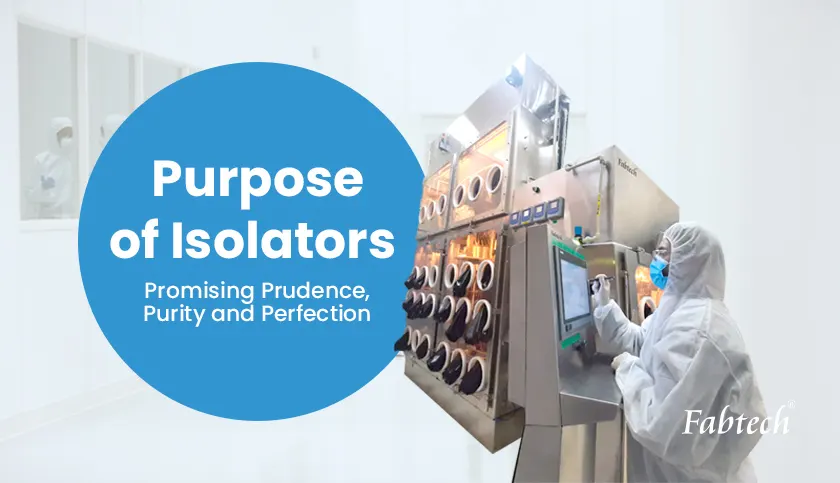
Positive pressure system. Fabtech offers a solution for customised applications covering microbiology testing, testing of sterile products, cell therapy applications, sterile powder handling systems, R&D setup and aseptic process. These systems are re-circulatory in airflow management, with an integrated VHP system, and are available for both viable and non-viable particles. Integration of process equipment is 21 CFR compliant. They have a PLC-based control system and a custom built validation protocol.
- Body, work area base and read panel supplied in SS 316, complete with interlocked type 'D' transfer hatches
- Main work area maintains air quality levels in accordance with Grade 'A' EU GMP (Class 100), supplied via HEPA filter H14/H13 providing unidirectional airflow
- Easy to use blue LCD backlit display showing work area and transfer hatch pressure
- Audible and visual alarm with clear and informative display
- High air change rates in both work area and transfer hatches
Negative pressure protects the operator and the environment. Air pulls inward, so if the barrier fails, the hazard stays inside. This is the containment case. It covers potent APIs, cytotoxics (drugs that kill cells), hormones and anything with a low occupational exposure limit. A plant for cancer medicines needs this containment at every step. See how the layers fit together in an oncology manufacturing facility.
Some processes need both at once, because the product is sterile and potent. These use pressure cascades between chambers instead of one pressure. We explain this decision in more detail in our guide to positive and negative pressure containment systems. The negative pressure system page covers the unit.
The isolator range
The range has eleven isolators. They are grouped by the process step they serve. The grouping does not follow the pressure type.
| Isolator | What it is for |
|---|---|
| Sterility testing isolator | QC sterility testing at ISO 5 / Grade A. A false positive then comes from the sample, not the room |
| Filling isolator line: vial, PFS, cartridge | Aseptic fill-finish (filling and sealing) of injectables in vials, prefilled syringes and cartridges |
| Sampling and dispensing isolator | Weighing and sampling raw materials without exposing the operator or the warehouse |
| QC / IPQA isolator | In-process checks and quality-control work that must stay contained |
| Tablet compression isolator | Containment around a tablet press that runs a potent formulation |
| Granulation isolator | Contained wet or dry granulation, the step before compression |
| Capsule filling isolator | Containment around capsule filling |
| Liquid dispensing isolator | Aseptic unit: measures and dispenses pre-sterile liquids into smaller containers through inline sterile filters. For contained dispensing of potent powders, see the sampling and dispensing isolator |
| Reactor charging isolator | Charging (loading) solids into a reactor in API and chemical synthesis |
| Potent API processing isolator (PAPI) | High-potency API handling at low OEL bands |
| Mobile isolator | A unit that moves between suites. It is not fixed to one |
Two builds for special uses sit next to the range. Radiopharmaceutical isolators serve nuclear medicine. They add radiation shielding to containment. Isolator systems for special products cover processes that do not fit a standard configuration.
Formulation, OSD (tablets and capsules) and bulk-drug work use the compression, granulation and dispensing units above. They do not need a separate machine.
Delivered. The reactor charging isolator is not only a catalogue entry. Fabtech built a chemical synthesis isolator for Umicore in Argentina.
Choosing by OEB band
For containment work, the specification starts with the compound. A toxicologist sets an occupational exposure limit (OEL). This is the amount of the compound in the air that a worker may be exposed to, in micrograms per cubic metre. The limit is then placed in a band, called an OEB (occupational exposure band). An equipment specification can be written against the band.
The table shows the bands in common use across the industry. No regulation fixes them. Companies and consultancies write their own banding schemes, and the limits between bands change from one scheme to the next. So one supplier can call a compound OEB 4 and another can call the same compound OEB 5.
| Band | Typical OEL, 8-hour TWA | What the handling usually needs |
|---|---|---|
| OEB 1 | above 1,000 µg/m³ | General ventilation and standard PPE |
| OEB 2 | 100 to 1,000 µg/m³ | Local exhaust, contained transfers |
| OEB 3 | 10 to 100 µg/m³ | Closed handling, split butterfly valves, contained charging |
| OEB 4 | 1 to 10 µg/m³ | Isolator at negative pressure, validated transfers |
| OEB 5 | below 1 µg/m³ | Isolator with containment proved by surrogate testing after installation |
Agree the number with your supplier. Ask which OEL in µg/m³ their design is held to. Ask how they will prove it once the unit is installed. A band name on its own is not exact enough.
Our standard design handles the lower OEB categories. Stricter bands change the transfer method, the glove specification, the cleaning method and how the finished unit is tested.
Two guides give more detail. OELs, a priority for containment solutions explains how the limit is set. Surrogate testing for OEL validation explains how containment is measured once the unit is built. If you are still choosing between formats, selecting the right containment system compares the options. A mock-up trial tests the ergonomics before fabrication.
Isolator, RABS or open cleanroom
A restricted access barrier system (RABS) is not an isolator. RABS allow limited intervention. The barrier can be opened under defined conditions. RABS also depend on the grade of the cleanroom around them. An isolator is sealed and decontaminated as a closed space. So it can hold its grade inside a lower-grade room.
Neither is better. The choice is between cost and flexibility.
| Open cleanroom | RABS | Isolator | |
|---|---|---|---|
| Separation from the operator | Gowning and procedure | Physical, openable under defined conditions | Physical, sealed |
| Background room grade needed | Grade B around Grade A | Grade B typically | Grade C or D |
| Intervention during a run | Direct | Limited, defined | Through gloves only |
| Format changes | Easiest | Straightforward | Slowest |
| Decontamination | Room cleaning | Room cleaning plus surface | Validated VHP cycle, closed |
| Where the cost sits | Running the room | Split | Equipment, then a cheaper room |
The last two rows show the main difference. An isolator costs more to buy. But it lets you build and run a smaller, lower-grade room around it for as long as the facility operates. RABS cost less and allow more direct work in the process. A line that changes format every week suits RABS. A process that can be closed and left closed suits an isolator. Our note on the role of RABS in aseptic filling explains where each fits.
Gloves, half-suits and material transfer
The weak points of a barrier are the places where people and materials pass through it. Glove ports are the usual access device. Half-suits give more reach in a deep or tall chamber. But a half-suit is a bigger opening to manage. Glove material is chosen to resist the chemicals it will meet. Gloves are one of the most common failure points on an isolator. That is why integrity (leak) testing runs on a schedule.
Materials cross the barrier through rapid transfer ports, alpha-beta ports, transfer hatches or a decontamination airlock. The packaging must suit the route. Isolator-compatible pharma packaging is packaging you can wipe down, or dock to a port, without breaking the barrier. A container that allows neither lets contamination in, however good the isolator is. Agree pack formats at design stage, while a change is still cheap.
Four guides give the detail: isolator gloves, leak testing for gloves and containment isolators, access devices used in containment systems, and material transfer devices. For keeping the transfer itself clean, see essential material transfer techniques.
Decontamination, qualification and standards
Aseptic isolators are bio-decontaminated between campaigns. This means the microbes inside are killed, usually by an automated VHP cycle. Nobody assumes the cycle works. It is developed and proved with biological indicators, which are test pieces that carry known microbes. Containment isolators are cleaned to a residue limit. This limit is set from the compound's exposure limit, and the cleaning method is proved against that number.
Qualification follows the normal DQ/IQ/OQ/PQ route: design, installation, operational and performance qualification. It is written against a URS (user requirement specification) that you approve first. The unit is tested at the factory before it ships. It is tested again on site once it is in place. On a containment unit, performance qualification adds surrogate testing against the OEB band. Surrogate testing uses a stand-in material in place of the real compound. Control systems that hold electronic records are built to 21 CFR Part 11.
Our page on best practices for validating containment systems sets out what a validation package should contain. The page on equipment qualification covers the wider protocol set.
Standards an isolator is built to
Aseptic isolators are designed to comply with EU GMP Annex 1 and FDA guidelines. The work zone is held at ISO Class 5 / Grade A. The background room grade is agreed at design stage and depends on the process. For a closed isolator it is usually Grade C or D rather than Grade B. Air classification follows ISO 14644.
Systems are built to WHO GMP, US FDA and EU cGMP expectations. This does not mean an isolator is certified. Fabtech holds no regulator's certificate for an isolator, and neither does anyone else. Regulators inspect and approve sites. USFDA (United States), MHRA (United Kingdom) and TGA (Australia) are the inspections these systems are documented to withstand. Equipment itself is qualified and validated.
Laboratory and pharmacy isolators
Laboratory isolators use the same technology at bench scale. The requirements do not become lower because the unit is smaller. A QC sterility testing isolator is a laboratory isolator. It has the same Grade A work zone, the same decontamination cycle and the same qualification set as a production unit.
Hospital and compounding pharmacy work splits the same way. Positive pressure is used for sterile compounding. Negative pressure is used for cytotoxic preparation. A pharmacy that prepares cytotoxics aseptically needs both, in a unit with a pressure cascade. These units are called CAI and CACI: a compounding aseptic isolator and a compounding aseptic containment isolator. US pharmacies specify them against USP chapters 797 and 800
Contained laboratory work at higher biological risk is a different scope. That is BSL-3 laboratory design and build, including the deployable mobile biocontainment laboratory.
Where we manufacture and support them
Fabtech Technologies Ltd is one of the pharmaceutical isolator manufacturers that builds the facility as well as the equipment. We are headquartered in Mumbai. We deliver pharmaceutical engineering projects internationally. This site names our work in Bangladesh, Egypt, Ethiopia, India, Kenya, Morocco, Nicaragua, Nigeria and Saudi Arabia. We engineer and build isolators in India. We then ship, install and qualify them on site. An isolator can be standalone equipment, or part of a turnkey pharmaceutical manufacturing facility or turnkey project.
FAQ
What is the purpose of an isolator?
It keeps the product and the room apart. In aseptic work, the isolator protects a sterile product from the operator and the environment. In containment work, it protects the operator and the environment from a potent or toxic compound. Both jobs use the same technology. Only the pressure is reversed.
What is an isolator in pharma?
It is a sealed box with HEPA-filtered air and a controlled environment inside. Operators work through gloves or half-suits. Materials pass in and out through validated transfer routes. An isolator lets a Grade A process run inside a lower-grade room.
What are the different types of isolators?
By pressure, there are aseptic (positive) and containment (negative) isolators. By process, there are the eleven units listed above, including sterility testing, filling, reactor charging and potent API handling. By mounting, an isolator is fixed or mobile.
What is an isolator for sterility testing?
It is a positive-pressure isolator with an ISO 5 / Grade A work zone for QC sterility testing. It stops the room from causing a false result, so a positive result can be blamed on the sample. See the sterility testing isolator.
Why are isolators used in the pharmaceutical industry?
There are two reasons, and they are opposites. Sterile products must be kept away from people. People must be kept away from potent products. An isolator does both with a physical barrier instead of procedures. This is more reliable than gowning and behaviour alone. It also lets a smaller, cheaper room carry a higher grade of process.
What guidelines apply to isolator qualification?
EU GMP Annex 1 is the main reference for aseptic isolators. FDA aseptic processing guidance covers the same ground for the US market. Qualification follows the standard four-stage sequence against a URS (user requirement specification). Containment units add surrogate testing against the OEB band.
Which company's isolator is best?
There is no honest general answer. Ask every supplier you compare, including us, for three things in writing. First, that the unit will be specified against your compound's exposure band. Second, that containment will be proved by surrogate testing after installation. Third, that they can qualify it in the room where it will stand.
Who are the major manufacturers of pharmaceutical isolators in India?
India has a few specialist builders, plus global companies that sell here. The difference between them is scope, not size. Some supply only the isolator. Others, including Fabtech, also build the suite and the air system around it. On a new suite, this removes one interface. When you replace a unit in a working room, a specialist may be enough.
Why does the importance of isolators keep growing in pharma?
More of the products being made now need isolators: injectables, biologics, high-potency oral solids and cytotoxics. Annex 1 also raised the expectation for barrier technology. The room grade you avoid costs money to build, and it costs money every year to run. So the case for an isolator gets stronger the longer a plant operates.
What does an isolator cost, and how long does it take?
Both depend on the process step, chamber size, containment band, transfer method and level of automation. We do not publish either, because a standard figure would mislead. We quote against a filled specification.
Are cleanroom isolators the same as pharmaceutical isolators?
Yes. People use the two terms for the same thing. "Cleanroom isolator" stresses where the unit stands. "Pharmaceutical isolator" stresses what it is for.
Can one isolator be both sterile and contained?
Yes. This is common for sterile potent products. The isolator is built as several chambers with a pressure cascade between them. The product sees positive pressure. The operator is still protected by a negative-pressure boundary.
Every isolator and containment page
Equipment
- Sterility testing isolator
- Filling isolator line: vial, PFS, cartridge
- Tablet compression isolator
- Radiopharmaceutical isolators
- Sampling and dispensing isolator
- Negative pressure system
- Isolator systems for special products
- QC / IPQA isolator
- Reactor charging isolator
- Granulation isolator
- Mobile isolator
- Capsule filling isolator
- Liquid dispensing isolator
- Potent API processing isolator (PAPI)
- Mobile biocontainment laboratory
Guides
- OELs and containment
- Positive vs negative pressure
- Isolator gloves
- Glove and isolator leak testing
- Material transfer techniques
- RABS in aseptic filling
- Selecting a containment system
- Surrogate testing for OEL validation
- Validating containment systems
- Material transfer devices
- Isolator viewing panels
- Access devices
- Containment mock-up trials