Mobile Isolator
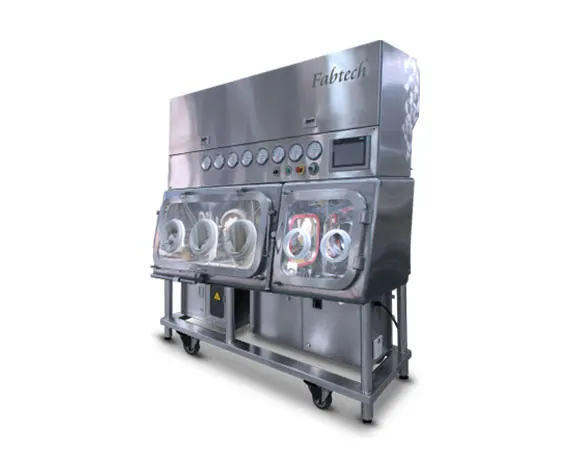
Fabtech supplies the mobile isolator, also called a portable isolator, in SS 316L stainless steel, with optional battery packs. A mobile isolator is an isolator on wheels.
We reply within 24 hours.
This is an aseptic unit. It protects the product from the room and from the operator.
Inside the chamber, the air is held at ISO 5 Grade A, a very clean air class.
Fabtech's Mobile Isolators are ideal for scenarios where the work environment is not confined to a single location, or when materials must be transferred from one aseptic isolator to another. They offer product protection in low-criticality operations.
They are compatible with VHP decontamination to achieve an aseptic environment and process integrity. VHP means vaporised hydrogen peroxide, a vapour that kills microbes.
Ask for the chamber pressure, the leak test and the qualification documents in your enquiry.
On this page
Key fact Detail
- Movement
- Equipped with wheels
- Power
- Optional battery packs for solo operations
- Air supply
- Room air intake and exhaust
- Chamber
- SS 316L, with laminar airflow at ISO 5 Grade A
- Decontamination
- H2O2, optional
When a mobile or portable isolator is the right choice for your plant
A fixed isolator stays in one room.
This one can be moved to the room that needs it. Drug manufacturers use it in two cases.
The work is in more than one place. The same clean task is done in two or more rooms, and one fixed unit in each room would stand unused for most of the day.
One unit on wheels serves all of them.
Material must go from one aseptic isolator to another. Two isolators stand in different rooms.
Sterile material has to cross the corridor between them without meeting room air. The unit works as a closed carrier, a small isolation chamber that travels with the material.
For a critical step, such as filling a sterile product into its final container, see the fixed filling isolator line.
How a mobile isolator moves between two isolators
Before loading, where H2O2 decontamination is fitted, the empty chamber is decontaminated with VHP.
At the first isolator, the material is loaded into the chamber, and the chamber is closed.
On the way, the unit rolls on its wheels. Optional battery packs are supplied for solo operations.
At the second isolator, the material is transferred across. How the two units connect is planned for your isolators.
Tell us the transfer port on your isolators.
The operator works through the glove ports at each end. Glove ports are sealed gloves fixed in the chamber wall.
The operator's skin never meets the clean air.
Specifications
- Robustly constructed in SS 316L with laminar airflow, ISO 5 Grade A classification
- Equipped with wheels for easy movement and supplied with optional battery packs for solo operations
- Customisable ergonomics
- Standard configuration: one pass box with 2 glove ports, main chamber with 4 glove ports, and a glove integrity tester
- Multiple chamber configuration options available
- On-demand process equipment (fitted when you ask for it) and online particle counter integration
- Room air intake and exhaust
- H2O2 decontamination optional
- Password protection for different authorisation levels
A unit on wheels, a fixed unit or a mobile cleanroom
Three things are easy to confuse.
A fixed isolator is built for one task in one room. The sterility testing isolator is an example.
It is the right choice when the task never moves.
A mobile cleanroom is a whole room that can be relocated, and people walk into it. An isolator is much smaller.
The operator stays outside and reaches in through gloves.
A mobile LAF trolley also moves material under clean air. LAF means laminar airflow.
The trolley is open at the front. The isolator is a closed chamber with glove ports.
This unit protects the product. An isolator that protects the operator from a potent product does the opposite job.
Our guide to positive and negative pressure containment systems explains the difference. The full range, with its transfer systems, is on the pharmaceutical isolators page.
FAQ
What is a portable isolator?
It is another name for a mobile isolator: a closed, clean chamber that can be moved to where the work is. Fabtech supplies it in SS 316L stainless steel, on wheels, with optional battery packs. Inside the chamber, the air is held at ISO 5 Grade A.
What industries use mobile cleanrooms and mobile isolators?
They are used in pharmaceuticals and biotechnology, hospitals and healthcare, research laboratories, aerospace and defense, and food and beverage quality control. Fabtech's own work is in pharmaceuticals, biopharma and healthcare only.
How does VHP decontamination work in mobile isolators?
VHP decontamination uses gaseous hydrogen peroxide to eliminate bacteria, viruses and spores inside the chamber. The vapour fills the chamber, and it is then removed before work starts again.
How are modular mobile cleanrooms different from fixed cleanrooms?
Fixed cleanrooms are built into a facility and remain permanent, while modular mobile cleanrooms can be relocated or reconfigured as needed.
What material is used for the construction of mobile isolators?
They are constructed using stainless steel (SS 304 or SS 316L), glass and non-reactive polymers for durability, cleanability and compliance with GMP requirements. Fabtech's unit is constructed in SS 316L.
Can mobile isolators be integrated with online particle counters?
Yes. They can be equipped with online particle counters for continuous monitoring of air quality, ensuring compliance with ISO standards.
Can mobile isolators operate independently without a fixed power supply?
Yes. They can work independently with UPS or battery backup systems.
Does the mobile sterile cleanroom unit have password-protected access levels?
The mobile sterile cleanroom unit can be fitted with HMI-based control systems that offer password-protected access. An HMI (human machine interface) is the touch screen the operator uses.
How does the room air intake and exhaust system work in a mobile isolator?
The intake system draws ambient air from the room and filters it through HEPA filters to remove contaminants, while the fans control the airflow. The exhaust system continuously extracts air from the chamber, passes it through a HEPA filter and expels it safely. An exhaust fan maintains the required air pressure.
What is a cleanroom isolator?
It is a closed chamber that stands inside a cleanroom and holds cleaner air than the room. The operator works from outside, through gloves. Cleanroom isolators can be fixed or on wheels.
Tell us what you need to move, between which rooms, and how often. We will plan the unit
We reply within 24 hours.