LAF
LAF (laminar air flow) pushes air over the product and out toward the operator. It protects the product.
Two examples are a vertical LAF unit and a mobile LAF trolley.
When an operator weighs or samples a powder, dust goes into the air. Fabtech's sampling and dispensing booth carries that dust down and away, and sends up to 30 percent of its air out through the exhaust.
We reply within 24 hours.
The operator opens a drum or a bag, takes out a scoop and taps it onto a scale. Without the booth, the operator would stand in a cloud of the product for a few minutes.
Fabtech's sampling and dispensing booth is a GMP compliant LAF recirculation booth. It protects both the product and the operator.
It uses a recirculatory sub-turbulent airflow system with air bleed. Recirculatory means the booth sends most of its air back into the work area.
Air bleed means the rest of the air leaves through the exhaust.
Clean, low-turbulence air flows vertically down into the work area. The booth vacuums the air out at the bottom, and this air carries the airborne substances with it in a controlled way.
An integrated exhaust air system keeps the booth at a slight negative pressure, so the air pressure inside is a little lower than in the room. This protects the surrounding area against cross-contamination at all times.
Material goes in and out for manual sampling through high-speed lateral doors, or on an automatic conveyor. Some buyers ask for inflatable sampling booths, or for an inflatable sampling and dispensing booth.
Tell us in your enquiry what you need, and we will confirm what we can supply.
Key fact Detail
Fabtech supplies this booth as a downflow booth, and the name says how it works.
Filtered air enters at the top of the booth. It moves downward over the work zone at low turbulence.
The booth takes the air out at the bottom. This point is below the operator's breathing zone (the air around the nose and mouth) and below the point where the dust is made.
Dust released at the bench moves down and away. It does not rise past the operator's face.
This is why a downflow booth protects the operator and a laminar flow bench does not.
Both supply filtered air. Only the downflow booth takes the air away in the right direction.
Downflow booth manufacturers and sampling booth manufacturers make the same machine. A buyer who searches for either wants one company that takes responsibility for the booth.
Fabtech designs and supplies the booth for international projects and stays responsible for it. In the pharmaceutical industry, a sampling booth is one of the few places where one enclosure protects both the operator and the product.
This is why nearly every dispensary (the area where raw materials are weighed out) has one.
An RLAF dispensing booth is the machine on this page.
LAF (laminar air flow) pushes air over the product and out toward the operator. It protects the product.
Two examples are a vertical LAF unit and a mobile LAF trolley.
RLAF (reverse laminar air flow) pulls air away from the operator and into the filters. It protects the person.
This booth does both at once. That is why it is the standard machine for dispensing.
The sub-turbulent downflow keeps a layer of clean air over the product. The bleed and the exhaust pull contaminated air out before it reaches the room.
Neither protection is total. The next sections explain the limits.
A booth that recirculated all of its air would move the same air round and round.
Any dust in that air would stay inside the booth.
This booth sends up to 30% of its air out through the integrated exhaust. This bleed does two things.
First, it removes part of the airborne material each time the air goes round, so the dust does not circulate for ever. Second, the booth exhausts more air than it takes back.
So the booth sits at a slight negative pressure compared with the room. If there is any leak path, air flows in through it.
Nothing moves out to the surrounding area.
This one number, the air bleed, is the difference between a clean-air bench and a containment enclosure.
OEB (occupational exposure band) is a scale for how much protection a molecule needs.
A higher band means a more potent molecule. The scale usually runs from OEB 1, the least potent, to OEB 5, the most potent.
An open-fronted booth is an enclosure for the lower bands. We do not publish one band for every booth.
Send us your molecule and its band, and we will tell you whether a booth fits.
Above the lower bands, an open-fronted booth is the wrong design, whatever is added to it. At higher bands, the direction of the airflow is not enough.
Containment then depends on a sealed barrier. That sealed barrier is a containment isolator.
A sampling and dispensing isolator does this same job for molecules in the higher bands. The operator works through gloves, and the isolator runs at negative pressure.
It costs considerably more.
Compare the two products on cost and on ease of access. The booth is faster to work in and cheaper to buy.
The isolator contains more. Choose by the molecule you handle, then plan the cost around that choice.
Once the band is settled, there are nine more specification decisions. They are set out in selecting a pharmaceutical containment system.
Booths are available in flameproof (ATEX) and non-flameproof models.
ATEX is the European rating for equipment used where there is a risk of explosion.
The reason is almost always a solvent. You need a flameproof booth if dispensing involves flammable solvents, or if the booth stands in a classified area (an area rated for fire or explosion risk).
Then the electrical equipment inside the booth has to be rated for that atmosphere. This includes the blower motor, lighting, PLC and weighing scale.
Flameproofing cannot sensibly be added to a booth later. So please include it in your enquiry.
Do not leave it for a later change order.
A sampling room is the classified space where incoming material is opened, sampled and weighed before release.
Classified here means a clean area with a set cleanliness grade.
The booth is the main equipment in this room, but the room needs more than the booth.
Material reaches the room through a dedusting tunnel. The tunnel removes loose dust from drums and sacks before they enter the room.
Samples leave through a pass box.
The cleanroom HVAC system sets the room's grade, its pressure cascade (the steps in air pressure between rooms) and its air changes.
When the booth is inside a suite we build end to end, all of this is one scope of work. The other clean air equipment in that scope is on our page of solutions for cleanrooms and clean air applications.
We do this work for export projects. Fabtech Technologies Cleanrooms Ltd is the cleanroom company that serves India, a separate company that is listed separately, and the one to contact for a project there.
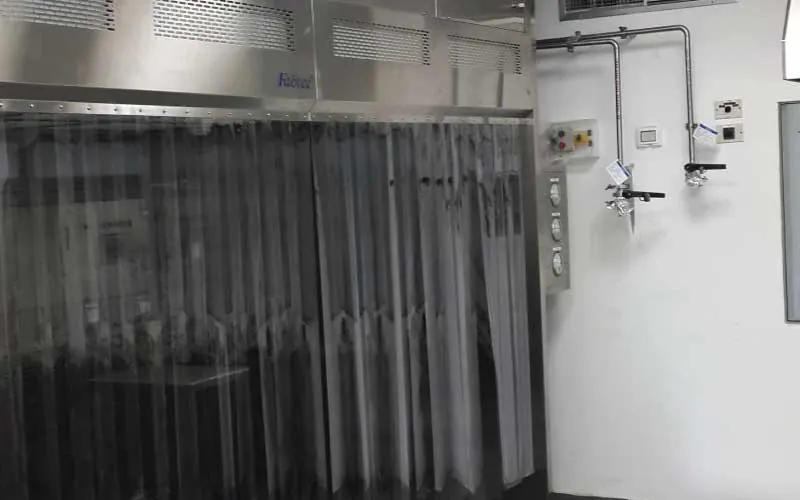
It is a GMP-compliant recirculatory LAF booth. It protects both the product and the operator. Clean air flows into the work area, and part of it is bled to the exhaust. The sub-turbulent downflow carries airborne material down and away from the operator's breathing zone.
It is the same enclosure, named for the work done in it. Dispensing means weighing out a measured quantity. Sampling means taking a small portion for testing. Both jobs open a container and both make dust, so both use the booth.
RLAF means reverse laminar air flow. The booth pulls air away from the operator and into the filters. It does not push air toward the operator. Its purpose is to protect the operator. This is what makes a dispensing booth different from a laminar flow bench.
It is the classified area where incoming material is opened, sampled and weighed before release. The booth is the main equipment in the room. The room provides the grade, the pressure cascade and the air changes around the booth.
Because it exhausts more air than it takes back. The booth sends up to 30% of its air out through the exhaust. This keeps the booth slightly below room pressure. Air flows in through any leak path, and nothing moves out to the surrounding area.
The booth is for molecules in the lower OEB categories. We do not publish one band for every booth. Send us your molecule and its band, and we will tell you whether a booth fits. For the higher bands, the booth design itself is the limit. A larger booth does not solve this. You then need a containment isolator.
SS 304 or SS 316 stainless steel as standard. These resist corrosion and are easy to clean. We specify protective coatings, powder-coated panels or toughened glass viewing windows to suit the process.
It is designed for GMP environments. It also supports the DQ/IQ/OQ/PQ qualification sequence. Airflow and filtration follow ISO 14644 cleanroom principles.
Yes. There are flameproof (ATEX-rated) and non-flameproof configurations. The choice depends on solvent use, the electrical area classification and the site's safety requirements.
The operator loads and unloads material manually through high-speed lateral doors. An integrated automatic conveyor can also move material in and out continuously. Both methods keep containment and limit operator exposure.
Low-turbulence downflow carries dust downward from the point where it is released. The bleed and exhaust remove the dust before it escapes. Sealed construction with HEPA filtration and door interlocks stops transfer from product to product and from product to the environment.
The difference is the barrier. A booth is open at the front and relies on the direction of the airflow. An isolator is sealed and relies on physical separation, and the operator works through gloves. The booth is faster to work in and cheaper. The isolator contains far more.
Send us your material, your OEB band and whether solvents are present, and we will specify the booth
We reply within 24 hours.