CIP and SIP systems
Our skid mounted CIP and SIP systems give high quality cleaning and critical processing. Fabtech designs and supplies them, and the design meets GMP norms and is compliant with USFDA 21 CFR Part 11 and GAMP 5.
We reply within 24 hours.
The results are repeatable and controllable, and they can be validated. The systems are simple to operate and easy to use.
Skid mounted means the equipment comes assembled on one frame. Clean-in-place (CIP) and sterilise-in-place (SIP) clean and sterilise process equipment without taking it apart.
In the pharmaceutical industry, the reason for this is not convenience. The reason is a reproducible cleaning result.
A machine runs the cycle the same way every time, so the cycle can be validated. A cycle run by hand cannot be validated.
On this page
Key fact Detail
- USFDA 21 CFR Part 11 and GAMP 5
- The design is compliant with both and meets GMP norms
- Less than 0.4 Ra microns
- Electropolished finish on all contact parts
- Orbital welding
- Checked by boroscopy and videoscopy
- DQ, FAT protocols, IQ and OQ
- Documents supplied to support validation
- Tankless option
- Saves space
CIP and SIP systems we supply for pharmaceutical plants
Fabtech supplies CIP and SIP stations for pharmaceutical plants.
Clean-in-place (CIP) and Sterilization-in-place (SIP) are very important in the Pharmaceutical industry. This is true in every facility: a drug manufacturing plant, a laboratory or other pharma operations.
The main aim is to clean and sterilise the equipment well and regularly. The aim is zero contamination and no risk to product quality, so the product is fit for patient consumption.
CIP and SIP also save the time needed to take the equipment apart for cleaning and put it back together.
Pharma and Biotech manufacturers use equipment such as vessels and pipes that come in contact with the product during manufacturing. How clean this equipment is affects the product.
CIP is a cleaning process for the product contact surfaces, which are all the surfaces the product touches. It cleans them, preferably without taking the equipment apart.
These surfaces include vessels, interconnecting process piping, pumps and filtration skids, among others. This process reduces cleaning cycle time.
More importantly, it shows that cleaning is reliable and consistent for the entire life cycle.
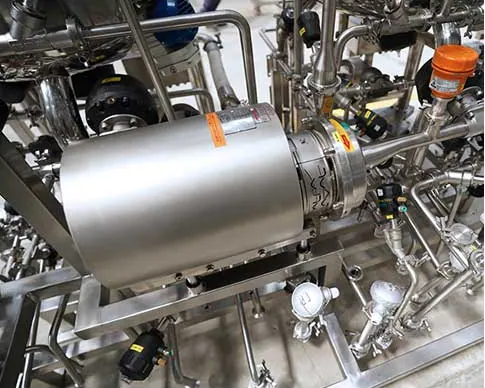
Many drugs are manufactured in a multi-product facility, in different dosage forms. This involves the use of potent APIs (active pharmaceutical ingredients that act at very small doses).
So we must take special precautions to prevent product-to-product carryover, which is when traces of one product get into the next. Clean-in-Place (CIP) systems are one of the most effective methods to avoid cross-contamination.
However, planning CIP systems into the designing stage of the facility is still not a priority. This is an expensive mistake.
A CIP station added later to a plant that was laid out without one must work with every pipe run and every slope the plant already has. A retrofit cannot change those two things.
The list of design elements below has five more.
CIP in pharmaceutical industries uses the same four cleaning factors as CIP in a food or dairy plant. The difference is the acceptance standard.
In a pharmaceutical plant, the cycle is written to cGMP (current Good Manufacturing Practice) and proved by cleaning validation. The equipment that the station serves is in the process equipment range.
For how SIP works as an operation, cycle by cycle, read the SIP systems guide.
How a CIP cycle is designed
An effective CIP system design considers all the parameters of Sinner's Circle for cleaning.
Critical setups must also consider one more parameter, coverage.
Sinner's Circle is the standard model of cleaning. It has four factors: time, mechanical action, chemistry and temperature.
If you reduce one factor, another must increase. So cleaning for longer is not a design on its own.
A faster CIP cycle is also not automatically a worse one.
Cleaning time
Many people think that more cleaning time gives better cleaning, and there is truth in this. However, the purpose of CIP systems is to give the most effective cleaning in the shortest possible cycle time.
Right-sizing of pumps and CP paths & spray devices, which means choosing the correct size for each, plays an essential role.
Rigorous cleaning validations can help to develop and optimise the cycle during the qualification stage. Qualification is the set of formal tests that prove the equipment works as specified.
Action
A thorough understanding of the type of residue is essential for designing the CIP process. The higher the viscosity of the product (the thicker it is), the deeper the cleaning should be.
Choose the spray balls and the flow velocity to match, using the pressure available, and keep the flow turbulent. ASME BPE ® recommends having flowrates of 1.5 m/sec inside the tube.
ASME BPE is the bioprocessing equipment standard of the American Society of Mechanical Engineers.
Put this figure in your User Requirement Specification (URS), the document that lists what you need from the equipment. CIP flow velocity is what produces turbulent flow in the pipe.
In turbulent flow, the liquid swirls and mixes as it moves. This is the mechanical action that cleans the pipework.
Below this velocity, the liquid slides along the pipe wall. Its force on the wall is too low to clean it reliably.
Coverage of surface
Spray devices spread the CIP fluid over the inner surface of the equipment to wash and rinse it. Spray balls, spray nozzles and lances are all spray devices.
A spray device may give good coverage, but it may not hit all areas with the same force. Spray devices are available in various designs: static, or dynamic (single and multi-axis).
A static spray ball does not move. A dynamic one turns while it sprays.
ASME BPE® guidelines recommend 31-37lpm/m of circumference for static spray balls. For dynamic spray balls, they recommend 16-28 lpm/m in circumference.
The operating pressure at the spray ball is between 2 Bar-5 Bar (based on spray ball model). Coverage can be confirmed by performing a riboflavin test.
Here, lpm/m means litres per minute for each metre of vessel circumference. In a riboflavin test, the inside of the vessel is coated with riboflavin, a vitamin that glows under UV light.
Any area that still glows after spraying was not reached.
Chemical concentration
Chemicals/detergents are selected based on the cleaning requirements. The right choice helps clean effectively and reduces the CIP cycle time.
When choosing the CIP detergents, check that they are compatible with the product and with the equipment MOC (material of construction). The detergent concentration must be validated, because unscientific methods or a rule of thumb may lead to under cleaning or to overdosing of chemicals.
Temperature
The temperature for CIP systems will vary for different cleaning cycles. Initial rinsing cycles may be performed at ambient (room) temperature.
Optimisation of the temperature ranges keeps energy losses (due to overheating) and cavitation of pumps (due to high temperature) to a minimum. It also takes into account the nature of the detergent (exothermic, eg.
Caustic). An exothermic detergent gives off heat when it mixes or reacts.
Cavitation is when vapour bubbles form and collapse inside a pump, which can damage it.
The CIP cycle, step by step
A clean-in-place cycle is a fixed sequence of steps.
Agree this sequence before the skid is sized, because the number of stages decides how many tanks, pumps and valves the station needs. The CIP process meaning is exactly that: a written, repeatable procedure rather than a cleaning method.
The CIP and SIP procedure below is the one most pharmaceutical plants run.
The five steps of CIP, in the order they run:
Pre-rinse. Water flushes most of the product residue out to drain. This way the detergent is not used up on material that plain water can remove.
Caustic wash. The station pumps a heated alkaline detergent (caustic) around the circuit. It breaks down proteins, fats and organic soil. The flow velocity, spray coverage, temperature and concentration described above are specified for this step and for the acid wash after it.
Intermediate rinse. Water pushes out the caustic and the soil dissolved in it. This stops the caustic from neutralising the acid that comes next.
Acid wash. Acid is pumped around the circuit. It removes mineral scale (hard deposits left by water) and neutralises any caustic left in the circuit. For some products or some water qualities, this stage is left out. The cycle then has fewer than five steps.
Final rinse. Purified water, WFI (water for injection) or another specified grade of water rinses the circuit. The rinse continues until the returning water meets a defined acceptance criterion. This is usually a conductivity or TOC (total organic carbon) limit.
A seven-step CIP process is the same sequence with the rinses counted separately. Or it is the same sequence with a sanitisation stage and a blow-down or drain step added at the end.
A blow-down uses air to push out the last liquid. Neither count is more correct than the other.
What matters is that the recipe is written down, validated and run the same way every time.
CIP in water treatment uses the same idea on the water system itself, instead of on process equipment. A loop is the ring of pipe that carries water around the plant.
A purified water or WFI loop is sanitised in place on a cycle of its own. Reverse-osmosis membranes are cleaned in place with their own chemicals.
These are different from the caustic and acid used on a vessel. Fabtech supplies both the CIP station and the water loop it draws from, so the two are specified together.
The loops are on Solutions for Water.
Where SIP begins. Sterilise-in-place starts after the final rinse, on a circuit that is already clean.
Pure steam pushes the air out of the circuit. The circuit is held at temperature for a defined exposure time.
Then it is cooled and kept under sterile air or nitrogen. If the circuit was not properly cleaned first, a SIP cycle will sterilise the soil (the product residue) in place.
This is why CIP and SIP are specified together, and why the station does both.
CIP stands for clean-in-place. SIP stands for sterilise-in-place, sometimes written sterilization-in-place.
Both names say the same thing: the equipment does not need to be taken apart.
What is dosed. Dosing means adding a measured amount of chemical.
The caustic step normally uses sodium hydroxide. The acid step normally uses nitric or phosphoric acid.
The residue sets the concentrations, and they are validated, not assumed. The acid/alkali dosing option in the specification below lets a station run both steps.
Design elements that decide whether a system cleans
Our CIP systems include the following design elements, which give the best cleaning outcomes:
Crevice & corner free equipment including pipes and fittings
The surface finish of < 0.4 µm Ra electro-polished for product contact parts
Dead legs should be avoided or minimised with L/D of 2:1
Maintaining slope and preventing sagging of pipes & hoses
Completely drainable system
Maintaining adequate flowrate inside the tube
Use and optimisation of correct CIP cycle sequence through automation and robust SOP's
Each of these is a decision about the piping rather than the skid. This is why ASME BPE piping design and clean-in-place must be planned together.
A dead leg is a branch of pipe with a closed end, where liquid can stay. A dead leg longer than two pipe diameters holds fluid that the flow does not reach.
A sagging hose holds fluid after the drain. A better pump does not fix either problem.
Investing in robust systems with inefficient CIP/SIP equipment's will only hamper the plant operations and efficiency.
CIP and SIP station specifications
The systems give reduced downtime and higher productivity, because cleaning time is reduced.
The design meets GMP norms and is compliant with USFDA 21 CFR part 11 and GAMP 5. 21 CFR Part 11 is the US FDA rule for electronic records and signatures.
GAMP 5 is the industry guide for validating automated systems.
- Customisable configuration
- Tankless space saving option
- All contact parts electropolished to less than 0.4 RA microns
- High quality orbital welding with boroscopy and videoscopy
- Dosing tanks and pumps
- Acid/alkali dosing option for better cleaning efficiency
- Jacketed/non jacketed tanks
- Interconnected piping and valves
- Instrumentation and control panels
- Elaborate document dossiers including DQ, FAT Protocols, IQ, OQ to support validation
- Cleanroom Factory Acceptance Test facilities available
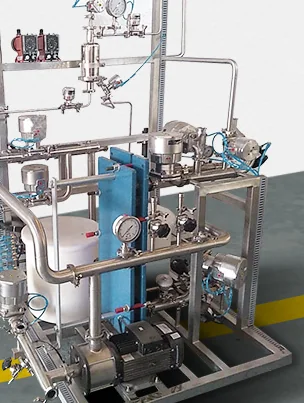
Skids come in various customisable configurations, such as a single CIP tank system or a multiple CIP tanks system. A single-tank station suits one cleaning recipe.
With multiple tanks, acid, alkali and rinse water can be held and dosed separately. A multi-product facility needs this.
The tankless CIP/SIP system option saves space and can serve a wide range of vessel capacities.
Why Fabtech CIP systems
We supply a complete CIP/SIP solution.
It covers the vessels, transfer piping, pumps and filter housings, up to the inlet of the filling machine. It includes validating instruments such as temperature sensors & conductivity sensors.
This boundary matters commercially. Buyers who search for CIP and SIP system manufacturers, or for a CIP SIP system manufacturer for a pharmaceutical plant, are looking for one company that takes responsibility for the cleaned circuit.
Fabtech designs and supplies the station and stays responsible for it.
Fabtech also supplies the vessels, steam and water systems around the station. This changes where the scope stops.
Our scope is typically taken to the filling machine inlet. So on most projects, no interface between two suppliers sits inside the cleaned circuit.
- Working with the right professionals. Our Life Engineers understand how contamination can harm pharmaceutical or drug manufacturing.
- The choicest design and technology. Our Life Engineers give you the ideal system to produce the outcomes you want.
- Review, evaluate and choose the expert for your CIP/SIP supply. We combine our technical expertise, business know-how and experience to supply you CIP/SIP systems that best suit your process.
- Training on plant operations before the handover of the systems.
- After-sales support for periodic plant maintenance.
- Global references for Installed plants
We supply the process vessels that the station cleans. We also supply the pure steam system that sterilises them and the purified water system that rinses them.
So one supplier is responsible for the whole circuit.
Documentation and qualification
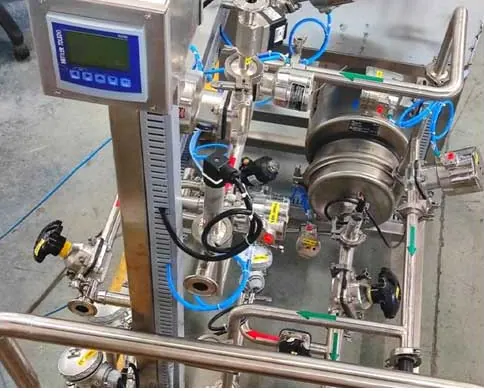
Systems are supplied with elaborate document dossiers to support validation of the equipment.
The dossiers include:
- DQ (design qualification) shows that the design meets your requirements.
- FAT Protocols describe the factory acceptance tests run before the system is shipped.
- IQ (installation qualification) checks that the system is installed correctly.
- OQ (operational qualification) checks that the system works as specified.
Cleaning validation is a separate exercise from equipment qualification. The equipment decides whether cleaning validation is cheap or expensive.
A CIP cycle that is reproducible, logged and instrumented gives a validation team data to work from. A cycle that is not gives them a programme of swabbing, which means taking many manual samples from surfaces.
Data like that is typically what shortens a validation programme.
The equipment sequence is on equipment qualification. Where the station is part of a whole plant, a turnkey pharmaceutical project includes it with the water, air and process scope.
FAQ
What is CIP in the pharmaceutical industry?
CIP means clean-in-place. It cleans product contact surfaces without disassembling the equipment. These surfaces include vessels, interconnecting process piping, pumps and filtration skids. CIP reduces cleaning cycle time. More importantly, it makes the result reproducible enough to validate.
What is the difference between CIP and SIP?
CIP cleans and SIP sterilises. Clean-in-place removes product residue and cleaning chemicals. Sterilise-in-place then sterilises the cleaned circuit, usually with pure steam. Most pharmaceutical stations do both, in that order.
What flow velocity does a CIP system need?
ASME BPE recommends a flow rate of 1.5 m/sec inside the tube. Velocity is what produces turbulent flow, where the liquid swirls as it moves. Turbulent flow is the mechanical action that cleans the pipework.
How is spray coverage checked?
Spray coverage is checked with a riboflavin test. ASME BPE guidelines recommend 31 to 37 lpm per metre of circumference for static spray balls. For dynamic ones, they recommend 16 to 28 lpm/m. Operating pressure at the spray ball is 2 to 5 Bar, depending on the model.
What are the 5 steps of CIP?
The five steps are pre-rinse, caustic wash, intermediate rinse, acid wash and final rinse. A seven-step process is the same sequence with the rinses counted separately, or with a sanitisation and drain stage added. The acid step is sometimes left out, depending on the product and the water.
What do CIP and SIP stand for?
CIP stands for clean-in-place and SIP for sterilise-in-place. Both mean cleaning or sterilising process equipment without taking it apart. This is what makes the result reproducible enough to validate.
How is a CIP cycle time decided?
By the four factors of Sinner's Circle, plus coverage. The four factors are time, mechanical action, chemistry and temperature. If one goes down, another must go up. So a shorter cycle is not a weaker one if the other three are right. The cycle is developed and optimised during qualification.
What makes equipment cleanable in the first place?
The piping, rather than the skid. Fittings must be crevice and corner free. Product contact surfaces are electropolished below 0.4 µm Ra. Dead legs are avoided or held to an L/D of 2:1. The slope is maintained, with no sagging hoses, and the system is completely drainable.
Are the systems 21 CFR Part 11 compliant?
Yes. The design meets GMP norms and is compliant with USFDA 21 CFR Part 11 and GAMP 5. Systems are supplied with a documentation dossier that supports validation.
Send your vessel list and residue type to specify a station
We reply within 24 hours.