Process vessels

Fabtech's skid mounted Process Vessels are available in a wide range of volume capacities to manufacture sterile and contamination free injectable drugs.

All contact parts are electropolished to less than 0.4 RA microns. The most important part of a pharmaceutical process vessel is its inside surface. That surface must be easy to clean, drain fully and sterilise to a validated standard. The volume, the agitator and the platform are designed around it.

We reply within 24 hours.

Key fact Detail

Finish of all contact parts, electropolished
Less than 0.4 RA microns
Regulations the designs meet
USFDA, WHO and MHRA
Field piping, fully drainable
ASME BPE grade
Compliance with SCADA, on automatic and semi-automatic variants
21 CFR Part 11
Documents supplied to support validation
DQ, FAT, IQ and OQ

Pharmaceutical process vessels we supply for sterile manufacturing

Our systems are flexible and can be seamlessly integrated with process equipment, instrumentation, clean and unclean utilities. The designs meet USFDA, WHO, MHRA regulations as well as ASME BPE, ISPE, cGMP guidelines.

Sterile manufacturing vessels hold the product when it is most exposed. In injectable manufacturing, this is the compounding and holding step before filling.

Compounding means mixing the ingredients into the product. Some lines have no sterilising-grade filter between the vessel and the filling point.

On those lines, the vessel is typically the last place a contaminant can enter.

This is why a pharmaceutical vessel manufacturing specification is more about the surface than about the tank. The same is true of a processing vessel spec for the pharma industry.

The volume is the easy part.

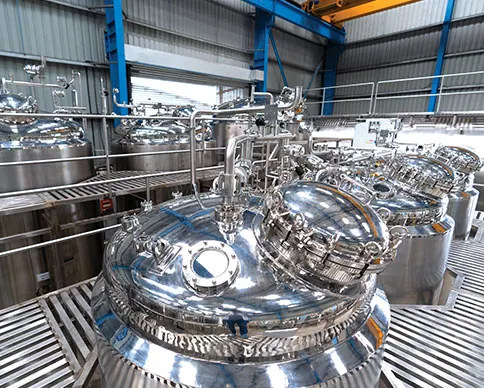
The dished tops of a row of Fabtech process vessels, with manways, sight glasses and nozzles, seen from the platform

The same applies to biopharmaceutical vessel fabrication and to process vessels for biologics manufacturing. Biologics are medicines made using living cells.

They are more sensitive to shear (strong mixing forces) and to temperature. On a sterile processing skid for biologics, the vessel is only part of the design work.

More of it goes into gentle mixing and tight temperature control.

Here, a sterile blending vessel means an agitated liquid mixing vessel, not one of the dry-powder blenders. An agitator is the stirrer inside the vessel.

The sterile blending vessel has the same specification, with an agitator duty added.

Surface finish, welding and drainability

All contact parts electropolished to less than 0.4 RA microns. Electropolished vessels and interconnecting transfer piping internals, valves. High quality orbital welding with boroscopy and videoscopy.

Each of these three points can be checked and proved. Electropolishing uses an electric current to make the metal surface smoother.

Ra is a measure of surface roughness. A surface electropolished below 0.4 µm Ra has far fewer small crevices than an as-welded or mechanically polished finish.

So residue has fewer places to stay.

Orbital welding

In orbital welding, a machine moves the welding head around the pipe. This makes the weld bead the same all the way round.

A hand weld does this far less reliably. Boroscopy and videoscopy are ways to look inside a closed pipe after welding.

So the weld quality is shown by evidence, not assumed.
Dead legs

ASME BPE grade field piping with insulation, fully drainable and integrated with zero dead leg valves, instruments, pendants.

A dead leg is a closed branch of pipe where liquid can stay still. In the line above, "zero dead leg" describes the valve type.

For the piping, the standard does not remove dead legs completely. It limits them by a ratio of length to diameter (L/D).

The working figure is an L/D of 2:1.

A vessel that cannot be fully drained cannot be cleaned to the same result every time.

This is why drainability and the CIP station that serves the vessel are planned together, not one after the other. CIP means clean-in-place: the vessel is cleaned without taking it apart.

Process vessel specifications

  • Customisable configuration.
  • Auto heating and cooling arrangements based on process requirements.
  • Skid based solutions which are simple and space saving.
  • Ergonomically designed support equipment including structural platforms and ladders for easy access.
  • Insulated for sterilisation temperatures with a host of inbuilt safety features.
  • All contact parts electropolished to less than 0.4 RA microns.
  • Electropolished vessels and interconnecting transfer piping internals, valves.
  • High quality orbital welding with boroscopy and videoscopy.
  • Automatic/semi-automatic variants with 21 CFR Part 11 compliance with SCADA.
  • ASME BPE grade field piping with insulation, fully drainable and integrated with zero dead leg valves, instruments, pendants.
  • Elaborate document dossiers including DQ, FAT Protocols, IQ, OQ to support validation.

Commercially, skid mounting is the line in this list that matters. A skid is a frame that carries the vessel and its equipment as one unit.

A skid is typically built and tested in a workshop before despatch. It arrives on site as one assembly.

On site, it is connected, not built. This moves the difficult welding away from the site and into a workshop, where the welds can be checked.

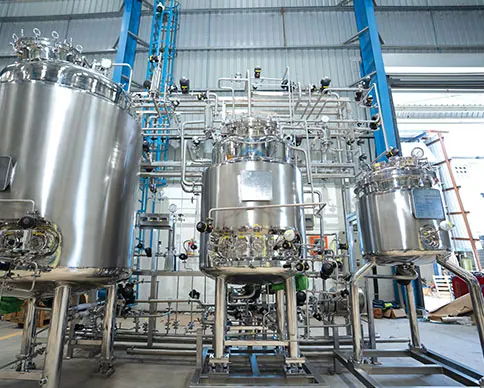
Three jacketed process vessels on their skids, connected by orbitally welded piping and valves

Heating, cooling and sterilisation

Auto heating and cooling arrangements based on process requirements. Insulated for sterilisation temperatures with a host of inbuilt safety features.

Some vessels are sterilised in place, which means without taking them apart. Such a vessel must stand the high heat and the repeated heating and cooling.

The jacket is a second wall around the vessel that heats or cools it. The same jacket that heats the product during the process usually also heats the empty vessel to sterilisation temperature and holds it there.

Insulation is as important for the operator and for energy cost as it is for the process.

The circuit is the vessel and its pipes. Pure steam sterilises the circuit.

The circuit is rinsed with purified water and WFI. The same water is also used to make up the batch in it.

WFI means water for injection.

Documentation and qualification

Elaborate document dossiers including DQ, FAT Protocols, IQ, OQ to support validation.

  • A vessel skid is handed over against a full document file, which is more than a delivery note.
  • Qualification is the written proof that the equipment is right for its job.
  • The file starts with the design qualification.
  • Next is the factory acceptance test (FAT), before the skid is despatched.
  • Then come installation and operational qualification at your plant.
  • The full sequence is on equipment qualification.

Buyers who search for a sterile vessel manufacturer, or a sterile filling vessels manufacturer, are looking for one company that takes responsibility for the vessel skid. Fabtech designs and supplies the skid as one scope.

So the surface specification, the piping and the control system are designed together.

The rest of the water and utility range is on Solutions for Water. The process machines that the vessels feed are on process equipment.

Sometimes the vessels are part of a whole plant. Then they are included in a turnkey pharmaceutical project, together with the rooms, the air and the water.

FAQ

What is a process vessel in pharmaceutical manufacturing?

It is a vessel in which the product is compounded, mixed or held during manufacture. Its product contact surfaces are built so that they can be cleaned, drained and sterilised to a validated standard. In sterile and injectable manufacturing, it is the last point at which the product is open.

What surface finish do the vessels have?

All contact parts are electropolished to less than 0.4 RA microns. This includes the internals of the interconnecting transfer piping and the valves.

How are the welds checked?

By boroscopy and videoscopy. These are ways to look inside the closed pipe. The welds are made by orbital welding, which gives a consistent bead all the way round. The inside of the pipe is then inspected visually, so the weld is not assumed to be sound.

What does "zero dead leg" mean here?

It describes the valve type. On the piping side, the standard does not remove dead legs completely. It limits them by an L/D ratio (length to diameter). So the two are specified separately: zero dead leg valves, and piping held within the ratio.

Are the vessels supplied as skids?

Yes. Skid based solutions are simple and space saving. A skid is typically built and tested in a workshop as one assembly before despatch. On site, it is connected, not built.

Which standards do they meet?

The designs meet USFDA (United States), WHO and MHRA (United Kingdom) regulations as well as ASME BPE, ISPE and cGMP guidelines. Automatic and semi-automatic variants have 21 CFR Part 11 compliance through SCADA. SCADA is the computer system that controls and records the process.

Send us your volumes and product, and we will plan a vessel skid

We reply within 24 hours.