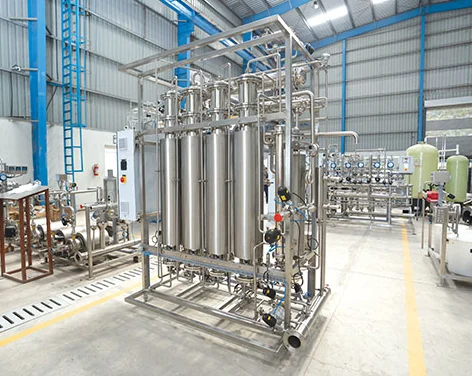
Water For Injections: WFI Generation Systems

Fabtech designs and supplies WFI generation systems that make the water by multi-column distillation and can give pure steam from the same still. Water for injection (WFI) is the water that goes into injected medicines.

If your product is injected, the water in it must be free of the fragments that bacteria leave behind. These fragments cause fever in patients.

We reply within 24 hours.

WFI is the most tightly controlled water a plant makes. The system that makes it is the first one an inspector will ask about.

We also supply the hot storage and distribution loops. These loops keep the water safe until it reaches the filling line.

Each system comes on its own skids (steel frames that carry the equipment). Fabtech engineers install it, and we qualify it with your team.

Key fact Detail

How the still makes WFI
Multi-column distillation
Where the pure steam comes from
The first column of the same still
Regulators whose expectations the systems meet
USFDA, WHO and MHRA

The water for injection systems we supply

Fabtech supplies these systems on standard skids, or on reduced skids for a smaller footprint, and they meet USFDA, WHO and MHRA expectations.

Water for injection (WFI) is purified water that has been distilled, or treated in another way, to remove bacterial endotoxins, dissolved solids and microorganisms. Endotoxins are the fever-causing fragments that bacteria leave behind.

WFI is used to make injectable medicines. It is also used to rinse and clean the equipment and containers that touch them.

The pharmacopoeias are the official books of quality standards for medicines. WFI must meet their limits for conductivity, organic carbon, microbial count and endotoxin.

It must meet them at every point of use, every day.

WFI starts as purified water. The WFI generation step removes what purification cannot remove.

Our beginner's guide to purified water generation systems explains the whole chain from raw water to purified water. The purified water skid that feeds the still (the distillation unit) is on our purified water generation systems page.

Fabtech supplies that skid too. Buyers who search for a purified water generation system manufacturer will find it there.

What Fabtech's WFI generation system delivers

Fabtech's WFI generation systems produce pyrogen-free water, which means water free of substances that cause fever.

The water is designed to meet the endotoxin limit of 0.25 EU/mL in the WFI monograph (the official WFI standard).

The water is stored in a system that circulates all the time. It is typically held at 80 to 85 degrees Celsius to prevent microbial growth.

This is the industry practice for hot WFI loops. The feed is purified water from the plant's PW (purified water) system.

The systems meet USFDA (United States), WHO and MHRA (United Kingdom) expectations. They follow ASME BPE, ISPE and cGMP guidance.

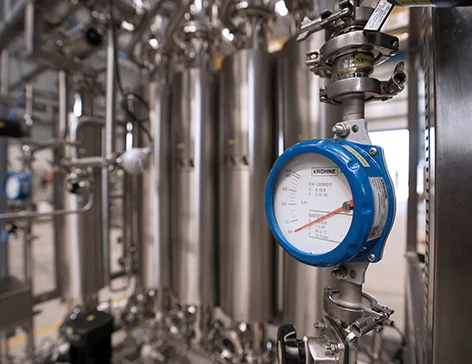
The polished columns of a multi-column still close up, a flow meter on the line in front of them
What you getDetail
Generation
Multi-column distillation unit (MCD) with distribution systems; falling-film working principle; energy-saving design
Loop hygiene
Inbuilt sanitisation mode for maintaining the loop under sterile conditions
Combi option
Pure steam generation from the first still outlet of the WFI generator, saving space and a second unit
Automation
Automatic or semi-automatic variants, generally supplied with 21 CFR Part 11 capable SCADA; exact platform
Skid formats
Standard skids for optimum performance, or reduced skids for minimum footprint
Fabrication
High quality orbital welding with boroscopy and videoscopy; ASME BPE grade field piping with insulation, fully drainable, zero dead leg valves, instruments and pendants
Documentation
Design qualification, FAT protocols, IQ and OQ protocols and reports to support your validation

How a WFI generation system works

Distillation turns liquid water into vapour and then back into liquid.

When purified water is boiled, the vapour leaves behind residual ions, particulates, colloids, non-volatile organic compounds and bacterial endotoxins. The still then condenses the vapour, and the result is water for injection.

A multi-column distillation unit, also called a WFI distiller, does this in stages. The heat from one column drives the next column, so the energy cost per litre falls.

In Fabtech's stills, the purified water flows down heated columns as a thin falling film. The thin film heats quickly.

It also lets the still separate the vapour cleanly from any droplets that could carry endotoxin over. The first column can also supply pure steam.

The WFI working principle is simple. The important engineering is in the droplet separation and the non-condensable gas removal.

Non-condensable gases, such as air, do not turn back into liquid. The rest is in how the distillate (the condensed water) is kept hot and moving afterwards.
Generation technologies compared

The pharmacopoeias now allow more than one way to make WFI.

The right choice depends on your product, the energy available on site and the regulators you expect to inspect the plant.

Multi-column distillation (Fabtech standard)

How it works
Purified water distilled through several columns in series, condensed as hot WFI
Where it fits
Injectables and biologics plants that want hot WFI and pure steam from one unit; accepted by every pharmacopoeia
Points to weigh
Plant steam and cooling water required; reliable, well understood by inspectors

Vapour compression distillation

How it works
Single-effect still with a compressor recycling the vapour's heat
Where it fits
Sites with electrical power but limited plant steam
Points to weigh
Uses electrical energy rather than plant steam; compressor maintenance

Membrane-based, "cold WFI"

How it works
Reverse osmosis, EDI (electrodeionisation) and ultrafiltration without distillation; permitted by the European Pharmacopoeia (EP) since 2017
Where it fits
Sites focused on energy saving, with a strong microbial control strategy
Points to weigh
Ambient loops need more intensive monitoring and sanitisation; not every regulator is equally familiar

Cold WFI generation and membrane-based WFI generation are real options today. Cold WFI is made with membranes, without distillation.

Fabtech's standard is still multi-column distillation. It delivers hot WFI and is accepted everywhere.

It also gives the plant pure steam from the same unit.

The energy figures show the difference. A single-effect still needs roughly 1.1 kg of plant steam per kg of WFI.

A still with four to six columns typically needs around 0.2 to 0.3 kg. If a site's steam costs or floor space really favour another technology, we scope it case by case.

Storage and distribution: keeping WFI safe until it is used

A still can meet its limits on the day of the FAT (factory acceptance test).

That does not prove the loop will meet them a year later. Rouging, dead legs and a slow return velocity are what put WFI out of limits.

Rouging is a reddish film that can form on stainless steel. Dead legs are pipe branches where water stands still.

Return velocity is the speed of the water flowing back to the tank. So Fabtech designs the storage tank, the distribution loop, the pumps, the heat exchanger and the point-of-use valves with the same care as the still.

Fabtech supplies the WFI storage tank, the distribution skid and the loop as part of the system. The tank and loop are typically held at 80 to 85 degrees Celsius.

The return velocity is high enough to keep the inside of the pipe wall clean. There are no dead legs where water can stand.

The design specifies the distribution pumps, the heat exchanger and the WFI samplers. The heat exchanger cools the water for any point of use that needs cooler water.

We size the storage volume and loop flow to your peak demand and your cleaning schedules rather than to a catalogue number.

Fabtech can also supply a WFI distribution skid on its own. This is for a plant that already has a still but has problems with its loop.

Point of use WFI is delivered through sanitary diaphragm valves. Each valve is identified in the loop layout and in the qualification protocol.

Applications

Injectable manufacturing

Vial, ampoule, prefilled syringe and cartridge lines use WFI as the base of the product and for final rinsing. We size WFI production to the filling line's demand profile, including the peaks during cleaning. So the still and the loop never run short on a changeover day, when the line changes from one product to the next.

Biologics and vaccine facilities

WFI and clean steam systems for biotech facilities handle large volumes of buffer and media. They also need tight endotoxin control. A WFI skid for biologics is often paired with a pure steam generator on the same skid. The facility's sterilisation steam then comes from the same qualified source.

Medical and healthcare

WFI for medical products, hospital pharmacies and sterile compounding units is delivered at smaller capacities. The documentation is just as complete.

Ophthalmic, parenteral nutrition and API

When the product or the final API (active pharmaceutical ingredient) is sterile, WFI is specified for the process and for cleaning.

Installation, qualification and handover

Qualification is the documented proof that the system works as designed.

A WFI system is qualified as one system, with the still and the loop together. It is not qualified as a still with some pipework attached.

Fabtech installs the skid, welds and documents the loop, and runs the qualification with your team.

Because the still and the loop are qualified together, turnkey WFI systems with installation and qualification are our normal scope. Turnkey means one supplier delivers the complete working system.

We quote it as one job rather than as a series of extras.

  1. StageDeliverable
  2. Design

    URS review, the P&ID for the still and its hot loop, storage sizing from the filling schedule, all folded into the design qualification

  3. Factory

    Still and distribution skid built and steam-tested; factory acceptance test protocol and report; a WFI generation system datasheet in PDF for your project file

  4. Site

    Skid set, loop welded and boroscoped, passivated, then the hot loop proven to hold temperature at the farthest point

  5. Qualification

    IQ, OQ and PQ: protocols and reports, with endotoxin and microbial sampling at every point of use and performance qualification planned across the seasons

  6. Handover

    Operating and sanitisation procedures, operator training, the complete dossier

Our guide to validating high purity water systems explains what inspectors look for once the system is running. When the WFI system is part of a new sterile block, Fabtech delivers it inside the turnkey pharmaceutical project.

Its utilities and documents then match the rest of the plant.

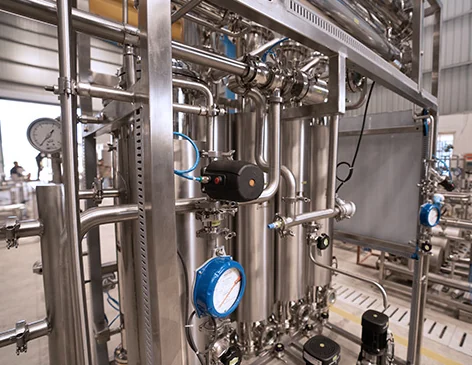
The sanitary piping, valves and flow meter between the columns of a WFI still, with the distribution pumps below

Why buy the WFI system from the manufacturer

A WFI system usually fails an inspection at the loop rather than at the still.

So ask water for injection system manufacturers who is responsible for the water at the point of use. That includes the loop that carries the water there.

A water for injection plant is judged the same way, whether it is called a WFI system or a WFI plant. In the pharmaceutical industry, a WFI system is judged on the design, the build, the installation and the qualification together.

Buyers who search for a WFI plant manufacturer are looking for one company that takes responsibility for the whole system. Fabtech designs and supplies the system, installs it and stays responsible for it.

One team is responsible for the water at the point of use. The same team supplies the pure steam generators that share the skid.

It also supplies the purified water systems that feed the WFI system. The full range is on our solutions for water page.

Fabtech delivers WFI systems as part of turnkey projects for injectable and biologics plants in international markets.

A four-column water for injection still on its skid, the condenser at the end of the row

FAQ

What is WFI?

Water for injection is purified water that has been distilled or treated in another way. This removes bacterial endotoxins, dissolved solids and microorganisms. WFI is used to make injectable medicines. It is also used to rinse and clean the equipment and containers that touch them. It must meet pharmacopoeial limits at every point of use.

What is the working principle of a WFI generation system?

The working principle is multi-column distillation. Purified water flows as a thin falling film down heated columns and boils. The still separates the vapour from droplets that could carry endotoxin. It then condenses the vapour as hot water for injection. Several columns in series reuse the heat, which cuts the energy cost per litre.

What temperature is WFI stored at, and why?

WFI is typically stored at 80 to 85 degrees Celsius and circulates all the time. The heat keeps microbial growth down without adding chemicals. If a process needs cooler water, a point-of-use heat exchanger cools it on demand. The rest of the loop stays hot.

Can pure steam and WFI come from the same unit?

Yes. Fabtech's WFI generation systems make the water by multi-column distillation and can give pure steam from the same still. Fabtech offers this as a combi unit. It generates pure steam from the first still outlet of the WFI generator. It saves floor space and a second qualified unit. Both utilities share one feed and one dossier.

Do you supply the WFI distribution skid and loop, or only the still?

Both. Fabtech designs and supplies the storage tank, distribution pumps, heat exchanger, samplers, loop piping and point-of-use valves with the still. A distribution skid on its own is possible for a plant that already has a still.

How do Fabtech WFI skids compare with WFI skids from China or Europe?

Compare them on the things that decide WFI quality. In the still, these are droplet separation and non-condensable gas removal. In the loop, the water must hold its temperature at the farthest point. A dossier must document both. Fabtech designs to the same pharmacopoeial limits as any European still. We support the system from India.

Is cold or membrane-based WFI acceptable?

The European Pharmacopoeia has allowed non-distillation WFI since 2017, with a strong microbial control strategy. Many plants still choose distillation. It gives hot WFI and pure steam from one unit, and every regulator is familiar with it. Fabtech's standard is multi-column distillation. We would scope an alternative case by case.

What capacity range do you supply?

We size each WFI system to the plant, within the 500 to 50,000 litres per hour range of Fabtech water systems. We size storage and loop capacity separately. They follow the demand profile of the filling lines, which is how much water the lines use and when.

Tell us your WFI demand and your filling lines, and we will size the still

There is no obligation. You get a proposed capacity, a loop concept and a budget price from the team that would design and supply it.

We reply within 24 hours.