Mist Shower
Fabtech supplies mist showers for pharma exit airlocks, with jets faster than 20 metres per second. They wet the particles on your clothes, where an air shower only blows them off.
Wet particles cannot rise into the air again as you walk out of the room. This difference tells you which one to fit at your exit airlock.
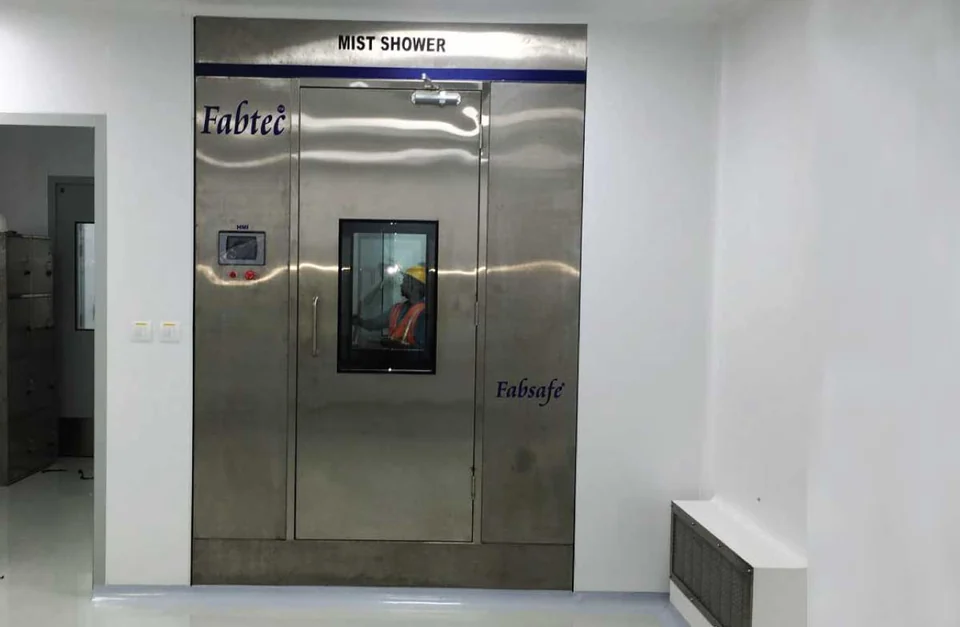
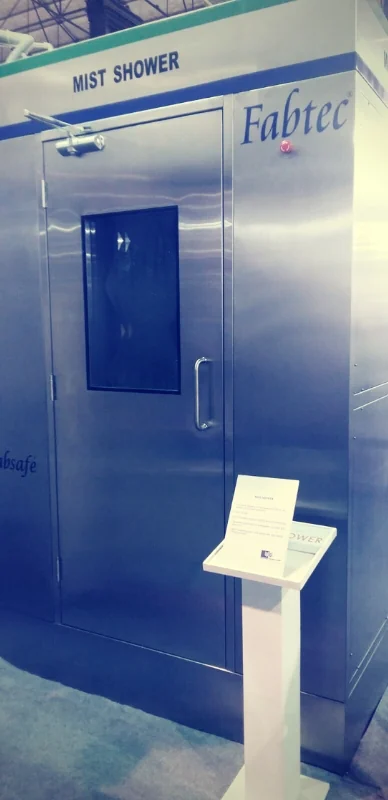
A mist shower is built into the exit airlock of the production area. It reduces cross-contamination within the facility.
The mist removes loose particles sticking to clothing. The particles are then collected in a customised container.
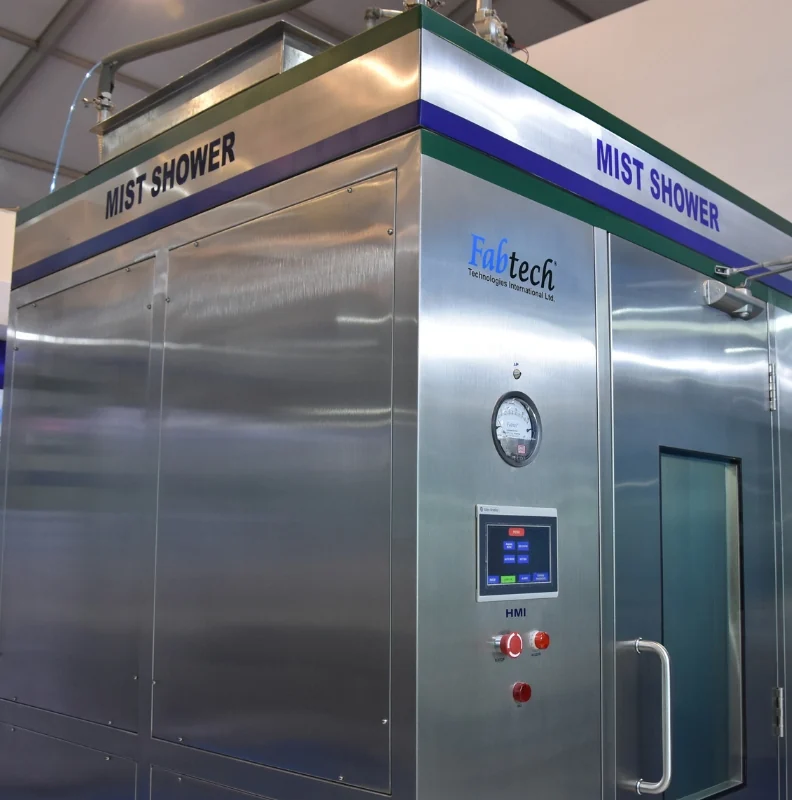
Contaminated water flows to the kill tank and ETP (effluent treatment plant) through a closed-loop system. Proper ventilation is provided.
The system is available in non-flameproof and flameproof execution. We customise the design to your application and your layout.
We reply within 24 hours.
On this page
Mist shower or air shower
Choose an air shower if the risk is carrying dust into a clean space.
Choose a mist shower if the risk is carrying an active compound out on a gown. Dry air would blow the potent powder off the suit and straight back into the room.
Key fact Detail
- Shower jets
- Faster than 20 m/s
- Construction
- SS 304, SS 316 or CRCA
- Filter
- H14 or H13 HEPA
- Control
- PLC, with customised cycles
- Execution
- Flameproof or non-flameproof
| Air shower | Mist shower | |
|---|---|---|
| How it works | Dry, high-velocity jets of HEPA-filtered air knock particles off | A fine fog wets the particles and holds them down |
| Where it sits | Usually at the entry to a classified (controlled clean) area | Usually at the exit, on the dirty side |
| What it suits | General cleaning of cleanroom garments | Potent compounds, powders, and anything that must not go back into the air |
| Effluent (waste water) | None. Particles go to the filters | Contaminated water goes to a kill tank and ETP |
| Added chemicals | Not applicable | Possible, to neutralise (make harmless) specific compounds |
Specifications
The specifications and options are listed below.
- Material of construction: powder-coated SS 304, SS 316 or CRCA
- HEPA filtration to H14 or H13. The filters stop particles. They do not stop gases or vapours
- High-velocity shower jets in excess of 20 m/s for efficient scrubbing action to remove particulates
- PLC-based control system with cycles customised to the requirement
- Two-stage filtration at supply, safe change at exhaust
- LED concealed lighting delivering in excess of 400 LUX
- Available in non-flameproof and flameproof execution
- Options: dedicated skid-mounted customised water system, combination air-plus-mist shower, PPE disposal, and modular construction for retrofitting to existing systems
Where the water goes
Everything the shower removes ends up in the water.
So the shower is not only clean-air equipment. It is also the start of an effluent (waste water) route.
Contaminated water goes to a kill tank and then to the effluent treatment plant through a closed loop. Nothing that came off a garment reaches a drain untreated.
If the compound needs it, chemicals can be added to the mist. They neutralise the compound as well as washing it off.
Plan the water route at the layout stage. On a retrofit (adding the shower to an existing plant), the most common problem is that there is nowhere for the water to go.
The shower itself is not the problem.
Where a mist shower belongs
This shower belongs at the exit from a production area that handles potent or dusty material.
It sits in the airlock, before the gown comes off. The clean side of that boundary is usually where the laminar airflow equipment sits: the LAF units and LAF workbenches.
This is why the shower and the LAF equipment get specified together.
Mist showers are common in high-potency API handling and in oncology and hormone suites. They are also common anywhere an occupational exposure limit drives the design, not product protection alone.
An occupational exposure limit (OEL) is the most of a substance a worker may be exposed to.
For the containment inside those rooms, see the pharmaceutical isolators range and our guide to OELs.
For a cleanroom project in India, contact Fabtech Cleanrooms, the group's cleanroom company. Its full name is Fabtech Technologies Cleanrooms Ltd.
It is a separate and separately listed group company.
FAQ
What is a mist shower, and how does it work in a cleanroom?
A mist or fog shower sprays a fine fog. The fog encapsulates (wets and holds) surface particles, which helps remove them. With the right chemicals added, it can also neutralise hazardous powders. Fabtech supplies mist showers with shower jets faster than 20 m/s, which scrub the particles off.
How does a mist shower compare with an air shower?
An air shower uses dry, high-velocity filtered jets to knock particles off. A mist shower uses fog to encapsulate particles or neutralise them. This is why it suits the exit from a potent area, and not the entry to a clean one.
What contaminants can a mist shower remove?
Loose particulates, powders and some surface contaminants. With added chemicals, it can also neutralise specific compounds, as well as washing them off.
Which industries benefit from mist showers beyond pharma?
Biotech, chemical manufacturing and high-potency API handling. Fabtech supplies them for pharma, biopharma and healthcare projects.
Where does the contaminated water go?
It goes to a kill tank and then to the effluent treatment plant through a closed-loop system. Nothing reaches a drain untreated.
Can it be retrofitted to an existing facility?
Yes. The modular construction is designed for retrofitting. A combination air-plus-mist unit is also available when you need both in the same floor space.
Is there a flameproof version?
Yes. The system comes in non-flameproof and flameproof execution. This matters wherever solvent is present.
Tell us what you handle and where your exit airlock is, and we will specify the shower
We reply within 24 hours.