Supply HEPA filter
First, the jets must hit the person with clean air. If not, the shower puts as many particles on the person as it takes off.
Fabtech supplies air showers for cleanroom entry, in SS 304 or SS 316 stainless steel. An air shower is the last step before a person walks into a cleanroom.
It removes the particles that clothing sheds on the way to the door.
We reply within 24 hours.
Air showers are specialised enclosed antechambers used to reduce cross-contamination within the facility. An antechamber is a small room in front of the main room.
Depending on the application, they are integrated with the entry or exit airlock system of the production area. The air shower is the part of a facility's clean air technology that people walk through.
Air shower systems are normally specified together with the rest of the clean air equipment. They are rarely specified on their own.
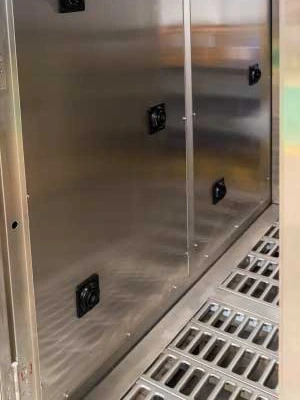
Our air showers use high-velocity HEPA filter jet streams in excess of 20 m/s to dislodge particles, dust, lint and other contaminants from clothing during entry or exit. A HEPA filter is a very fine air filter.
The system is 21 CFR and GMP compliant. A manual or microprocessor-based control system manages the entire cycle.
Key fact Detail
Fabtech supplies each air shower as a small room with two interlocked doors and a set of air nozzles.
A person steps in, and both doors stay locked. Air jets run for a set time, called the cycle.
Then the far door opens.
Its purpose is to remove particles from people and from the portable equipment they carry. This is the one source of contamination that the cleanroom's air handling cannot deal with, because people bring it in through the door.
The HVAC system (heating, ventilation and air conditioning) dilutes the particles already in the room. The air shower reduces the particles that arrive.
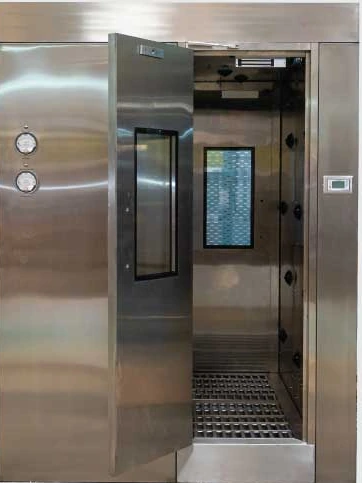
An air shower is not a decontamination step. It does not kill spores, so it is not sporicidal.
It does not replace gowning. Gowning means putting on clean clothes and covers, and it removes what it can. But the walk from the changing room adds some particles back. Clothing sheds particles, however well it was put on. The air shower removes them just before the door. It removes loose particles, and that is exactly the part gowning cannot finish.
Almost every other clean-air product on this site is specified at 0.45 m/s.
That is laminar flow: slow air that moves in one direction and does not disturb anything.
An air shower works in the opposite way. It has to dislodge particles.
The air must hit hard enough to pull each particle off the fibre it sticks to. Ours run in excess of 20 metres per second.
If you are comparing quotations, compare this number. Also compare the number of nozzles and how they are arranged.
High speed at the nozzle does very little if the air does not reach the whole body. So the nozzle layout, and whether the unit blows from both sides, is a design question.
Price does not settle it.
HEPA filtered air is air that has passed through a high-efficiency particulate air filter.
These filters are graded H13 or H14 on the European classification. H14 is the stricter of the two grades.
The air shower needs this clean air in two places.
First, the jets must hit the person with clean air. If not, the shower puts as many particles on the person as it takes off.
Second, the air leaving the chamber must be filtered. If not, the particles just removed are pushed into the corridor.
The air recirculates through the HEPA filters on both paths.
HEPA filters do not capture gases and vapours. A HEPA filter stops particles only.
If the risk is solvent vapour or a gas, an air shower is not the right control. For the same reason, a reactor charging isolator has a scrubber on its exhaust.
A scrubber removes gases from the exhaust air.
HEPA filters are also not washable. Washing a HEPA filter damages the filter material.
It destroys the efficiency the filter is certified to. You replace a HEPA filter, you do not clean it.
The pressure drop across the filter tells you when to replace it. Pressure drop is the difference in air pressure between the two sides of the filter.
The order is fixed, and the air shower is always last: unclassified corridor → change room → gowning → air shower → cleanroom.
If the air shower is placed any earlier, it cleans clothes that people will then handle again.
The air shower is for people. Other routes into the cleanroom handle everything else, and a properly designed entry has all of them:
Three numbers decide the size of an air shower.
Only one of them is about the machine itself.
Door width and swing decide the chamber. Swing is the direction the door opens.
Traffic per hour is the number of people who pass through each hour. It decides whether a single-person unit is enough.
If it is not, you need a tunnel that takes several people or a trolley. Cycle time is the number people underestimate.
At a shift change of forty people, a 20-second cycle creates a queue. When people queue at a cleanroom entrance, they start to skip steps in the procedure.
Indicator lights mounted on both exteriors regulate traffic flow in and out. The lights stop a second person from opening the door during a cycle.
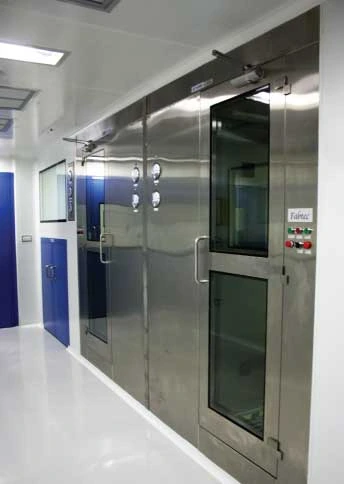
Buyers who search for an air shower manufacturer or an air shower factory are looking for one company that takes responsibility for the unit. Fabtech designs and supplies the air shower and stays responsible for it.
We supply it internationally, as standalone equipment and as part of a turnkey plant. Custom air shower suppliers are common in this market.
A supplier that also engineers the cleanroom the shower opens into is less common.
In the Gulf, MENA (the Middle East and North Africa) and Africa, buyers search for air shower manufacturers and suppliers. Fabtech is an export house and quotes into these markets.
We specify every clean room air shower for the destination's electrical supply, 50 Hz or 60 Hz. Each one ships with documentation in the format the destination regulator expects.
Indian buyers should contact the Fabtech cleanroom company for India for a cleanroom project. It is Fabtech Technologies Cleanrooms Ltd, a separate company that is listed separately.
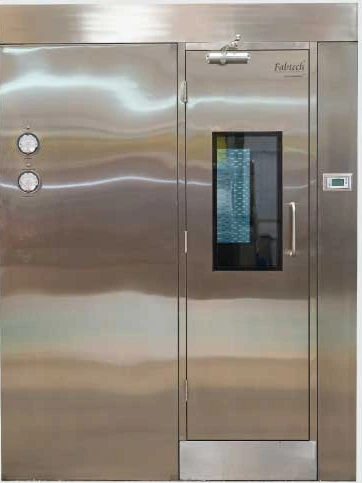
It removes loose particles from people and portable equipment before they enter. It uses high-velocity HEPA-filtered air jets. It deals with the one contamination route that the room's air handling cannot control: particles that people carry in through the door.
Air that has passed through a high-efficiency particulate air filter, rated H13 or H14. In an air shower, both the jets and the chamber exhaust are filtered. So the air that hits the person is clean. The particles removed are captured, not pushed into the corridor.
Much more than a laminar flow unit. Ours run in excess of 20 m/s at the nozzle, because the jets have to pull particles off the fabric. A laminar-flow figure of around 0.45 m/s belongs to a different type of machine. It would remove almost nothing.
No. Washing damages the filter material and destroys the certified efficiency. HEPA filters are replaced based on their condition. The pressure drop across the filter tells you when.
No. It is the step after gowning. It does not replace gowning. It removes loose particles that gowning cannot finish, and the particles added on the walk to the door.
No. It is a device that removes particles. Sporicidal decontamination, which kills spores, is a separate control. Where surface decontamination is required, that is VHP in a pass box or a validated disinfection procedure.
Biotech, chemical manufacturing, high-potency API handling, and any facility where garments or equipment carry a heavy particle load. Fabtech supplies them for pharma, biopharma and healthcare projects.
Long enough to cover the whole person. It should also be short enough that it does not create a queue at shift change. Cycle time is a design decision based on traffic per hour. It is not a fixed number.
Inspect prefilters every one to three months and replace them every three to six. HEPA filters are changed based on pressure drop, typically between six and twenty-four months. Leak-test every six to twelve months. Check fans, nozzles and doors quarterly.
Fabtech is an export house and supplies air showers to international markets only. We specify each unit for the destination's electrical supply and documentation requirements.
Yes. Fabtech supplies air showers in SS 304 or SS 316 stainless steel. We size the chamber to your door and traffic. We can change the nozzle count and arrangement, supply single or multi-person tunnel configurations, and fit manual or microprocessor cycle control.
Send us the door width, the number of people per hour and the destination country. We will specify the air shower
We reply within 24 hours.