Reactor Charging Isolator
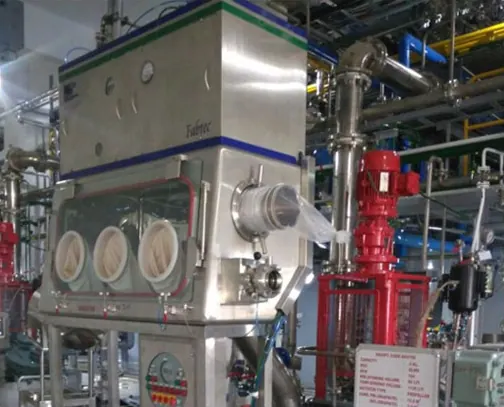
Fabtech supplies a reactor charging isolator in SS 316L that can be retrofitted to your existing reactor. Charging a reactor means loading material into it.
Charging is where a potent powder is most exposed. The drum is open, the manway (the opening on top of the reactor) is open, and an operator stands between the two.
A reactor charging isolator is a sealed enclosure around this step. Inside it, the material goes from its container into the vessel at negative pressure, so it does not reach the room air.
We reply within 24 hours.
Fabtech's reactor charging isolator gives containment for processes that use potent products. Buyers often describe these products by their band, OEB 4 or OEB 5.
OEB (occupational exposure band) is an industry scale for how dangerous a substance is to the people who handle it. OEB 4 and OEB 5 are for very potent substances.
The negative pressure chamber is ergonomically built. It contains the product during processing, and operators reach inside through glove ports.
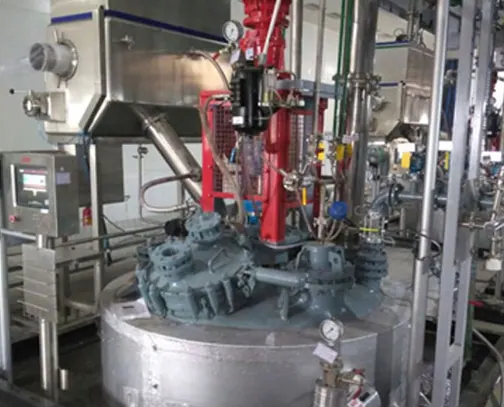
The isolator connects to the charging port to dose potent chemicals into the reactor. Material goes in and out through the pass box or antechamber.
On this page
Key fact Detail
- Chamber material
- SS 316L stainless steel
- Your existing reactor
- Can be retrofitted
- Glove ports in the standard configuration
- 4 on the main chamber, 2 on the pass box
- Inlet air filter
- H14 HEPA
- Exhaust air
- Double HEPA and an inline scrubber
Retrofit to the reactor you already have
The common case is not a new plant.
It is an existing reactor that now needs more containment. This happens when a molecule moves up an OEB band, when an audit finds a problem, or when a new product comes into an old suite.
We can retrofit the isolator to your reactor. Retrofit means we fit the isolator to the reactor you already own.
This matters when you compare quotes, because the other quote a buyer usually gets is for a new contained vessel.
To make a retrofit work, we need the reactor's geometry:
- the manway size and orientation
- the height of the charging point from the floor
- the headroom above the charging point
- whether the reactor is in a flameproof area
Retrofit is more a fabrication job than a design job. The enclosure is made to fit your reactor.
We do not change your reactor to fit a standard catalogue enclosure.
Containment charging: what the isolator does
Containment charging means loading the reactor while the powder stays inside a closed enclosure.
Three needs must be met at the same time, and they work against each other.
The powder has to move from its container into the vessel. The operator has to be able to reach it.
Nothing may leave the enclosure.
The isolator meets all three with negative pressure. This means the chamber is kept below room pressure, so any leak pulls air inward.
The exhaust also has double HEPA filtration. HEPA filters are high-efficiency filters that stop very fine particles.
The operator works through glove ports instead of an opening.
At OEB 4 and OEB 5, the occupational exposure limits are very low. An occupational exposure limit is the highest amount of a substance allowed in the air a worker breathes.
At these bands, room ventilation or protective clothing alone cannot keep exposure below the limit. The process itself has to be contained.
For a substance in these bands, the limit can be as low as 1 µg of the potent compound per cubic metre of air. This limit belongs to the substance, and your own safety assessment sets it.
The lower the limit, the more the exhaust system design decides how the isolator is built. Our containment selection framework explains the nine specification decisions that follow from this limit.
An enclosure can run below or above room pressure. The right choice is different for a sterile product.
Our note on positive and negative pressure containment systems explains why.
Getting powder in without breaking containment
The containment of an isolator is only as good as its weakest opening.
So the way material goes in matters. There are three transfer routes.
Batch size usually decides which one to use.
- Pass box or antechamber. This is the standard route on this unit. It suits bagged or bottled material in moderate amounts. Material enters the antechamber (a small entry chamber) and the outer door closes. Only then does the inner door open.
- Rapid transfer port (RTP). An RTP is a docking port with two halves, called alpha and beta. It opens only after both halves are sealed together. Use it for containers that move back and forth between suites many times.
- Split butterfly valve. A split butterfly valve has two halves. One half is on the drum and one is on the charging point. The two halves join and open as one unit. The powder never passes through an open gap.
The same transfer rules apply to every containment enclosure we supply. The sampling and dispensing isolator applies them at the weighing stage.
The tablet compression isolator applies them at the other end of the process.
Why there is a scrubber on the exhaust
HEPA filters capture particulates, which are small solid particles.
They do not capture gases or vapours. Reactors contain solvents, and this makes reactor charging different from almost every other isolator use.
The inline exhaust scrubber treats the exhaust air for what the filter cannot hold. If your process uses volatile solvents, the solvent decides the scrubber specification.
The powder does not. This is why the solvent list is one of the three things we ask for before we quote.
Specifications
- Can be retrofitted to your existing reactor
- Robustly constructed in SS 316L, with H14 HEPA filtration on inlet air and double HEPA on exhaust
- Optional room air intake and dedicated air handling unit for temperature and humidity management
- Safe changing of HEPA filters
- Inline exhaust scrubber for exhaust air treatment
- Customisable ergonomics
- Standard configuration: one pass box (2 glove ports) and a main chamber (4 glove ports), with a glove integrity tester. Multiple chamber configurations available
- In-situ chamber washing and drying; drain collection cachepot for safe handling
- Password protection for different authorisation levels
- Optional IPC SCADA, 21 CFR Part 11 compliant, for integration and compliance
Charging, and what happens after it
A charging isolator handles the start of the reaction. The material that comes out at the end also needs its own containment.
This may be wet cake, isolated API or milled powder, and each one needs a different machine.
Sometimes the whole process line has to stay contained. Then the isolator is one part of a containment strategy for the suite.
It is not a separate purchase. Buying it this way usually costs less.
Industries
Reactor charging isolators are used for pharmaceutical API and HAPI handling.
API is the active pharmaceutical ingredient, and HAPI is a highly potent API. They are also used in fine and specialty chemicals, in biotech, and by any manufacturer of potent powders or toxic liquids, including agrochemicals.
Fabtech's own projects are in pharma, biopharma and healthcare.
FAQ
What is the purpose of a reactor charging isolator?
It moves or doses powders and liquids into reactors or mixers. The product stays contained and the operator stays protected. The isolator sits at the reactor's charging point, so the material never passes through open room air.
Can it be retrofitted to an existing reactor?
Yes. Fabtech customises charging isolators to the reactor and the process. Three things decide if a retrofit is possible: the manway geometry, the charging height and the headroom above it.
What is the standard configuration of a reactor charging isolator?
Fabtech supplies the reactor charging isolator in SS 316L, and it can be retrofitted to your existing reactor. The standard configuration has one pass box with two glove ports and a main chamber with four glove ports. Other chamber configurations are available.
What OEB level does it handle?
OEB (occupational exposure band) is an industry scale for how potent a product is. Buyers usually choose a reactor charging isolator for products in the bands OEB 4 and OEB 5. Tell us the band and exposure limit of your product, and we size the isolator for it. Lower bands usually use a sampling and dispensing booth, a simpler enclosure.
What safety features protect the operator during charging?
The isolator has negative pressure containment, interlocked airlocks and doors, HEPA filtration on inlet and exhaust, and glove ports. It also has rapid transfer ports for safe transfer, weigh-scale interlocks and an ergonomic design.
What industries use reactor charging isolators?
They are used in pharma (API and HAPI handling), fine chemicals, specialty chemicals and biotech. Makers of potent powders or toxic liquids, such as agrochemicals, also use them. Fabtech's own projects are in pharma, biopharma and healthcare.
Can it be customised for automated or remote charging?
Yes. The isolator can be set up for automated charging or remote operation. It can also have optional IPC SCADA to 21 CFR Part 11, the US FDA rule for electronic records.
Why is there a scrubber on the exhaust?
HEPA filters capture particulates. They do not capture solvent vapours, and reactors contain solvents. The scrubber treats what the filter cannot.
How is the isolator qualified?
It goes through the standard qualification sequence. This includes glove integrity testing and a containment performance test, on top of the usual airflow and particle counts. After commissioning, certified hygiene professionals carry out OEL validation with surrogate materials, working with the end user. The results are independently certified. So the containment figure is measured, as well as designed.
Can it be customised for different reactor types and capacities?
Yes. Fabtech customises charging isolators to the client's reactor and process. This is why we can retrofit one to an existing vessel, and also fit one to a new vessel.
Send us your reactor details, your OEB band and your solvent list, and we will size the charging isolator
We reply within 24 hours.