De-Dusting Tunnel

Fabtech's de-dusting tunnel stops dust at its source. Its filtered air jets blow at 8,000 to 10,000 feet per minute.

It reduces dust levels and improves product quality and yield. Every drum, sack and carton that arrives at a plant has dust on its outside. When the container passes through the airlock, that dust is inside the facility. Every later cleaning step then has to remove it. A dedusting tunnel removes the dust before the container reaches the airlock.

We reply within 24 hours.

Fabtech's de-dusting tunnels remove loose particles and dust that collect on raw material containers (drums, cartons, sacks and bags) prior to sampling. The brushing system is adjustable.

It cleans containers of prefixed geometry, which means container shapes and sizes that are set in advance. Loose particles fall into a collection tray.

The filtration system captures the particles in the air. The dedusting machine is automated and mechanised, and it is 21 CFR and GMP compliant.

It gives consistent performance and is easy to maintain.

Key fact Detail

HEPA filter jet velocity
8,000 to 10,000 fpm
Cabinet
SS 304 or powder coated CRCA
Brush
Rotary, moving in the X and Y axes
Control
PLC or manual, with pressure gauges
Compliance
21 CFR and GMP

The de-dusting system Fabtech supplies

Fabtech supplies the de-dusting system as a closed cabinet placed where materials move from one area into another.

The technical name is a point-of-transfer enclosure. A conveyor carries the container in at one end.

Inside, a brush and air jets clean the container, and the system pulls the dusty air away. The container comes out at the other end.

It is now clean enough to enter a controlled area, which is a clean area where dust and air quality are kept under control.

The space where this cleaning happens is called the dedusting area. It is usually between the warehouse and the dispensing suite, the room where raw materials are weighed out.

The position of this area matters more than the machine's specification. If the tunnel is installed after the airlock, the containers have already brought dust into the room.

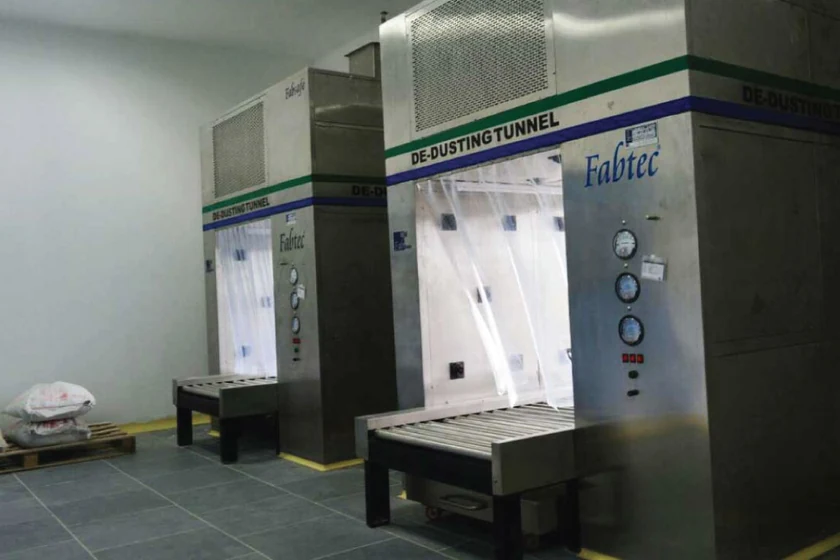
Two Fabtech de-dusting tunnels in a materials entry room, their roller conveyors in front and a sack on a pallet beside one of them
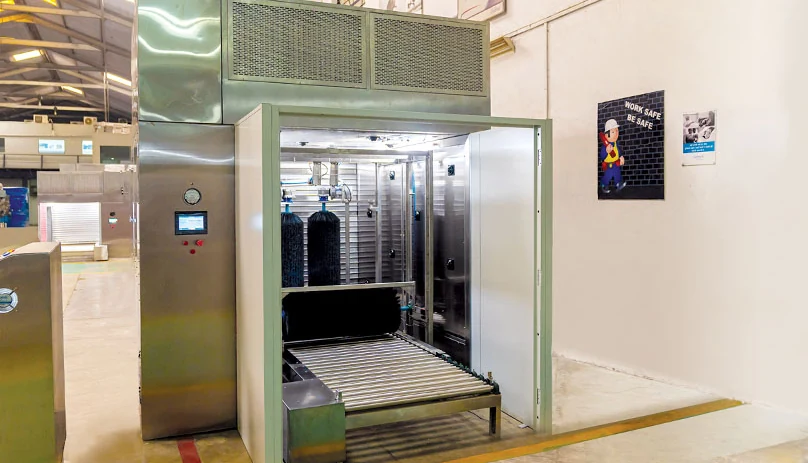
A Fabtech de-dusting tunnel seen from its entry: the roller conveyor leading into the cabinet and the filter box on its roof
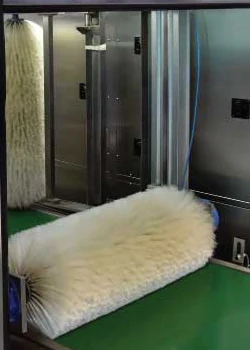
The mouth of a Fabtech de-dusting tunnel close up: the white rotary brush across the entry

What it is not: four machines people search for together

People often search for these four machines together. They are four different pieces of equipment.

Depyrogenation tunnel

A depyrogenation tunnel is a different machine. It is a dry-heat sterilising and depyrogenation tunnel for glass vials on an injectable line.

It runs hot enough to destroy endotoxin, a toxin from the cell walls of bacteria. The two machines share the word "tunnel", but they do unrelated jobs.

We supply depyrogenation tunnels too.

Dust collector

A dust collector is a central extraction system for the whole plant. It uses ducts to pull dust away from many sources.

A dedusting tunnel is a self-contained enclosure with its own filtration at the point of use. Larger plants have both.

One cannot replace the other.

Tablet deduster

A tablet deduster is a small unit fixed to the discharge chute of a tablet press. It removes loose powder from tablets as they leave the press.

If you need this machine, it belongs with tablet compression. Our tunnel cleans the outside of containers.

Dedusting personnel

Dedusting personnel is the fourth. It is the one people most often come to this page for.

To remove particles from a person's garments as they enter a cleanroom, you need an air shower. An air shower blows high-velocity HEPA jets at a person.

HEPA filters trap very fine particles from the air. This tunnel uses a brush to clean a drum.

How the tunnel works

The tunnel cleans each container in three steps, during one pass through the machine.

Mechanical. A rotary brush moves over the container in the X and Y axes, which means in two directions.

The brush is adjusted to the container's shape and size. The brush removes dust that sticks to the surface.

Air alone cannot remove it.

Pneumatic. A high-velocity HEPA filter jet system blows air at 8,000 to 10,000 fpm (feet per minute).

The jets lift away the dust that the brush has loosened. The operator sets the direction of the jets by hand.

This direction control is important. A jet aimed the wrong way puts dust back on the surface it has just cleaned.

Capture. Loose particles fall into a collection tray.

The filtration system captures the dust in the air. Only the container is meant to leave the tunnel.

Sliding doors at the entry and exit keep the tunnel closed during the cleaning cycle. An endless conveyor, a moving belt that runs in a loop, carries the containers.

The operator never has to reach inside.
Where the tunnel is installed, and what it protects

The tunnel is installed at the boundary between an uncontrolled area and a controlled area.

This is typically between the warehouse and dispensing. Sometimes it is between the warehouse and a general manufacturing corridor.

After the tunnel, the material is sampled and dispensed. Ordinary materials usually go to a sampling and dispensing booth.

Potent materials, which are harmful even in very small amounts, usually go to a containment isolator. Smaller items cross the same boundary through a pass box.

People cross it through an air shower. The tunnel does the same job for large containers.

The room that the tunnel protects is built and served by the cleanroom HVAC system. Every kilogram of dust that the tunnel stops at the entry is dust that the air handling plant does not have to remove later.

Specifications

  • Basic cabinet: SS 304 / CRCA powder coated / double-wall PUF-filled panel
  • Single-pass fully automated system with sliding doors at entrance and exit
  • Endless conveyor with rotary moving brush in the X and Y axes
  • High-velocity HEPA filter jet system, 8,000 to 10,000 fpm, with manually adjustable direction control
  • PLC or manual control system with differential pressure gauges
  • Concealed LED lighting delivering in excess of 400 lux
  • 21 CFR and GMP compliant

Supply and installation

Fabtech designs and supplies de-dusting tunnels for pharmaceutical plants.

Buyers who search for a de-dusting tunnel pharmaceutical manufacturer are looking for one company that takes responsibility for the unit. Fabtech takes that responsibility.

We supply the tunnel to international projects, as part of a turnkey plant or as standalone equipment. The tunnel is normally specified together with the rest of the material entry route.

This is because its footprint, conveyor height and door positions must match the airlock it serves.

For cleanroom projects in India, contact Fabtech Technologies Cleanrooms Ltd. It is a separate, separately listed group company.

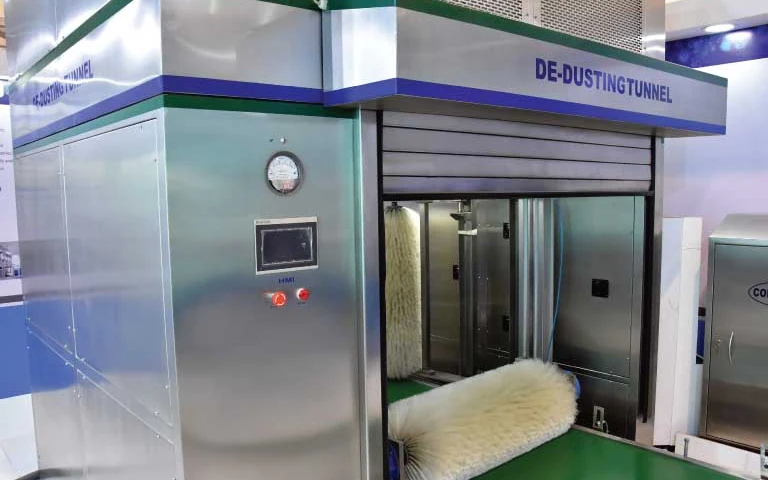
A Fabtech de-dusting tunnel with its door, its control screen and pressure gauge, and the rotary brush at its mouth

FAQ

What is a de-dusting system?

It is an enclosure that removes loose dust and particles from the outside of containers. It cleans them as they move from an uncontrolled area into a controlled area. The container goes in at one end. Inside, a brush and air jets clean it. It comes out clean at the other end.

What is the purpose of a dedusting tunnel in pharmaceutical operations?

It stops dust at the entry to the clean area. Raw material containers (drums, cartons, sacks and bags) carry loose particles on their outer surfaces. The tunnel removes these particles before sampling, so the dust does not enter the dispensing area at all.

How does a dedusting tunnel protect product quality?

It removes leftover powder and debris that stick to container surfaces. This stops the dust from moving to the next stage or cross-contaminating another material.

Is a dedusting tunnel the same as a depyrogenation tunnel?

No. A depyrogenation tunnel is a dry-heat sterilising tunnel for glass vials on an injectable line. It runs hot enough to destroy endotoxin. A dedusting tunnel is a mechanical and pneumatic cleaning enclosure. It runs at ambient temperature, which means normal room temperature.

What is the difference between a dedusting tunnel and a dust collector?

A dust collector is a ducted extraction system that serves many sources in the plant. A dedusting tunnel is a self-contained enclosure with its own filtration at the point of transfer. Plants often have both.

How is personnel dedusting handled?

This machine does not dedust people. An air shower at the cleanroom entrance removes particles from garments.

What filtration is used?

HEPA filters, and ULPA filters where the application requires them. ULPA filters trap even finer particles than HEPA filters. The jet system supplies HEPA-filtered air at 8,000 to 10,000 fpm. The extraction side filters the dust it captures.

What construction materials are used, and why?

The cabinets are SS 304 or CRCA powder-coated, with double-wall PUF-filled panels. CRCA is cold rolled steel and PUF is polyurethane foam. Stainless steel is easy to clean and resists corrosion. The double-wall panel makes the cabinet rigid and reduces noise.

Can the tunnel be customised for container geometry?

Yes. The brushing system is adjustable for containers of prefixed geometry. The airflow patterns, nozzle positions and conveyor speed are all set to the mix of containers you run.

What regulatory standards does it comply with?

GMP and ISO 14644. 21 CFR Part 11 applies to the PLC control system where it keeps electronic records. 21 CFR Part 11 is the US FDA rule for electronic records.

How many types of cleaning are there in pharma?

Broadly three, and people often confuse them. The first is cleaning of product-contact surfaces (CIP and manual, validated against residue limits). The second is cleaning of non-contact surfaces and the room itself. The third is dust removal from goods and people at boundaries. A dedusting tunnel and an air shower do this third type.

Send us your container types, dimensions and throughput, and we will size the dedusting tunnel

We reply within 24 hours.