Containment suite
The first is to build a containment suite around the machine. This is a closed room with airlocks, cascade pressures (each room held at a different air pressure), its own air handling and full gowning for the staff.
A capsule filling machine makes dust. Fabtech supplies the capsule filling isolator that keeps the dust inside, in SS 316L stainless steel, with filtered air going in and double filtration on the air going out.
Dust is normal. It is not a fault in the machine. The machine fills powder into capsule shells several thousand times an hour, and some of that powder gets into the air.
When the powder is potent, the dust decides how the room has to be built. The other choice is to put the machine inside an isolator. Then the dust stays inside the isolator, and the room does not have to contain it.
We reply within 24 hours.
Fabtech's containment solutions for capsule filling cover the spectrum from powder to pellet filling. They are for processes with potent products.
OEB (occupational exposure band) is the industry's scale for how harmful a substance is to the people who handle it. A higher band means a more potent product, and OEB 4 and OEB 5 are high bands.
Dust from the process stays inside the isolator. This protects the operator and the environment.
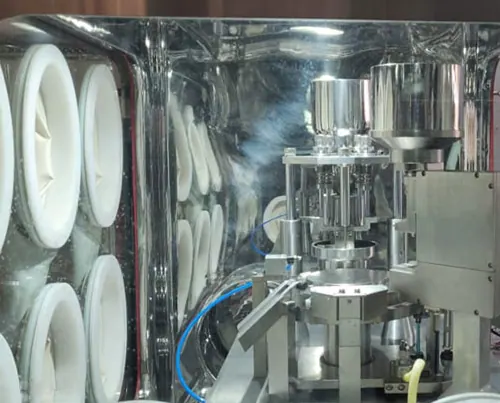
The ergonomically built negative pressure chamber holds the product during processing. Negative pressure means that air flows into the chamber, not out of it.
Operators reach inside through glove ports. Materials go in and out through the pass box or antechamber.
The capsule filling line is integrated with the isolator. The isolator's split butterfly valve dispenses filled capsules into IBC bins or polybags.
Key fact Detail
There are two ways to fill capsules with a potent product.
The first is to build a containment suite around the machine. This is a closed room with airlocks, cascade pressures (each room held at a different air pressure), its own air handling and full gowning for the staff.
The second way is to put the machine inside an isolator.
The isolator is smaller, and it can be moved. It also costs less to qualify, which means to test and document that it works as designed.
A containment suite is part of the building. An isolator is a piece of equipment.
Some plants add one potent product to an existing facility. For them, this difference is usually the whole business case for an isolator.
The cost is access. Operators reach everything inside through gloves.
So changeover, cleaning and machine adjustment all take longer. Some plants run many short potent campaigns (a campaign is a run of batches of one product).
These plants should work out this extra time before they buy.
With powder, the main problem is dust.
Fine powder sticks together, and it rises into the air easily. The negative pressure and the double HEPA exhaust are there for this reason.
HEPA (high-efficiency particulate air) filters trap very fine particles.
With pellets, the main problems are flow and dosing. Pellets do not float in the air like a micronised (very finely ground) powder.
But they bounce, they scatter, and they get into the moving parts of the machine. So the need for containment is lower, and the need for cleaning up is higher.
Most lines end up handling both. So the standard build handles the full range from powder to pellet.
It is not designed for only one of them.
Fabtech designs the isolator around the machine.
We do not fit the machine to the isolator. The capsule machine is either mounted inside the enclosure or connected to it through a sealed interface.
Feed hoppers, capsule elevators and discharge conveyors pass through transfer ports. Fabtech also supplies the machine.
How the machine fills a capsule, station by station, is on our page for capsule filling machines.
To design the isolator, we need to know:
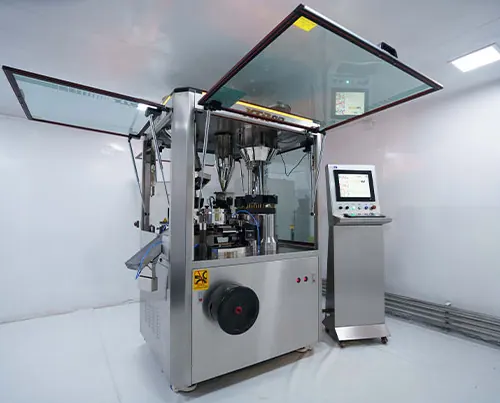
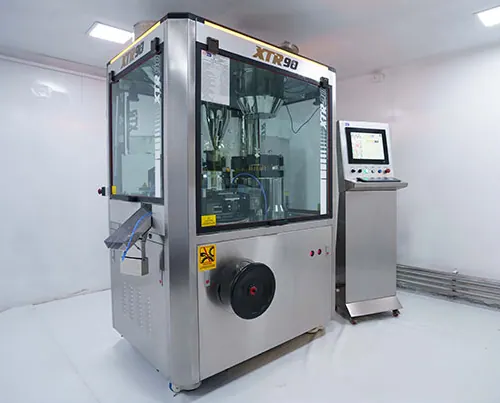
Some machines need the operator to open a guard during a batch. These machines need a different enclosure from machines that run closed.
There are two major containment risks: charging (loading material into the isolator) and discharge.
Filled capsules have to leave the isolator, and this exit is the second risk.
The split butterfly valve controls discharge in the same way it controls charging. The valve has two halves.
One half is on the isolator and one half is on the receiving bin. The two halves join and open together as one sealed unit.
Filled capsules go into IBC (intermediate bulk container) bins or polybags with no open gap to the room. Waste leaves by its own route, through the waste liner port.
It goes into a bag, and the bag is sealed before it is removed.
CIP (clean in place) means the chamber is washed without taking it apart.
Of all the specifications, the optional CIP in the capsule filling chamber needs the most thought before you order. It is difficult to add later.
Cleaning by hand through gloves is slow. With a potent product, it is also the task with the highest exposure risk in the whole campaign.
This is because the operator has to disturb residue that has settled.
In-situ washing and drying, with a cachepot to collect the drain water, removes this manual step. On a line that makes only one product, manual cleaning is a reasonable choice.
Some lines run potent campaigns of different products one after another. On these lines, CIP usually pays for itself in shorter changeover time alone.
Capsule filling is one step.
A line for potent oral solid products (tablets and capsules) usually needs containment at several steps:
The isolator is sealed. HEPA-filtered air is supplied inside, and the chamber is held at negative pressure. Material goes in and out through transfer ports. The doors are interlocked, and the exhaust air is filtered. The filling turret is enclosed. This reduces both airborne contamination and operator exposure.
Stainless steel, polymer and glass. These materials resist chemical cleaners. They do not trap particles. They meet GMP cleaning and validation requirements.
Fabtech supplies the isolator in SS 316L stainless steel, with filtered air going in and double filtration on the air going out. The inlet air has H14 HEPA filtration, and the exhaust has double HEPA filtration. The standard configuration has a pass box with two glove ports, a main chamber with four, and a glove integrity tester.
The machine is mounted inside the enclosure or connected through a sealed interface. Feed hoppers, capsule elevators and discharge conveyors pass through transfer ports.
Yes. The containment covers the spectrum from powder to pellet. With powder, dust is the bigger problem. With pellets, flow is the bigger problem.
Pharmaceutical and nutraceutical (health supplement) companies. They use them when the material in the capsules is too potent to handle in the open.
Interlocked doors, negative pressure control, emergency stops, HEPA filtration, glove systems and safe access panels. There is also an integrated exhaust scrubber. Monitoring gives alarms on pressure and filter status.
It depends on your production, your contamination risk and your SOPs (standard operating procedures). HEPA prefilters are commonly changed every one to three months. Primary HEPA filters are commonly changed every six to twelve months. Full internal cleaning or CIP is scheduled per batch.
An isolator is sealed. It holds a defined pressure compared with the room. A RABS (restricted access barrier system) is a physical barrier inside a classified room. It depends on the grade of that room. For products in high bands such as OEB 4 and OEB 5, plants normally choose an isolator.
No. This one is a containment isolator. It protects the operator from the product, and it runs at negative pressure. A sterile filling isolator protects the product from the operator, and it runs at positive pressure. The difference is explained in positive versus negative pressure containment.
Send us your capsule machine make and model, your OEB band and your batch size, and we will size the isolator
We reply within 24 hours.