Potent API Processing Isolator (PAPI)
Fabtech supplies the PAPI isolator in SS 316L, with a negative pressure chamber that works with processing equipment such as lab-scale reactors, Nutsche filters, centrifuges and vacuum tray dryers. After a potent API is made, it has to be filtered and dried, and at these steps the pure product is open.
We reply within 24 hours.
API means active pharmaceutical ingredient, the part of a medicine that acts on the body. A potent API can harm a person in very small amounts.
This is a containment unit. It protects the operator and the environment from the product.
Buyers ask for this unit for processes involving potent OEB 4 or OEB 5 products. OEB means occupational exposure band, a scale of how harmful a substance is to the people who handle it.
Your own occupational hygienist sets the band for your compound. The unit integrates with processing equipment for optimal performance and safety.
Ask for the chamber pressure, the leak test and the qualification documents in your enquiry.
On this page
Key fact Detail
- Process equipment it works with
- Such as lab-scale reactors, Nutsche filters, centrifuges, vacuum tray dryers
- Cleaning
- In-situ chamber washing and drying
- Front doors (add-on)
- Hinged or pneumatic cylinder
- Extra protection (add-on)
- Glove ports for front sliding panes
- Solvent areas (add-on)
- Flameproof (ATEX) model
An API isolator for the filtering and drying steps
Fabtech supplies this API isolator for the steps after the reaction, where the API is filtered, spun in a centrifuge and dried.
An API is made by a chemical reaction in liquid. After the reaction, the solid API has to be separated from the liquid and dried.
These are the steps where the pure product is open, first as a wet solid and then as a dry powder.
At these steps the API is at full strength. Nothing has been added to dilute it yet.
This is why API isolators are planned around the equipment for these steps, and why the same unit is sometimes called an HPAPI isolator. HPAPI means highly potent API.
The chamber runs at negative pressure. Our negative pressure system page explains how that keeps a product inside.
The process equipment a PAPI isolator works with
Lab-scale reactors
A reactor is the closed vessel where the API is made. A lab-scale reactor makes a small quantity, for development or for a small batch.
The risk is at the openings: where solids are added and where samples are taken. The charging and sampling openings are the point a PAPI isolator is planned around.
How it joins your reactor is settled in the design.
Nutsche filters
A Nutsche filter separates the solid API from the liquid it was made in. The liquid drains through a filter plate, and the solid stays on top as a wet cake.
The cake then has to be taken out. The cake discharge is the point the isolator is planned around.
The design settles how it joins your filter.
Centrifuges
A centrifuge does the same job by spinning. The spin throws the liquid out through a filter cloth and leaves the solid behind.
Unloading the solid from the basket is manual work with an open product. Here the unloading point is what the isolator is planned around, and the way it joins your centrifuge is part of the design.
Vacuum tray dryers
A vacuum tray dryer dries the wet cake on trays, under vacuum and gentle heat. The trays are loaded wet and unloaded dry.
Dry powder makes dust easily, so unloading is the step where dust is most likely. The dryer door and its trays are the point to plan around.
Tell us the dryer model, and the joint is settled in the design.
Specifications
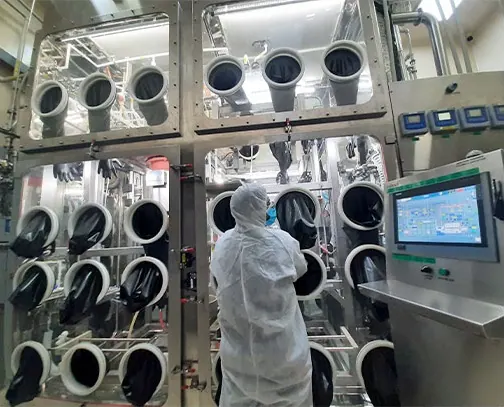
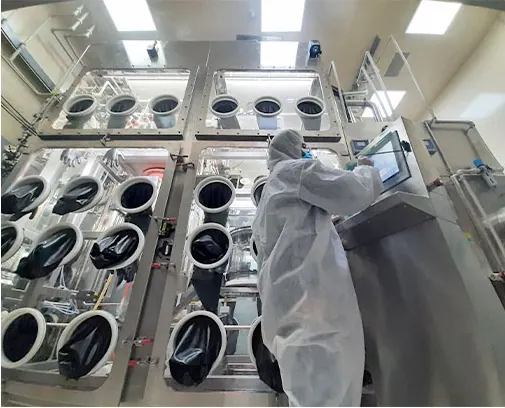
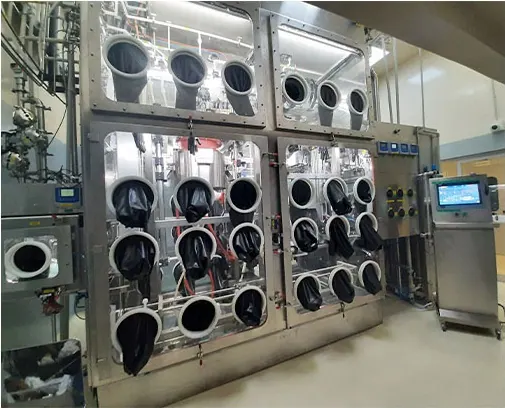
The ergonomically built negative pressure chamber safely contains the products during processing with glove ports for easy access. Material is transferred safely in and out of the isolator through the pass box or antechamber.
- Robustly constructed in SS 316L, with H14 HEPA filtration on inlet air and double HEPA filtration on exhaust
- Optional room air intake and dedicated air handling unit for temperature and humidity management
- Safe changing of HEPA filters
- Inline exhaust scrubber for exhaust air treatment
- Customisable ergonomics
- Add-ons include a flameproof (ATEX) model, hinged or pneumatic cylinder front doors, weighing system integration, and glove ports for front sliding panes for increased personnel protection
- Standard configuration: one pass box with 2 glove ports, main chamber with 4 glove ports, and a glove integrity tester
- Multiple chamber configuration options available
- In-situ chamber washing and drying, with drain collection cachepot (a collection pot) for safe handling
- Password protection for different authorisation levels
- Optional IPC SCADA 21 CFR (control and data software on an industrial computer) for high-grade integration and compliance
Solvents and flameproof areas
API work uses solvents, and many solvents burn.
Two items in the specification are there for this reason.
The first is the flameproof (ATEX) model. ATEX is the European rule set for equipment used where the air can ignite.
In a flameproof model, the electrical parts are built not to ignite the air.
The second is the inline exhaust scrubber. HEPA filters hold particles.
They do not hold solvent vapour. The inline exhaust scrubber treats the exhaust air.
Tell us your solvents so it can be specified.
Which containment isolator for which step
The right unit depends on the step.
- Loading a production reactor is the job of the reactor charging isolator, which can be fitted to a reactor you already own.
- Weighing the finished API before it goes into a medicine is done in a sampling and dispensing isolator.
- Turning the API into granules is done in a granulation isolator.
- A step that fits none of these is planned as a custom negative pressure system.
The exposure limit of your compound decides how strict each unit must be. Our guide to OELs explains the limit.
After installation, containment can be measured by surrogate testing, with a safe powder in place of the real one. A plant for cancer medicines uses this containment at many steps.
See our oncology manufacturing facility page, and the full range on the pharmaceutical isolators page.
FAQ
Does Fabtech supply custom-designed PAPI isolators?
Yes. Fabtech offers potent API processing isolators (PAPI) as part of its containment and isolator portfolio. Each one is designed around your process equipment.
What industries can benefit from a PAPI isolator?
Industries or segments that benefit include pharma, biotech, speciality chemicals, nutraceuticals, and research and development. Fabtech's own work is in pharmaceuticals, biopharma and healthcare only.
How does Fabtech ensure regulatory compliance for PAPI isolators?
Fabtech designs its cleanroom and containment solutions to support compliance with global regulatory standards. These include the standards of the US FDA, the MHRA and the TGA. Optional IPC SCADA to 21 CFR is available for integration and compliance.
Is there an option for multiple chambers in the PAPI isolator?
Yes. Multi-chamber options are available, based on the process or the client requirement.
What does PAPI stand for?
PAPI stands for potent API processing isolator. API means active pharmaceutical ingredient. It is also called an API isolator or an HPAPI isolator, where HPAPI means highly potent API.
What equipment does a PAPI isolator work with?
Fabtech supplies the PAPI in SS 316L, with a negative pressure chamber that works with processing equipment such as lab-scale reactors, Nutsche filters, centrifuges and vacuum tray dryers.
What is the difference between a PAPI and a reactor charging isolator?
A reactor charging isolator covers one step: loading material into a reactor. This unit covers the steps after the reaction, where the API is filtered, spun and dried. Many API plants need both.
Send us your compound, its OEB band, your process equipment and your solvents. We will plan the isolator
We reply within 24 hours.