On this page
A turnkey biopharmaceutical facility from one partner
Fabtech designs, builds, equips and qualifies the whole biopharmaceutical plant on one contract.
A turnkey biopharmaceutical facility is a plant for medicines made by living cells. Qualification means proving, with written tests, that the plant works as designed.
The rooms, the air, the water and the steam protect the product and the people at the same time.
Key fact Detail
- Vaccine plant taken over and commissioned
- 9,000 square metres, for Mechnikov S.A. in Nicaragua
- Planned output of the Mechnikov plant
- Up to 30 million vaccine doses a year
- Biosafety level 3 (BSL-3) laboratory built
- 950 square feet, for the Government of Uttar Pradesh
- Filling lines we supply
- Vial, ampoule and prefilled syringe (PFS) lines
- Facilities we build
- GMP (good manufacturing practice) and WHO compliant
A biological plant uses the same pharmaceutical facility engineering as a tablet plant, built for the demands of biopharma operations. Fabtech builds both kinds of plant.
See all the industries Fabtech builds for.
How a biological plant differs from a tablet plant
The product is grown. In a tablet plant, machines mix and press powders.
In a biological plant, living cells grow in a liquid and make the product. Any germ that enters the liquid grows too, and the batch is lost.
So the liquid stays in closed vessels and tubes that are sterile, which means free of all living germs.
The room protects in two directions. Some vaccines are made from a live virus or bacterium.
The room must keep that organism inside and keep germs away from the product. A tablet plant mainly controls its own dust.
The air pressure is set room by room. Where the product is open, the room has a higher pressure, so air flows out.
Where a live organism is handled, the room has a lower pressure, so air flows in. An airlock keeps the two kinds of air apart.
It is a small room with two doors that are never open at the same time.
Containment means keeping a harmful product away from the people who make it. Biosafety levels (BSL) state how much containment a live organism needs, and the work can need BSL-2 or BSL-3.
A production suite uses the same principles as a BSL-3 laboratory, at a larger scale, and adds treatment of liquid waste. For the levels one by one, read biosafety level 3 (BSL-3) laboratories.
From seed to filled vial: what each step needs
A monoclonal antibody, most biosimilars and a vaccine grown in cell culture follow the same six steps.
A vaccine grown in eggs or in a bacterial fermenter changes the first three.
The seed is a vial of frozen cells from the cell bank, the stock of starting cells. The cells are thawed and grown in a flask.
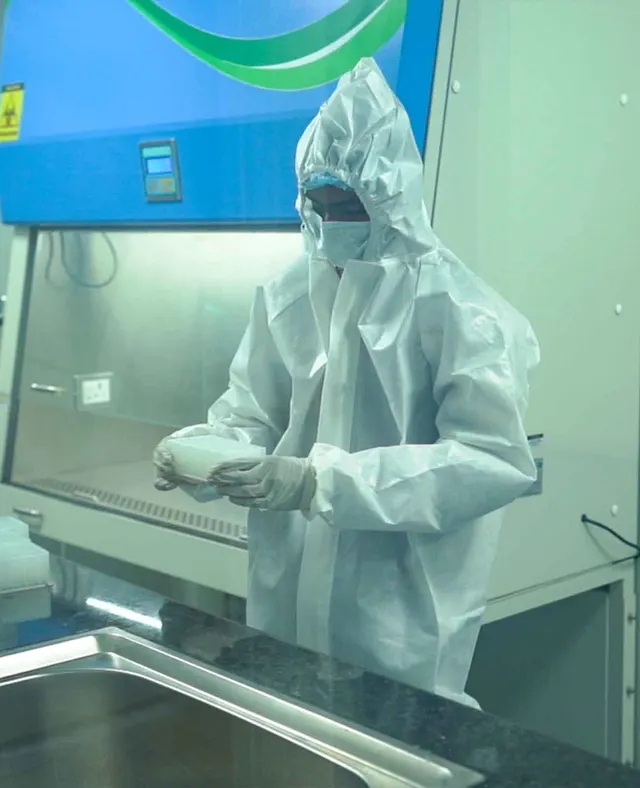
The room must give the open flask clean air. So the work is done in a biosafety cabinet, a cabinet with its own filtered air.
Expansion moves the culture, the liquid with the growing cells, into larger vessels, one size at a time. The room must keep people and materials moving in one direction.
The equipment must make each transfer through closed, sterile tubes.
The production bioreactor is the biggest vessel. Here the cells make the product, over days or weeks.
The bioreactor must control temperature, acidity, oxygen and mixing. The building must supply gases, cooling and, for a steel tank, pure steam to sterilise it.
Harvest separates the cells from the liquid, with a centrifuge, a machine that spins the liquid, or with filters. The equipment must stay closed.
If the organism is live, the room must stay under containment until the organism is removed or killed.
Purification separates the product from everything else. Chromatography columns are tubes packed with a material that holds the product while impurities wash through.
The step uses large volumes of salt solutions. So the plant must supply a lot of water for injection (WFI), the purest water grade.
Filling puts the product into vials or syringes. A product that can pass a sterilising filter is filtered first.
Some vaccines cannot, so every earlier step must be sterile. The filling point must have Grade A air, the cleanest grade.
It is usually inside an isolator, a sealed cabinet that the operator works in through gloves fixed in its wall.
The air grades come from EU GMP Annex 1, the European rule for sterile medicines. An injectable plant uses the same filling suite. For the rooms in order, read sterile facility design and construction.
Vaccine manufacturing facility design
Vaccine manufacturing facility design and engineering start with the organism.
A vaccine manufacturing plant may grow a live virus or bacterium. The vaccine is a weakened or killed form of it, or one part of it.
The biosafety level of that organism sets the containment for each room.
A vaccine production plant follows these rules:
- Live and killed areas are separate. Each has its own air handling, staff entry and waste route.
- Air from live areas passes through HEPA filters, very fine filters that stop particles. They do not stop gases or vapours.
- Liquid waste that held the live organism is made safe with heat or chemicals before it leaves.
- Vaccine manufacturers often make several vaccines in one plant. The rooms and equipment are cleaned, and proved clean, between products.
For a vaccine plant in detail, read the Mechnikov vaccine facility case study.
Monoclonal antibody (mAb) and biosimilar manufacturing facilities
A monoclonal antibody (mAb) is a protein medicine that living cells make in a bioreactor.
A biosimilar is a medicine made to match a biological medicine that is already approved. Many biosimilars are monoclonal antibodies.
Our guide to monoclonal antibody production covers how an antibody is developed and produced.
A monoclonal antibody manufacturing facility is a biopharmaceutical plant with three linked areas. Upstream is where the cells grow.
Downstream is where the product is purified. Fill-finish is where it goes into vials or syringes.
Each area has its own air and its own route for people and materials.
A biosimilar manufacturing facility for an antibody has the same three areas, and one more duty. The biosimilar must match the original medicine, and the regulator checks this.
So the plant must run each batch in the same way and keep the records that show it.
Many monoclonal antibodies treat cancer. Cancer medicines made by chemistry need a different kind of containment.
Stainless steel or single-use: what the choice changes in the building
The equipment that touches the product is either fixed stainless steel or single-use. A single-use system is a set of sterile plastic bags, tubes and filters, used for one batch and then thrown away.
A single-use bioreactor is a bioreactor built this way.
| Stainless steel | Single-use | |
|---|---|---|
| What touches the product | Fixed tanks and pipes | Sterile bags, tubes and filters, used once |
| Between batches | Cleaned and steam-sterilised in place | Used parts are removed and new ones fitted |
| What the building supplies | More pure steam, more WFI, cleaning chemicals and drains | Less steam and less rinse water |
| Space | Tanks, pipework and a cleaning station | Storage for new parts and for waste |
| Batch size | Suits very large, steady volumes | Limited by the size of the bag |
Many plants use both. Tell us your choice before design starts, because it sets the size of the water, steam and cleaning systems.
Bioreactors and purification equipment are specified for each process.
Biopharma Solutions: what Fabtech supplies
Fabtech Technologies delivers end-to-end pharma project solutions across design, engineering, construction and validation.
Integrated engineering for biopharma facilities means that one team designs the process, the rooms, the air and the water together. Our biopharma facility turnkey solutions and biotech facility turnkey solutions follow the same ten steps as our other pharmaceutical turnkey projects.
End-to-end cleanroom services
Our Biopharma Solutions include:
- Cleanroom design and engineering.We lay out the rooms, the room grades and the routes for people and materials.
- Turnkey cleanroom construction.We make the wall and ceiling panels, supply the doors and the view panels, and install them.
- HVAC and environmental control systems.HVAC means heating, ventilation and air conditioning. The system holds each room at its grade, pressure, temperature and humidity.
- Modular cleanroom solutions.The panels are made in the factory, so rooms can be added in stages.
- Cleanroom upgrades and expansions.We upgrade a facility with as little interruption to production as possible.
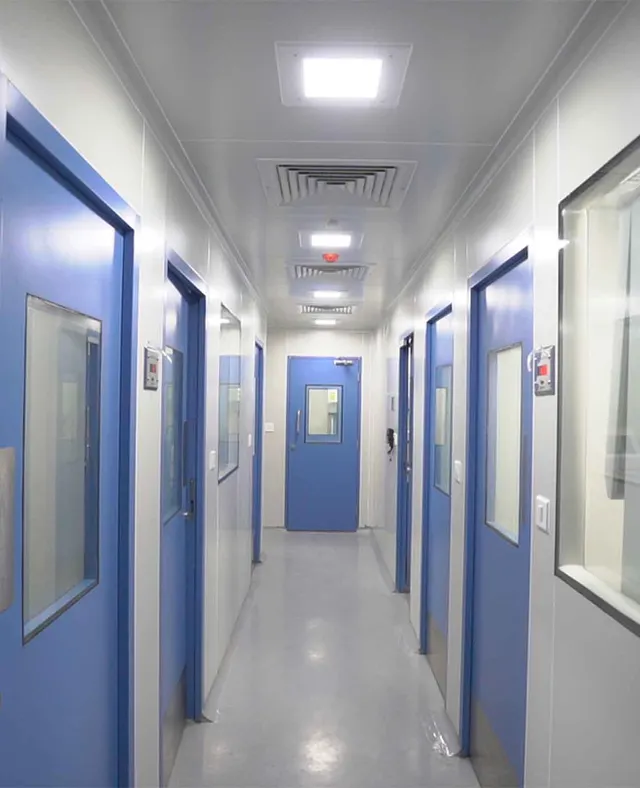
Biopharma cleanrooms are the controlled environments of the plant, the rooms where the air is kept clean to a set grade. Our biotech cleanroom construction covers the panels, the doors and the air system.
Fabtech cleanrooms support a wide range of biopharma applications:
- Pharmaceutical manufacturing and packaging
- Biotechnology and life sciences research
- Vaccine and sterile product facilities
- Cell and gene therapy environments
- Healthcare applications
If you need only a cleanroom, and the project is in India, speak to our group company Fabtech Technologies Cleanrooms Ltd.
Biopharma equipment and utilities
| Part of the plant | What it must do | From Fabtech |
|---|---|---|
| Rooms and air | Hold the room grade and the room pressure | Cleanroom systems |
| Water and steam | Stay within the limit for endotoxins (toxins from bacteria) | WFI generation system, pure steam generation |
| Vessels and cleaning | Hold sterile liquids, and be cleaned and sterilised in place | Process vessels for biopharma, CIP and SIP systems |
| Filling | Fill and close vials and syringes | Vial filling and capping machine, prefilled syringe machine, filling isolator line |
| Containment, transfer and testing | Contain open steps, pass materials between rooms and test for sterility | Pharmaceutical isolators, dynamic pass box with VHP, sterility testing isolator |
All of these are products in the Fabtech Technologies range, and each system is engineered for your process. For the filling step, we supply vial and ampoule filling lines and prefilled syringe (PFS) lines.
New facility or upgrade of an existing building
New medicines and new production methods change what a plant needs. So the building must be able to change. The same team can develop a new turnkey pharmaceutical manufacturing plant or upgrade a running one.
In a biopharma upgrade, the plant often needs more water, steam and air capacity before it needs more floor space. Both routes are compared in greenfield and brownfield projects.
Modular cleanroom engineering and modular cleanroom solutions for biopharma use wall and ceiling panels that Fabtech manufactures. A biotherapeutic modular facility is a plant for medicines made by living cells. It is built in sections and can be extended in stages.
Qualification: designed for regulated environments
Our biopharma cleanroom solutions are designed to support GMP and other international regulatory guidelines. GMP means good manufacturing practice, the rules that inspectors check. The United States writes GMP as cGMP, where the c means current. We build GMP and WHO compliant facilities. WHO is the World Health Organization.
Qualification follows the stages DQ/IQ/OQ/PQ: the design, the installation, the operation and the performance are each checked. In a biological plant, we qualify the air, water and steam systems first, because each later test depends on them. Each stage is explained in our guide to equipment qualification.
Biotech and vaccine facilities Fabtech has delivered
Mechnikov S.A., Nicaragua. Mechnikov needed a vaccine plant of 9,000 square metres, to make influenza vaccines for Latin America.
Its first contractor could not finish the work, so Mechnikov asked Fabtech to take over, and our team commissioned the whole project. The plant was planned to make up to 30 million doses a year.
We started our cooperation in a relatively unpleasant time for my company because our main contractor at that time didn't manage to deliver the project on time and to full scope.

BSL-3 laboratory, Shahjahanpur, India. The Government of Uttar Pradesh needed a diagnostic and research laboratory for Covid-19 tests.
Fabtech started the work during India's second wave of Covid-19 lockdowns. It built the laboratory in 950 square feet, where 1,500 is the best size for such a laboratory.
The Deputy Chief Minister of Uttar Pradesh opened the laboratory.
See all our projects, including our projects in Egypt.
FAQ
What is a turnkey biopharmaceutical facility?
A turnkey biopharmaceutical facility is a vaccine, biosimilar or antibody plant that one partner designs, builds, equips and qualifies under one contract. Turnkey in manufacturing means the owner receives a working, qualified plant and does not manage separate vendors. In Nicaragua, Fabtech took over the Mechnikov vaccine plant of 9,000 square metres and commissioned the whole project.
How is a vaccine manufactured?
The organism, or one part of it, is grown in cells, in eggs or in a fermenter. It is harvested and purified, and in many vaccines it is killed. The bulk vaccine is mixed to its final strength and filled into vials or syringes under sterile conditions.
How are biosimilars manufactured?
Biosimilars are made by the same kind of process as the original biological medicine. Cells grow in a bioreactor and make the protein. The protein is harvested, purified and filled. The maker must show the regulator that the biosimilar matches the original in quality, safety and effect.
Where are monoclonal antibodies manufactured?
Monoclonal antibodies are made in biopharmaceutical plants with three linked areas. Upstream, cells grow in bioreactors. Downstream, filters and chromatography columns purify the antibody. In fill-finish, it is filled into vials or syringes under Grade A air.
What is a sterile single-use system?
A sterile single-use system is a set of plastic bags, tubes, connectors and filters. It arrives sterile and is used for one batch. No part of it is cleaned or steam-sterilised between batches. The plant needs more storage and a dependable supply of parts.
How much does it cost to set up a biopharmaceutical manufacturing plant?
There is no general figure. The cost depends on the product, the batch size and the biosafety level. The choice of steel or single-use equipment, the filling format and the countries you will sell in also change it. We can price the plant once the process and the capacity are defined.
Tell us your product, batch size and site, and we will outline the plant