Navesta, Sri Lanka: cleanroom and HVAC installation during the lockdown
During the pandemic lockdown, nobody knew what would happen next, and every step forward needed care. At Fabtech we take pride in solutions based on safety, sterility and precision. In that period our work meant more than technical skill. We saw it as work that could save lives. That goal guided us when nothing was certain, and it kept the team going.
On this page
A project with purpose
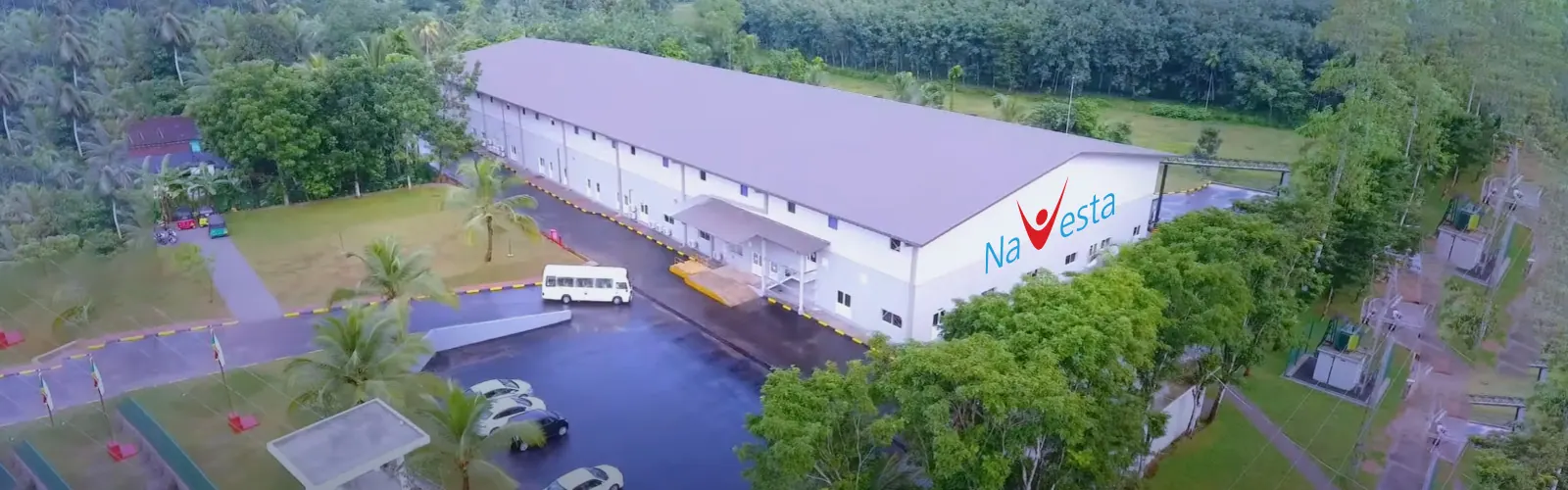
During the lockdown, Fabtech was awarded a project to set up an R&D (research and development) facility for Navesta in Sri Lanka.
The facility was Sri Lanka's first plant for granulation production of tablets and capsules at low relative humidity.
Granulation is the step where fine powder is formed into small grains before it becomes a tablet or fills a capsule. Relative humidity (RH) tells you how much moisture is in the air.
To meet these needs, we proposed full solutions for cleanroom systems and HVAC.
Why low relative humidity changes the engineering
Low RH is a hard requirement to meet, in general.
Granulation adds moisture to the powder and then takes it out again. So the humidity of the room is not a comfort setting.
It is a process parameter, which means it can change the product. Hygroscopic powders are powders that take up water from the air.
They pick up this moisture and stop flowing. Blends segregate, which means the mixed powders separate again.
Capsule shells become brittle or soft. Tablet hardness changes across a batch.
When a product needs low RH, the room must keep the humidity low all the time. It must stay low when doors open, when machines give off heat, and whatever the weather is outside.
In a tropical maritime climate, the outside air has high ambient humidity. There, the dehumidification load (the moisture the system must remove from the air) is the normal design condition.
It is not an occasional peak. In general, this load decides the choice of plant, the coil arrangement, the chilled water capacity, the dehumidification strategy and the reheat load.
Airflow is decided only after these. At Navesta, Fabtech's scope was cleanroom systems and HVAC, as the live site states it.
Our cleanroom HVAC systems page explains the same reasoning in general terms. The granulation techniques page describes the process this room serves.
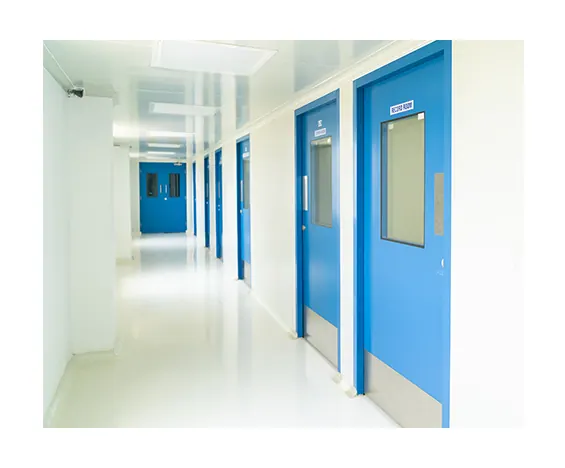
Cleanroom systems for production
We designed the cleanroom systems as controlled environments.
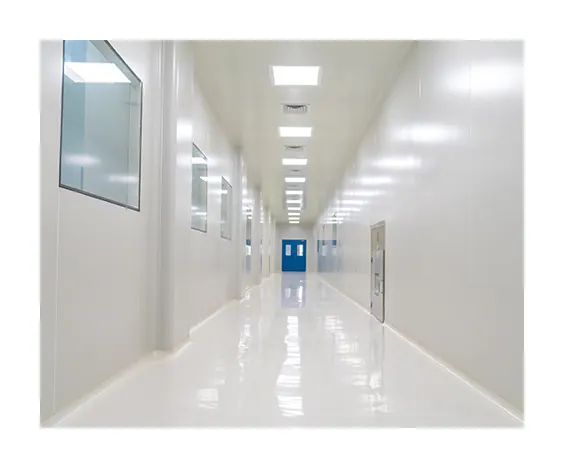
They were built for the strict cleanliness levels that granulation production needs.
We balanced filtration, airflow and climate control with care. This kept product quality to the highest standards and kept the risk of contamination low.
With these systems in place, Navesta's facility could reach the quality levels needed for advanced manufacturing and research, even under difficult low-RH conditions.
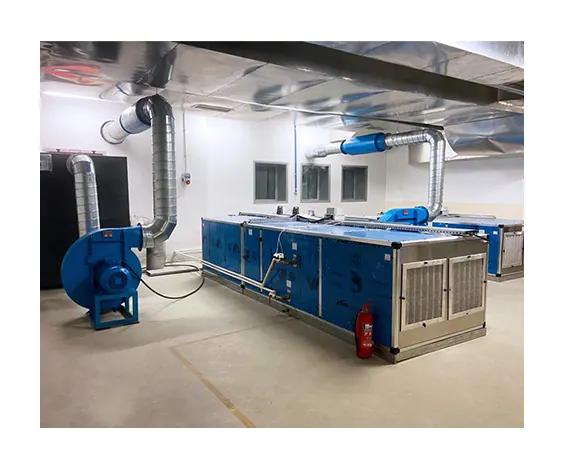
HVAC: control of temperature, humidity and airflow
HVAC means heating, ventilation and air conditioning.
The HVAC systems were the clean air solutions for the cleanroom. They kept the temperature, humidity and airflow in the room at the right levels.
HEPA (high-efficiency particulate air) filters remove very fine particles from the air. Laminar airflow means the clean air moves in one direction, in even layers.
Fabtech's high-performance HEPA filtration for laminar airflow removed contaminants steadily. It reduced cross-contamination, microbial growth and electrostatic discharge (static electricity).
All three matter for product integrity. The third one is a problem of dry rooms.
The drier the room, the more easily fine powder takes an electric charge and sticks to surfaces. So the environmental design must also control static.
The HVAC systems kept conditions stable and free of contaminants. This let the facility run high-quality, reliable production and research.
How we worked through the lockdown
During the pandemic, strict safety rules were essential.
We took new measures to protect both our team and our client.
One important step was to get special permission from government authorities to use charter air services. Services everywhere were disrupted, and finishing on time mattered.
So our team travelled on chartered flights. These flights gave enough space for social distancing during travel.
They also kept the team away from crowded commercial aircraft.
We protected health beyond travel too. The team followed quarantine procedures and took regular RT-PCR tests for COVID-19, so that any health problem was found early.
This approach was an important factor in preventing COVID-19 cases in our team. It also let us meet project deadlines consistently without putting anyone's health at risk.
In Sri Lanka there were serious supply chain delays and government-imposed restrictions. The team managed this by working closely with local and international suppliers.
This got the materials and equipment we needed delivered on time. Because we adapted and planned carefully, we completed the project within the ambitious one-year timeline.
We also obtained local government approvals for trial batches in the R&D facility. This was an important milestone.
It prepared the facility for future work and made it simpler to develop new products there.
The result
The project faced very large difficulties and still finished successfully, because of the team's resilience and expertise.
Today the Navesta facility runs smoothly and efficiently. We thank Navesta for their constant support during that difficult time.
What was delivered
| Client | Navesta, Sri Lanka |
|---|---|
| Facility | R&D facility. Sri Lanka's first plant for granulation production of tablets and capsules at low relative humidity |
| Fabtech scope | Cleanroom systems and HVAC |
| Environmental requirement | Low relative humidity |
| Timeline | Completed within one year, during pandemic lockdown |
| Milestone | Local government approvals secured for trial batches in the R&D facility |
FAQ
What did Fabtech deliver for Navesta in Sri Lanka?
Fabtech delivered cleanroom systems and HVAC for an R&D facility. It was Sri Lanka's first plant for granulation production of tablets and capsules at low relative humidity.
Why does granulation need low relative humidity?
In granulation, the humidity of the room is not a comfort setting. It is a process parameter. Hygroscopic powders take up moisture from the air and stop flowing. Blends segregate, capsule shells change, and tablet hardness drifts across a batch. So the room must hold the low humidity all the time.
What makes low RH difficult in a tropical climate?
Dehumidification is no longer an occasional peak load. It becomes the design condition. It decides the coil arrangement, the dehumidification strategy and the reheat load before airflow is even considered.
How long did the project take?
Fabtech completed it within a one-year timeline. This was during the pandemic lockdown, with supply chain delays and government-imposed restrictions.
How was the project delivered during the lockdown?
Fabtech got special government permissions for charter air services. The travelling team followed quarantine procedures and took regular RT-PCR tests. The team also worked closely with local and international suppliers to keep material deliveries on schedule.
Does Fabtech work elsewhere in South Asia and beyond?
Yes. Delivered projects published on this site include Sri Lanka, India, Saudi Arabia, Nigeria, Nicaragua and Argentina.
Can Fabtech design a low-humidity cleanroom for our facility?
Yes. Our cleanroom HVAC scope covers design, engineering, installation, commissioning and qualification in-house. We size the plant to the climate where it will run.
Tell us your process, the room conditions it needs and your market, and we will design the facility