
The Uncomfortable Truths About Healthcare: Why Building Pharmaceutical Infrastructure Can No Longer Wait
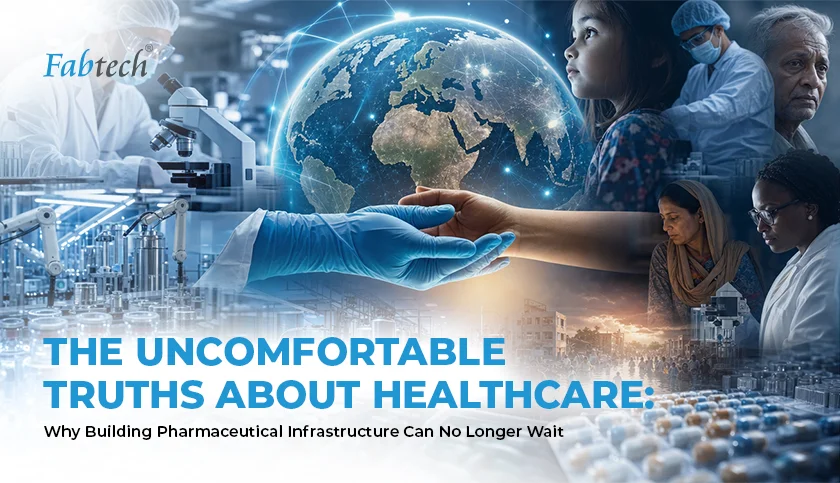
“Health is wealth” is perhaps one of the most universal truths we have all grown up hearing. But is maintaining good health really that simple?
Certainly not.
Good nutrition, exercise, and healthy habits are undoubtedly essential for a healthy life. Yet, many factors that influence our well-being lie far beyond individual control.
Diseases emerge, supply chains fail, climate changes, pandemics spread, and suddenly, personal discipline alone is no longer enough.
There are certain uncomfortable truths about healthcare that compel us to pause, reflect, and ask ourselves an important question: Is individual care enough when healthcare systems themselves remain vulnerable?
These simple yet hard-hitting realities should not only make us sit up and take notice, but also encourage us to think about what needs to be done next.
Medicines Exist. Access Does Not.
This may be the biggest truth of all. These truths are not distant global issues. They shape healthcare outcomes every day, which we often fail to notice, until a crisis arrives.
The world has developed treatments for countless diseases, yet millions still struggle to access them. Medicines remain unavailable, unaffordable, or delayed. In many cases, the lack of local manufacturing becomes the root cause of these bottlenecks.
The challenge today is no longer only about discovering medicines. It is about ensuring they reach the people who need them.
For millions around the world, the problem is not the absence of medicine, but the absence of access.
Healthcare Becomes Fragile When Medicine Depends on Geography
A country’s health should not depend on another country’s factory.
Yet, COVID-19 exposed this reality rather brutally. Developing and low- and middle-income countries across Latin America, the Caribbean, Africa, and Southeast Asia relied heavily on imports of essential medicines from major pharmaceutical manufacturing hubs. This dependence often led to supply disruptions, delayed access to medicines, and added pressure on already strained healthcare systems.
As borders closed and global supply chains broke down, these vulnerabilities became impossible to ignore.
Many of us witnessed these shortages firsthand.
And when supply chains failed, it was patients who paid the price.
The Next Pandemic May Be Uncertain. The Need for Preparedness Is Not.
COVID-19 will not be the last outbreak. History has shown us that diseases emerge unexpectedly. Preparedness, however, cannot.
Whether it is viral diseases, antimicrobial resistance, or climate-sensitive illnesses, new health threats will continue to emerge.
Preparedness must be continuous and proactive. It requires foresight long before a challenge becomes visible.
Preparedness is not a reaction; it is an investment.
Before Medicines Reach Patients, Nations Must Have the Capability to Make Them
Hospitals save lives.
But before a hospital can heal, a medicine must first be manufactured.
Hospitals treat disease, but pharmaceutical manufacturing infrastructure prevents shortages. While healthcare professionals focus on healing patients, someone must manufacture the medicines that make treatment possible.
This capability becomes especially critical during emergencies, when demand rises unexpectedly and global supply networks come under pressure.
The ability to manufacture locally is often the difference between dependence and resilience.
Resilience Is Not Built During a Crisis. It Is Engineered Before It.
Imagine attempting to build factories, cleanrooms, or vaccine facilities in the middle of an emergency.
The crisis may already be halfway through.
Laboratories, manufacturing facilities, and controlled production environments cannot be created overnight. Infact, it takes years to plan, design, construct, validate, and commission. By the time infrastructure is built during a crisis, the crisis may already be well underway.
Thus, resilience must not be built when disaster strikes, it must be engineered long before.
Climate Change Is Becoming a Healthcare Crisis
Healthcare resilience and climate resilience are becoming deeply interconnected.
It is because climate change is no longer only an environmental issue. It is increasingly becoming a healthcare issue.
Heatwaves, floods, and shifting ecosystems are contributing to the rise of dengue, malaria, respiratory illnesses, and water-borne diseases. Healthcare demand is evolving faster than infrastructure can keep pace.
At the same time, innovations in medicine, from biologics to advanced therapies, can only move as fast as the infrastructure supporting them.
What Do These Truths Lead Us To?
Yes, it all leads us to one clear answer – to build local pharmaceutical facilities.
These facilities are not merely industrial assets. They are foundations of strengthening healthcare security, public health preparedness, and national resilience.
At Fabtech Technologies, we believe that building pharmaceutical infrastructure is ultimately about building healthcare capability.
Through advanced turnkey pharmaceutical solutions and integrated manufacturing facilities, we support nations in strengthening local production and moving closer to healthcare self-reliance.
Yes, access to medicines should not depend on geography.
And yes, preparedness should begin before a crisis arrives.
And it is the right infrastructure that paves the way for stronger healthcare systems.
The future of healthcare will not be defined by medical discoveries or scientific breakthroughs alone. It will be defined by our ability to manufacture, deliver, and make those discoveries safe and accessible to all.
At Fabtech Technologies, we remain committed to engineering environments that help make that future possible.
Connect with us to build pharmaceutical capabilities that strengthen healthcare systems, improve access to medicines, and prepare nations for tomorrow’s challenges.
Categories
Recent Posts
Subscribe
Never miss a post from Fabtech. Sign up to receive updates direct to your inbox.