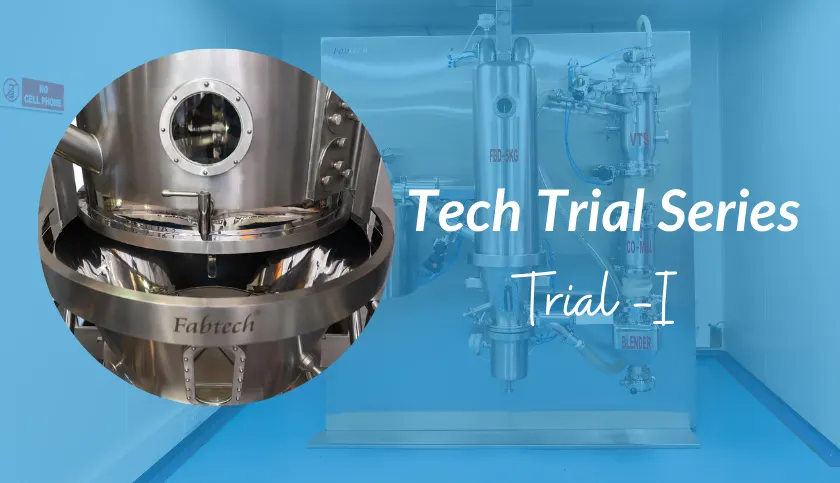
Non-Pareil Sugar seeds (NPS) of varying sizes have always been conventionally prepared in coating pans for the last four or more decades. It requires a skilled workforce and consumes lot of person-hours, and the product needs to be finally dried in Tray Driers overnight to get the right and desired dryness and hardness to the seeds. More often than not, the first throughput yields are also not very high. The process itself is done on a conventional coating pan and is very difficult to validate, and presents a very dusty environment in the process zone.
Hence alternative process equipment such as the fluidized bed was investigated to observe if some technology-induced automated process could be applied for this manufacture that reduces workforce dependence and improves overall yield and reproducibility.
Materials & Methods employed:
Substrate: Sugar refined 80 mesh powder Coating Dispersion: Containing Sugar crystals (30 mesh) and Corn Starch in Water Equipment Used: Fablife Particle Coater Granulator FPCG Lab Model LM 1 Spray Nozzle: Coaxial type with 0.8 mm nozzle orifice Peristaltic Pump: Watson Marlow Solution Tubing: Silicon Tubing 6mm OD / 4 mm ID 1 mm WT
Process parameters:
Substrate Load: 0.500 kg Exhaust Air Blower Speed: 2400 RPM In Let Air Temp: 50° C Product Bed Temp: 38° to 42° C Exhaust Temp: 34° to 38° C Atom Air Press: 1.2 bar Pump Speed: 4 rpm Spray Rate: 5 gms per min Sprayed Qty: 3.000 kgs Final Drying Time: 10 mins @ 40° C Total Process Time: 10 hours and 10 mins
Yield Issues: about 98 % (2% agglomerates and losses) Final Pellet size range 50 to 60 mesh Hard almost spherical
Note: If continued for more time, then sphericity and size will improve
Final Observations:
Observation from the final output that it is indeed possible to make spherical pellets of NPS seeds from powder form of sugar using FB columns. It takes a longer period, but the benefits like process automation and saving of a separate drying process outweigh the long process times. The geometry of the expansion tower also plays a critical role in the process; it was duly noted.
Development of NPS sugar beads from sugar powder using Roto Bed FB Columns.
What is possible in a FB column? It’s said that it is mostly done faster and better in the Centrifugal Roto Bed version of the FB Processor! So it was thought fit to conduct a trial using Roto Granulator change part of the FB Processor Lab Model 1 to judge the suitability of this variant to grow NPS beads from 80 mesh sugar powder in the tangential version of the Fluid Bed Processor. The details of the trial are as follows:
Materials & Methods employed:
Substrate: Sugar refined 80 mesh powder Coating Dispersion: Containing Sugar crystals (30 mesh) and Corn Starch in Water Method Employed: Suspension Layering Technique
Equipment Used: Fablife Roto Granulator FRG Lab Model LM 1
Spray Nozzle: Coaxial type with 0.8 mm nozzle orifice Peristaltic Pump: Watson Marlow Solution Tubing: Silicon Tubing 6mm OD / 4 mm ID 1 mm WT
Process parameters:
Substrate Load: 0.500 kg In Let Air Blower Speed: 2000 RPM Exhaust Air Blower Speed: 2400 RPM In Let Air Temp: 45° C Product Bed Temp: 36° to 40° C Exhaust Temp: 32° to 35° C Disc Speed: 700 rpm
The gap between the disc and the wall 1200 microns Atom Air Press: 1.2 bar Pump Speed: 10 rpm Spray Rate: 12 gms per min Sprayed Qty: 2.000 kgs Final Drying Time: Non-significant Total process Time: Nearly 3 hours
Yield Issues: About 95 % (5% agglomerates and losses) Final Pellet size range 40 to 50 mesh Hard almost spherical (sphericity may improve with more material addition)
Note: If continued for more time, then sphericity and size will improve
Final Observations:
The observation from the final output that it is indeed possible to make spherical pellets of NPS beads from powder form of sugar using a Tangential Rotor Granulator. Due to the centrifugal forces in force, this process is essentially a much faster way of applying the material for deposition and is also has an extremely faster drying rate providing for much larger application spray rates for deposition. Critical parameters are as mentioned below:
- Speed of the rotating Disc (very critical for the sphericity)
- The gap between the disc and the wall
- Spray Rate
- Atomization Pressure
- Air Balance between the inlet and exhaust blowers
- The twisted rope appearance of the bed and the floating (air suspended feel of the bed)
This equipment is very good for the studied purpose, particularly the quality of the sphericity and the size range observed in the shorter process timings. Currently, in this experiment, the Wets suspension layering method is carried out. However, the author’s surmise can bring down the timing much shorter if the Dry Powder method of application is followed in place of suspension layering.
In our continuing series, we will see this and several other trials conducted on various pharmaceuticals, foods and nutraceuticals at the Application Services Centre in recent times.