Specialised manufacturing in industries like pharma, biotech, food and beverages, even semiconductors, defence and aerospace mandate sterile/clean environments where foreign particulate matters have a negative impact on product quality and yield. A significant challenge that needs to be addressed is contaminant entry from the outside through raw material containers, canisters, sacks and bags brought into the facility.
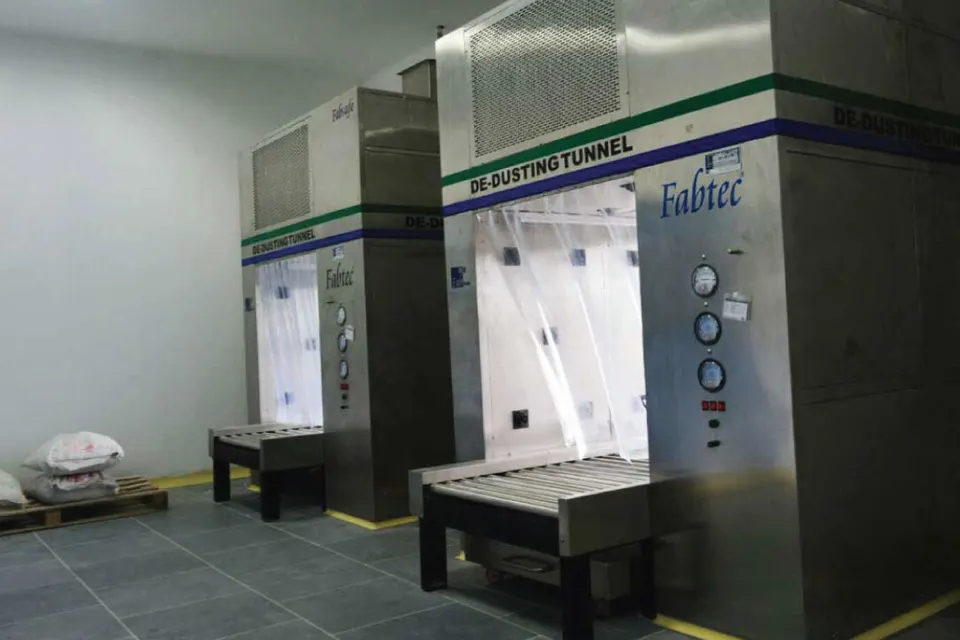
Fabtech’s De-dusting tunnels can be regarded as a clean-air gateway between the warehousing and quarantine area. This offers a significant reduction in dust levels, ensuring product quality and improved yield.
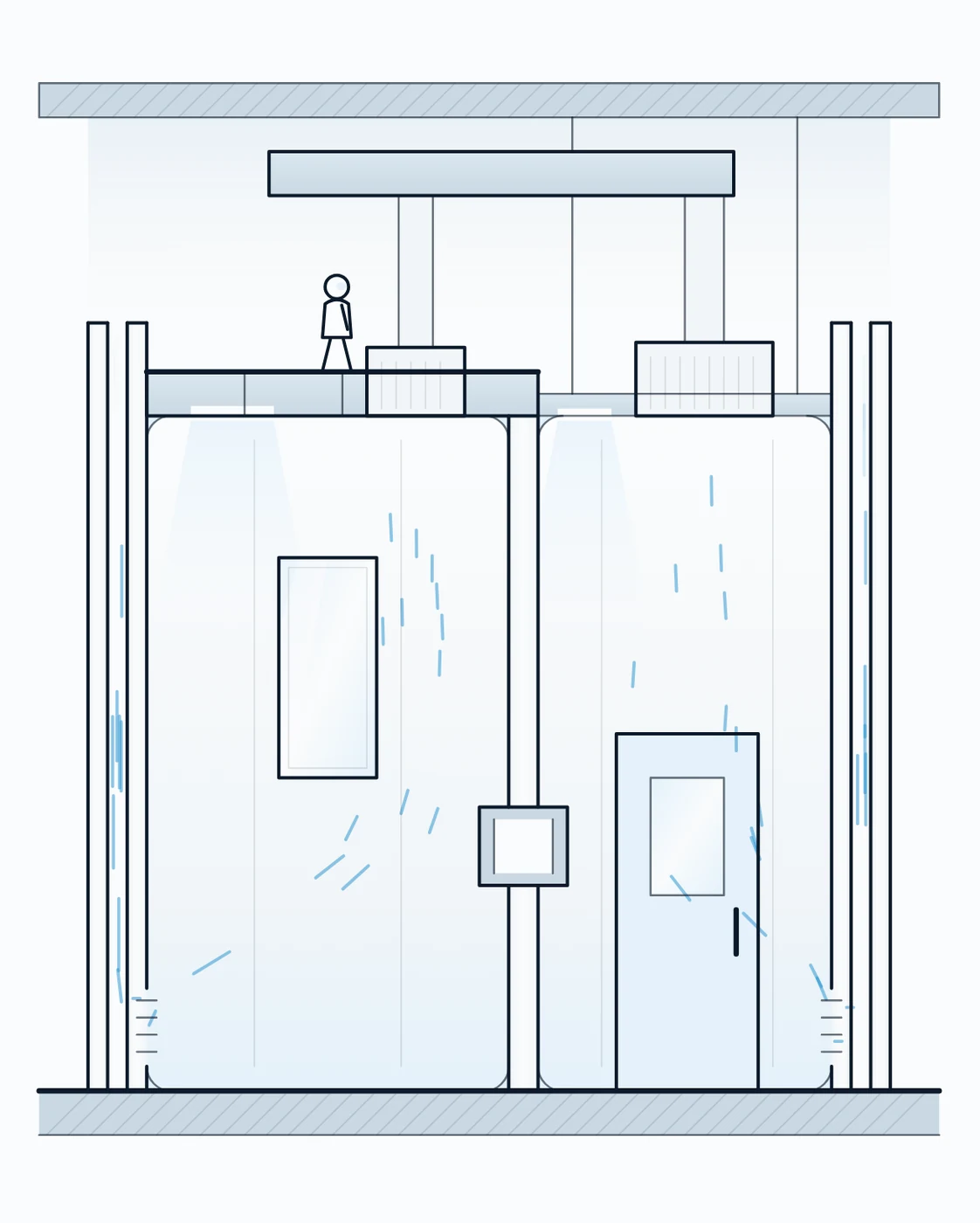
These tunnels are a single pass fully automated system with sliding doors at entrance and exit of the system. Containers are moved through an endless conveyor and through combinations of rotary moving brush in X and Y axis which scrub and detach non-viable particles from the container. The adjustable brushing system enables the scrubbing of containers of prefixed geometry. Containers are subjected to high-velocity air, and loose particles are collected in a tray while airborne particles are retained in a series of filters.
Fabtech pioneered De-dusting Tunnels and ever since we have upgraded and innovated the product through continuous customer feedback. We continually add new features to address evolving requirements. Our De-dusting system is increasingly becoming a part of the standard project design layout.
Fabtech's de-dusting system is GMP compliant, reliable, automated, mechanised system, delivers consistent performance and is easy to maintain.
It offers more consistent performance over human manual cleaning, is predictable, reduces dependence on manpower and saves costs. Add-on features like synchronisation with continuous sampling system make it an online integrated system with proper data storage and tracking.
Features and Specifications
Material and Construction – The de-dusting unit is furnished with an effective cabinet made of SS304/CRCA powder-coated/double wall PUFF-filled panels.
High-Performance Filters - HEPA Filters employ a high-velocity jet system (8000 fpm – 10000 fpm) with manually adjustable direction control.
Control Systems – The tunnel is equipped with a PLC/Manual Control system with differential pressure gauges. The PLC enables adjustable speed for the brushes, conveyer and blower.
Enhanced Visibility – The LED concealed light offers light intensity exceeding 400 Lu.
De-dusting tunnels stand out as a comprehensive decontamination solution, uniquely suited to diverse industries with cleanroom applications. For instance, in pharmaceutical manufacturing, de-dusting machines ensure that medications and pharmaceutical ingredients remain free from any foreign particles or contaminants. Similarly, in food processing, these tunnels play a crucial role in preserving the quality and safety of consumables by removing any unwanted particles that might compromise the products. Beyond their commitment to cleanliness, the tunnels significantly reduce maintenance expenditure, thus becoming an indispensable and modern dust collection system in the industrial landscape.
Use the form below to schedule a visit to our state-of-the-art manufacturing facility at Umargaon, Gujarat for a first-hand look at our De-dusting tunnels.